
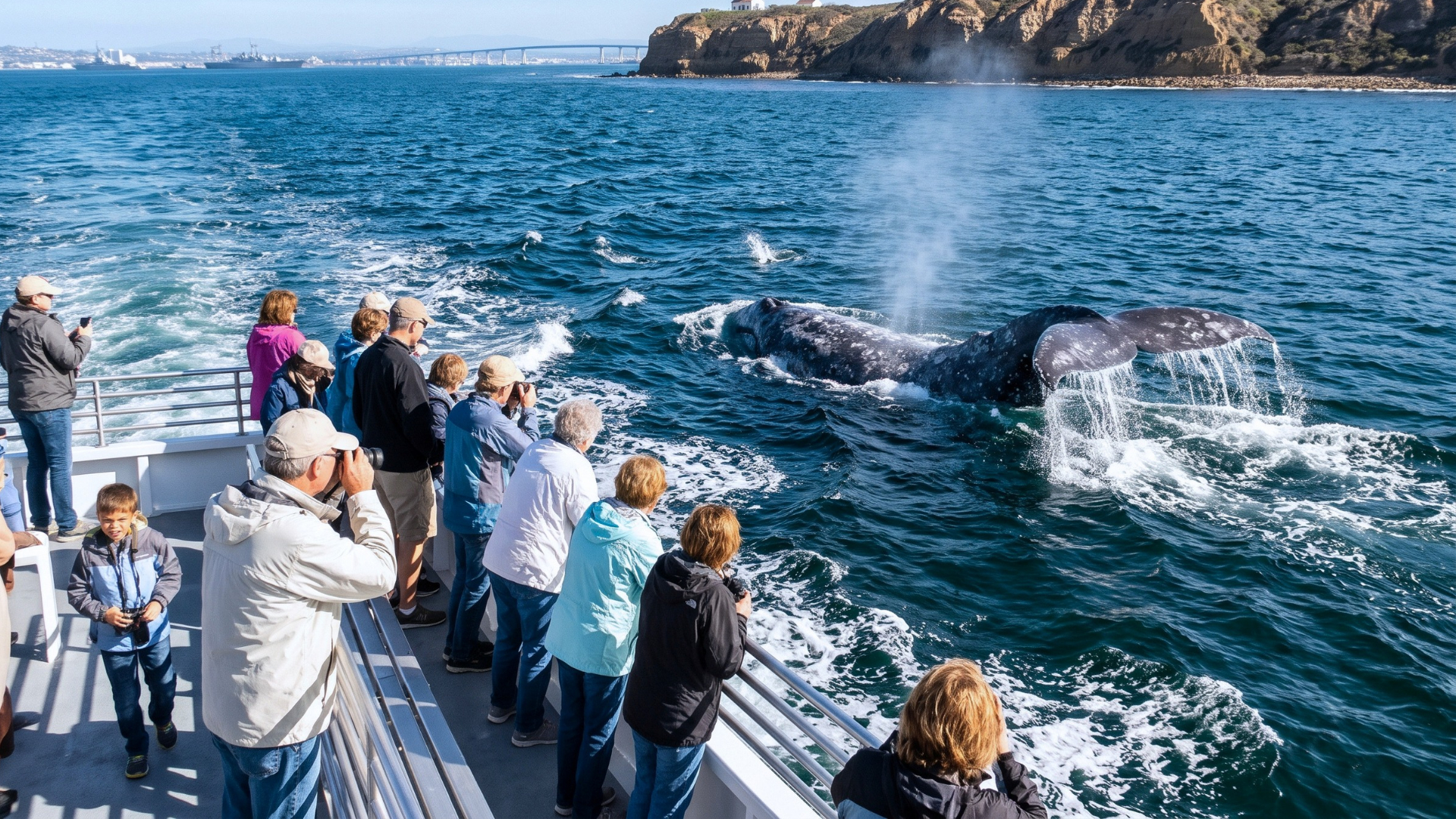
A little preparation goes a long way on the ocean. With the right departure, the right spot on deck, and a plan made the day before, most guests come home talking about the whales, not their stomachs.
This winter is a great time to try it. NOAA’s July 2026 estimate put the Eastern North Pacific gray whale population at about 17,750, up from about 12,890 the year before. Those whales pass San Diego from December through April.
At Wild Pacific Whale Watch, we run daily trips from H&M Landing on Shelter Island. Our owner-operators bring over 40 years of combined experience in San Diego and Monterey Bay. After helping thousands of guests enjoy a comfortable ride, we’ve noticed a clear pattern: the guests who feel best aren’t the ones with “iron stomachs.” They’re the ones who prepared.
The Misconception Worth Correcting
Seasickness Isn’t a Weak Stomach
Many people assume seasickness only happens to a sensitive few. The CDC Yellow Book says otherwise: people vary in their susceptibility, but given a sufficient stimulus, almost everyone with a working balance system can develop motion sickness.
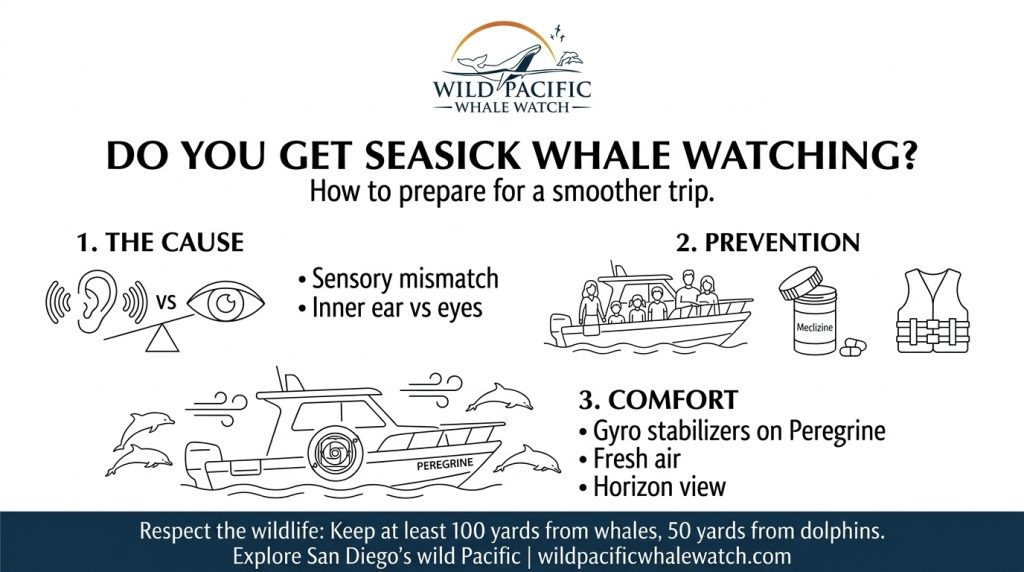
The cause is a sensory mismatch. CDC explains that on a ship with limited outside visibility, the inner ear reports motion while the eyes suggest you’re not moving. That’s why staring at a phone can make things worse, and why watching the horizon helps.
According to the CDC, heritability accounts for 55–70% of the variation in susceptibility, and people with migraine, vertigo, or vestibular disorders are more prone. Because it’s predictable, it’s also very preventable.
Your Allergy Pill Won’t Help
This surprises many travelers. CDC states that newer, minimally sedating antihistamines such as cetirizine, fexofenadine, and loratadine are not effective for motion sickness, because they’re designed not to reach the brain.
That’s different from motion sickness products labeled “less drowsy.” CDC’s trade-name notes show that Dramamine Less Drowsy is meclizine, which is a true motion sickness medication. Read the active ingredient, not just the brand name.
Best Prevention Plan by How Prone You Are
| Your history | Best departure | Where to be on board | Medication |
| Rarely queasy | Any | Anywhere you like | Usually not needed |
| Sometimes carsick | Morning, ideally summer | Outside, midship, eyes on the horizon | Ask a pharmacist about an OTC option |
| Very prone | Summer morning | Lower deck, middle of the boat, fresh air | Ask your doctor about all options |
| Traveling with kids | Morning | Outside with a clear view | Pediatrician first (see below) |
Rarely queasy. Enjoy the ride. Still, CDC notes that alcohol and smoking increase motion sickness, and sleep deprivation can worsen it.
Sometimes carsick. Positioning matters most. Scuba Diving magazine notes that the center of the vessel on the deck nearest the waterline usually experiences the least motion. CDC also advises avoiding locations of maximum motion, such as the bow.
Very prone. Plan medication days in advance, not on the dock.
Traveling with kids. See the child-specific guidance below.
Seasickness Medication: What Works and What to Check First
Choosing a remedy involves more than knowing when to take it. The CDC Yellow Book’s clinical guidance explains that medication is most effective when taken before exposure, rather than after symptoms begin. Different products have different onset times, side effects, and precautions.
How the Common Options Compare
| Option | Availability | Typical onset (CDC) | Typical duration (CDC) | Key cautions |
| Dimenhydrinate (Dramamine Original) | OTC tablet | About 2 hours | About 8 hours | Drowsiness |
| Meclizine (Bonine, Dramamine Less Drowsy) | OTC chewable | About 2 hours | 8–24 hours | Drowsiness still possible |
| Scopolamine patch (Transderm Scōp) | Prescription | 6–8 hours | Up to 72 hours | FDA heat-risk warning; not for everyone |
| Promethazine | Prescription | About 2 hours | About 15 hours | Most sedating |
| Loratadine, cetirizine, fexofenadine | OTC allergy pills | Not effective | — | Not a substitute |
Onset and duration figures come from CDC’s table of common anti-motion-sickness drugs in adults. Always check your specific product’s label for directions and warnings.
Clarifying the Timing
Advice on timing varies, and it’s worth understanding why. Mayo Clinic advises taking dimenhydrinate or meclizine at least 30 to 60 minutes before you travel. CDC’s table, however, lists an onset of about 2 hours for oral dimenhydrinate and meclizine. In practice, earlier is safer.
CDC also explains why timing matters so much: once initial symptoms begin, gastric stasis may prevent absorption of tablets. In other words, a pill taken after you feel sick may not get absorbed well. As a planning example, for a 9 a.m. departure, an oral option might be taken around 7 a.m. if the label allows. A scopolamine patch needs much more lead time, often the night before. Confirm the timing with your pharmacist.
Drowsiness, Driving, and Alcohol
CDC notes that all motion sickness medications have side effects, and the most common is drowsiness. It adds that scopolamine is slightly less sedating than dimenhydrinate or meclizine, while promethazine is the most sedating.
That matters if you plan to drive after the trip. Arrange a driver if you’re trying a new medication, and avoid combining it with alcohol or other sedating substances.
The Scopolamine Patch Needs Extra Care
Scopolamine is effective but not right for everyone. CDC advises that it should not be used by travelers with glaucoma or those at risk of prostatic urinary retention, and that the patch should never be cut to change the dose.
In June 2025, the FDA issued a safety warning that the patch can raise body temperature and cause heat-related complications, sometimes leading to hospitalization or death. The FDA noted that most cases occurred in children 17 and younger and adults 60 and older.
The FDA instructs users to remove the patch and contact a healthcare professional if body temperature rises or if they stop sweating in warm temperatures.
Try It Before Trip Day
Because reactions vary, CDC suggests that clinicians consider recommending a trial dose of one or more medications before departure. If you’ve never used a product, ask whether testing it at home first makes sense.
Child-Specific Medication Guidance
Children need a more cautious approach.
- Very young children rarely need it. CDC notes that children under 2 do not usually experience motion sickness, and susceptibility peaks between ages 7 and 12.
- Start without medication. CDC advises that behavioral countermeasures should be tried first, and anti-motion-sickness medication for children should be used with caution.
- Ask your pediatrician about dosing. Use only products and doses your child’s doctor or pharmacist recommends, based on your child’s age and weight and the product label.
- Test at home first. CDC notes that some children have paradoxical agitation with antihistamines, so a test dose before departure is encouraged.
- Watch for oversedation. CDC warns that over-sedating young children with antihistamines can be life-threatening.
- Avoid scopolamine. CDC states that scopolamine, including patches, can cause hallucinations and confusion in children and should be avoided. The FDA adds that Transderm Scōp is not approved for use in children.
Families can find more trip-planning ideas in our family reunion guide.
When to Go: A Seasonal Breakdown
Summer is the calmest window. Our blue whale guide notes that summer brings the most activity and the calmest sea conditions.
Fall is often settled. It’s a strong second choice for sensitive stomachs, especially on morning trips.
Winter through spring brings great whales and more variable seas. Our top whale sightings guide notes that gray whales sometimes pass within a mile of land, which can shorten the ride. Choose mornings and keep a backup day.
Mornings are usually smoother. The National Weather Service explains that onshore wind is strongest in the afternoon, when air over land is warmest.
Check the forecast. Use the NWS San Diego marine forecast. NWS Jacksonville explains that long wave periods, around 12 seconds, typically mean a smoother ride, while short periods around 5 seconds can be choppy.
See our best time of year guide and season guide for more.
What Wild Pacific Whale Watch Offers for a Smoother Ride
A Boat Built to Reduce Roll
Peregrine is an 82-foot vessel with twin Tohmei anti-rolling gyro stabilizers that greatly reduce roll, especially while drifting or moving slowly. Boats roll most when they slow near whales, which is exactly when you’re watching. Powerboat Magazine notes that Tohmei’s design works efficiently at trolling and zero speeds.
The boat also has air-conditioned indoor seating and clean, modern restrooms, plus a galley with snacks and drinks for purchase.
A Crew That Plans Around Comfort
Our crew has worked every job on a boat and can point you to the steadiest spots on board. One homepage review from Michael D. says the stabilizers made the ride smooth, even for someone who usually gets seasick. Meet the team behind Peregrine or see what sets us apart.
Where We’re Honest About What We Can’t Control
Gyros reduce roll, but a gyroscopic stabilizer produces a limited stabilizing force that can be exceeded as wave height increases. Our FAQ suggests prone guests consider taking medication before boarding. Based on CDC guidance, choose a true motion sickness product, not an allergy pill.
If conditions are unsafe, we reschedule or issue a full refund. If we don’t spot a whale, you receive a return voucher with no expiration date that’s fully transferable.
What to Expect Beyond the Boat
Before you board. Eat a light meal, skip alcohol, and arrive rested. Mayo Clinic notes that some people feel better nibbling plain crackers and sipping cold water or a caffeine-free carbonated drink.
On the water. Head outside and watch the horizon. CDC notes that a horizon view has been shown to provide some protection on ships. It also reports that controlled breathing, at your normal resting pace, was about half as effective as drugs in lab trials, with no side effects. Dress warmly, since it’s often 15 to 20 degrees cooler on the water.
About wristbands and ginger. CDC is candid: lab trials show acupressure bands are no more effective than placebo, and ginger has only weak and contradictory evidence. If they make you feel better, they’re fine to try alongside proven steps.
If you start feeling queasy. Tell a crew member, move midship on the lower deck, and get fresh air on your face. Fresh air, music, and pleasant scents are among the distractions CDC says may be useful.
After you dock. CDC notes that a brief rocking sensation after a sea trip is normal and usually resolves within a few hours. Then enjoy the coast. Our hidden-gem viewing spots guide recommends Sunset Cliffs for dolphins and distant whale blows near sundown.
Doing It Responsibly Because the Rules Produce a Better Ride
NOAA’s viewing guidelines ask boats to avoid excessive speed or sudden changes in speed or direction near whales and dolphins, and to slow to no-wake speed when encountering marine mammals.
Those rules protect whales and also make for a gentler ride: steady speeds and smooth turns mean less lurching on deck. Learn more in our guide to responsible whale watching in San Diego.
Planning the Trip: Booking and Logistics
- A week before: Ask a pharmacist or doctor which option, if any, fits your health history and other medications.
- Several days before: Consider a trial dose at home if you’re using a new product.
- For kids: Talk to your pediatrician, and avoid scopolamine.
- The night before: Check the marine forecast, sleep well, and apply a prescribed patch if your doctor advised it.
- Booking: Choose a morning departure, ideally in summer.
- The morning of: Eat light, skip alcohol, and take oral medication early enough for its label onset time.
- After the trip: Arrange a driver if you took a sedating medication.
- For groups: A private charter lets you pick a calm-weather time.
Book on our booking page, call 619-821-8205, email info@wildpacificwhalewatch.com, or visit H&M Landing at 2803 Emerson St., San Diego, CA 92106. See our FAQ page, contact page, and Sightings Log.
Ready for a Smoother Day on the Water
Seasickness is common, predictable, and very manageable. With a calm departure, the right spot on deck, and the right medication taken at the right time, you can spend your trip watching for blows instead of watching your stomach. Peregrine helps with rare gyro stabilizers, indoor comfort, restrooms, and a crew that plans around conditions, plus a return voucher if the whales don’t show.
Check availability and book your Wild Pacific Whale Watch trip, or call 619-821-8205 and we’ll help you choose the smoothest departure for your dates.
Frequently Asked Questions
Will I get seasick on a whale-watching trip?
Most guests don’t, especially with preparation. Almost anyone can feel motion sickness given enough motion, but a calm departure, a midship spot outside, and a horizon view make a big difference.
How early should I take seasickness medication?
Follow your product’s label and your pharmacist’s advice. CDC lists an onset of about 2 hours for oral dimenhydrinate and meclizine, and 6 to 8 hours for the scopolamine patch. Taking medication after symptoms start is less effective.
Can I use my allergy medicine instead?
No. CDC states that loratadine, cetirizine, and fexofenadine are not effective for motion sickness. Look for motion sickness products such as dimenhydrinate or meclizine instead.
Can my child take seasickness medication?
Only with guidance from your pediatrician or pharmacist. CDC recommends trying non-medication strategies first, giving a test dose at home, and avoiding scopolamine in children. Oversedation in young children can be dangerous.
Is the scopolamine patch safe?
It can be effective for adults, but it isn’t right for everyone. The FDA warns it can raise body temperature, especially in children and adults 60 and older. Discuss it with your doctor, and never cut the patch.
Will I be drowsy after taking medication?
Possibly. CDC says drowsiness is the most common side effect of motion sickness medications. Plan for someone else to drive if you’re unsure how a product affects you.
Do ginger and wristbands work?
Evidence is limited. CDC says ginger’s evidence is weak and contradictory, and wristbands performed no better than placebo in lab trials. They’re fine to try alongside proven steps if they help you feel better.
Do the gyro stabilizers prevent seasickness completely?
No, but they help a lot. Peregrine‘s gyros greatly reduce roll, especially while drifting near whales, though they can’t fully counter large swell.