Whale watching has grown into a genuine industry, not a niche hobby — worldwide, more than 13 million people take whale watching trips annually, and in California alone, federal researchers estimate the non-market value to whale watchers at more than $40 million a year.
San Diego sits at the center of that activity, directly on the gray whale migration route, and the rules governing how boats behave around whales here aren’t red tape. They’re the reason the experience stays good year after year.
We run one of San Diego’s whale-watching boats at Wild Pacific Whale Watch, departing daily from Shelter Island, and the guidelines we follow come from federal law, not internal marketing copy. Knowing what those rules actually say — and how to spot them being followed from the deck — changes how most people think about choosing an operator.
The Misconception Worth Correcting
The 100-Yard Rule Isn’t a Suggestion
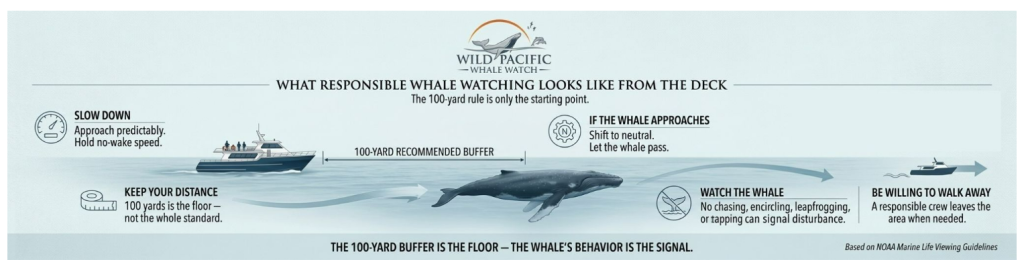
Many visitors assume the distance boats keep from whales is a courtesy. It’s a legal requirement. Whales are federally protected under the Marine Mammal Protection Act, and NOAA Fisheries directs boaters on the West Coast to stay at least 100 yards away from whales, operate at no-wake speed near marine mammals, and avoid entering a whale’s path or approaching it head-on. Closing that distance, chasing a whale, or altering its behavior can be treated as harassment under federal law — a category with real enforcement consequences.
There’s No West Coast “Whale SENSE” Badge, and That’s Worth Saying Plainly
NOAA partners on a voluntary recognition program called Whale SENSE, developed with Whale and Dolphin Conservation, that certifies responsible operators. It currently operates only in the Atlantic and Alaska regions, not on the West Coast. No San Diego operator, including us, can point to a Whale SENSE badge as proof of compliance. What passengers here can do instead is watch how a crew actually behaves on the water — which turns out to be a more reliable signal than any certification anyway.
What Responsible Whale Watching Looks Like From the Deck
A Cautious Crew Often Looks Less Exciting, Not More
A responsible captain may appear less aggressive than passengers expect. Rather than racing toward a whale for a closer photo, NOAA’s guidance calls for slowing down and positioning the vessel parallel to the animal while holding the 100-yard distance — a calmer approach than the dramatic, fast-closing scene many people picture beforehand.
If a Whale Approaches, the Boat Should Stop, Not Follow
Occasionally a curious whale closes the distance on its own. NOAA’s guidance in that situation is for the vessel to shift into neutral and let the whale pass rather than pursuing it — worth knowing so it doesn’t read as a rule being broken when the opposite is actually happening.
Watch for What the Crew Won’t Do
NOAA specifically warns against chasing, encircling, or “leapfrogging” between animals with a boat, and against crowding a whale with multiple vessels, since several boats in the same area raise the overall chance of disturbance. A responsible crew should also avoid approaching whales when calves are present and should never position the boat between a mother and her calf.
A Willingness to Walk Away Is a Good Sign, Not a Bad One
The clearest tell of a responsible operator is whether the crew is willing to leave the area when animals show signs of disturbance, rather than pushing for a longer or closer look. Combined with NOAA’s broader guidance — limiting observation of any individual or group to 30 minutes or less, avoiding sudden changes in speed or direction, and always leaving the animal a clear escape route — these are things a passenger can actually watch for in real time, without needing to take an operator’s word for it.
The 100-Yard Rule Is Only the Starting Point
Distance Is the Easy Part to Measure, Behavior Is the Real Standard
Staying 100 yards away is the most quoted rule, but NOAA’s full guidance goes further. Boats shouldn’t chase, encircle, or leapfrog between animals, trap a whale between vessels or the shoreline, or make sudden changes in speed or direction nearby. Approaches should come from a predictable angle rather than heading straight at a whale, and vessels should hold no-wake speed throughout.
One Boat Is Rarely the Only Boat a Whale Sees That Day
NOAA’s guidance explicitly accounts for cumulative pressure: operators are advised to avoid approaching an animal when another vessel is already nearby, since prolonged exposure to multiple boats over the course of a day raises the likelihood of disturbance regardless of how carefully any single boat behaves.
The Whale’s Behavior Is the Final Signal
NOAA recommends cautiously moving away if a whale shows rapid changes in direction or speed, erratic swimming, repeated diving or underwater course changes, tail slapping, or — specifically — a female attempting to shield a calf with her body or movements.
On the West Coast, vessels are also told to stay out of a whale’s direction of travel and never position a boat between a mother and calf. Put together, responsible whale watching isn’t really about a tape-measure distance at all, it’s about how long a boat stays, how many other boats are around, how the vessel moves, and whether the whale’s own behavior changes because a boat showed up. The 100-yard buffer is the floor, not the whole standard.
When to Go: An Honest Seasonal Breakdown
Responsible viewing looks slightly different depending on the season, since the animals present and their vulnerability shift throughout the year.
Winter and Early Spring — Peak Season, Peak Vigilance
December through April is peak gray whale migration, with over 20,000 California gray whales passing the coast and January and February producing the highest concentration of sightings. Mothers travel with newborn calves from late February through May, and NOAA specifically lists disturbance from whale watching activities as a documented threat to gray whales — a risk that’s highest around mother-calf pairs, since startling or separating a pair can meaningfully affect a calf still building strength for the northward journey.
Summer — Blue Whales and Feeding Behavior
From roughly mid-June through September, blue whales — the largest animals to have ever lived — feed off the San Diego coast, with June and July the strongest months. A feeding whale is focused on locating and consuming krill, and closing in too fast can interrupt a behavior that costs real energy to resume, which is part of why the same 100-yard standard applies regardless of species or season.
What Wild Pacific Whale Watch Does
Speed to the Area, Caution Once There
Wild Pacific operates the Peregrine, an 82-foot vessel with a 25-knot cruising speed, letting the crew reach known feeding zones efficiently and then slow well before approaching any animal. Getting to a sighting quickly and approaching it slowly aren’t in conflict — closing in fast and then braking hard near a whale is itself a disturbance risk, so the approach pattern matters as much as the destination.
Where Experience Actually Shows Up
Our owner-operators bring over 40 years of combined experience running whale-watching trips between San Diego and Monterey Bay, and that experience is most visible in how the crew reads a whale’s behavior before deciding how, or whether, to approach further. A whale that’s feeding, traveling with a calf, or showing early signs of avoidance gets a wider berth than the legal minimum, based on judgment rather than a checklist alone.
Being Honest About What Responsible Viewing Can’t Guarantee
No amount of caution guarantees a whale will surface, approach, or stay in view — that unpredictability belongs to the animal, not to any flaw in the trip. What Wild Pacific controls is compliance and crew judgment, tracked openly through our sightings log, backed by a guarantee: if you don’t see a whale, your next trip is free. That guarantee exists precisely so the crew never feels pressure to cut the distance short just to force a closer look.
What to Expect Beyond the Sighting Itself
Narration That Explains the Why, Not Just the What
A responsible trip includes context. If a whale is sighted at a distance the boat won’t close, expect the crew to explain what NOAA’s guidelines require and why — that explanation is part of the experience, not a consolation for a missed photo opportunity.
Other Wildlife Along the Way
Dolphins are visible in San Diego’s waters essentially every month of the year and often approach boats voluntarily to ride the wake — a different dynamic than a boat approaching a whale, since the guidelines govern how the boat behaves, not how the animal chooses to interact. Sea lions near the harbor and coastal seabirds round out most trips.
Doing It Responsibly Because the Rules Produce a Better Sighting, Not a Worse One
It’s worth stating plainly why these guidelines matter, since they’re often framed as a limit on the experience rather than what actually improves it. NOAA lists disturbance from whale watching activities among the documented threats facing gray whales, alongside vessel strikes and entanglement — a reminder that even a well-intentioned trip can cause harm if it isn’t run carefully.
The upside runs both ways. A whale that isn’t chased or crowded keeps behaving naturally — surfacing, diving, and moving at its own pace — which consistently produces a better sighting and a better photo than a boat that’s pushed the distance and startled the animal into an early dive. Choosing an operator that visibly follows the guidelines isn’t a tradeoff against a good trip; it’s usually what makes one possible.
Planning the Trip: Booking and Logistics
A few practical notes for booking a responsible trip:
- Watch how the crew behaves near a whale, not just what they promise beforehand — slowing down, holding distance, and a willingness to leave the area are the real signals.
- Book 1–2 weeks ahead for peak season (January–February), when weekend mornings fill quickly.
- Choose morning departures for calmer seas, which also make it easier for a crew to approach gradually rather than at speed.
- Dress in layers. Ocean wind runs 10–15 degrees cooler than shore temperature, even on a mild day.
- Arrive 20–30 minutes early for parking near H&M Landing on Shelter Island.
- Report concerning behavior from any vessel to the NOAA Fisheries Enforcement Hotline at (800) 853-1964, available 24/7.
Check current departure times, pricing, and availability at wildpacificwhalewatch.com, by phone at 619-821-8205, by email at info@wildpacificwhalewatch.com, or in person at 2803 Emerson St., San Diego, CA 92106. For the full federal guidance, NOAA’s Marine Life Viewing Guidelines page covers distances, behavior cues, and vessel conduct in detail.
Frequently Asked Questions
Is the 100-yard rule the only guideline boats have to follow?
No — it’s the starting point. NOAA also prohibits chasing, encircling, or leapfrogging between animals, requires no-wake speed near whales, limits observation time to 30 minutes or less, and calls for leaving the area if a whale shows signs of disturbance.
How can I tell if a whale-watching crew is actually following the rules, or just claiming to?
Watch the boat’s behavior once a whale is sighted: a responsible crew slows down, approaches from a predictable parallel angle rather than head-on, holds the 100-yard distance, and is willing to move away if the whale seems disturbed. That’s more reliable than any marketing claim.
What should the crew do if a whale swims toward the boat?
NOAA’s guidance is to shift the engine into neutral and let the whale pass on its own terms, rather than moving toward or away from it. This is different from a boat actively closing the distance, which remains restricted.
Why does it matter if other boats are nearby?
NOAA specifically warns that multiple vessels near the same animal raise the overall likelihood of disturbance, even if each boat individually follows the distance rule. Responsible operators avoid approaching a whale that already has another boat nearby.
What behaviors signal that a whale is stressed by a boat’s presence?
NOAA lists rapid changes in direction or speed, erratic swimming, repeated diving, tail slapping, and a mother trying to shield her calf as signs to back away. A responsible crew treats these as a cue to leave, not to get closer.
Does San Diego have a certified “responsible” whale watching program like other regions?
Not currently — NOAA’s Whale SENSE certification program operates only in the Atlantic and Alaska regions. On the West Coast, the best approach is asking an operator directly about their practices and observing how their crew behaves on the water.
Will following these guidelines mean a less exciting trip?
Not usually — a whale left undisturbed tends to behave more naturally and often stays in the area longer, which frequently produces a better sighting than an aggressive approach. Wild Pacific also guarantees a free return trip if you don’t see a whale.
What’s the difference between a boat approaching a whale and dolphins approaching a boat?
The guidelines govern how a vessel behaves toward an animal, not how an animal chooses to interact. Dolphins often voluntarily approach boats to ride the wake, which isn’t a violation, while a boat closing in on a whale is restricted regardless of the whale’s apparent interest.
Ready to See Whales the Right Way
Responsible whale watching isn’t a constraint on the experience — it’s what keeps San Diego’s gray whale and blue whale seasons worth showing up for year after year. A crew that slows down, keeps its distance, and is willing to walk away isn’t holding back the experience; it’s protecting the one thing that makes the trip worth taking in the first place.
Check current departure times and book your whale-watching trip with Wild Pacific Whale Watch.