
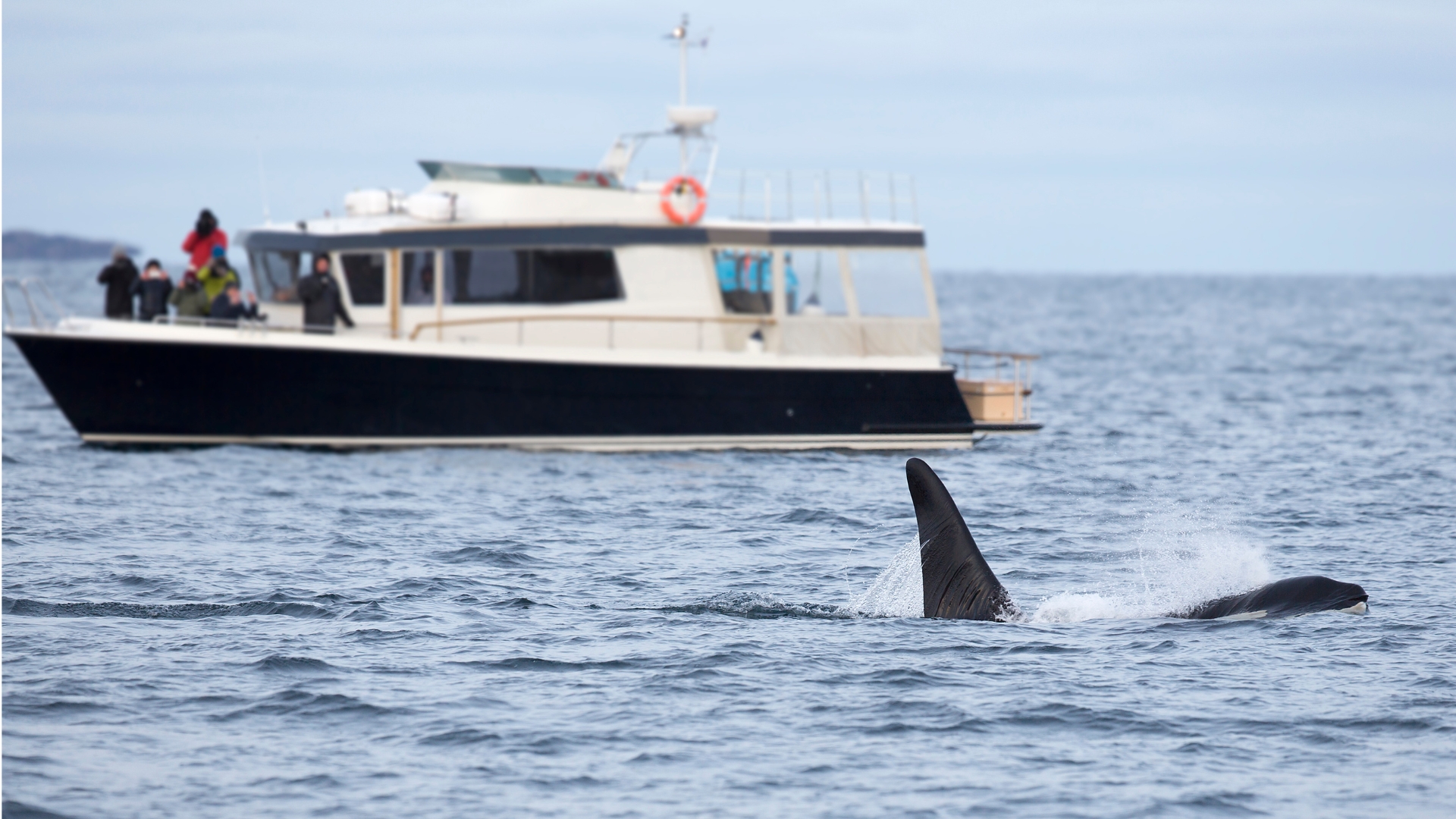
Somewhere between the group text that says “we should all get together” and an actual trip, most family reunions die. But that pattern is breaking. Industry researchers now report that 85% of families are planning multigenerational trips, with millennials leading the charge at 73 percent, and Gen X close behind, often traveling with both their adult children and their aging parents in one trip.
San Diego is absorbing a good share of that demand: the county welcomed approximately 32.4 million visitors in 2025, who spent an estimated $14.4 billion across the region’s hotels, attractions, and restaurants. Whale watching keeps showing up as the anchor activity that makes a scattered reunion feel like an actual trip — one thing everyone from age six to seventy-six can do together, at the same time, without anyone sitting out.
At Wild Pacific Whale Watch, we run daily whale watching trips out of Shelter Island and built our whole approach around exactly that kind of group.
The Misconception That Trips Up Most First-Time Planners
Ask most people when to see whales in San Diego and they’ll say “winter, for the gray whale migration.” That’s true, but it’s half the story, and treating it as the whole story is the most common planning mistake for reunion groups picking dates.
San Diego sits at the intersection of two separate whale seasons, not one. Whale watching here is technically year-round, though the most popular window is mid-December through April for gray whales, with a second popular season in summer for blue whales. Those are two different animals, two different behaviors, and two different reasons to book — confusing them is how families end up disappointed when they show up in July expecting the gray whales they read about.
The Surprising Fact About Blue Whales
Blue whales tell a more encouraging, and more surprising, story. Researchers at Scripps Institution of Oceanography have found that blue whales migrating to Southern California have been arriving progressively sooner, using the previous year’s ocean temperatures as a cue for how much krill will be available the next summer, according to lead researcher Angela Szesciorka. That’s why “summer” as a blue whale window has effectively stretched at both ends in recent years.
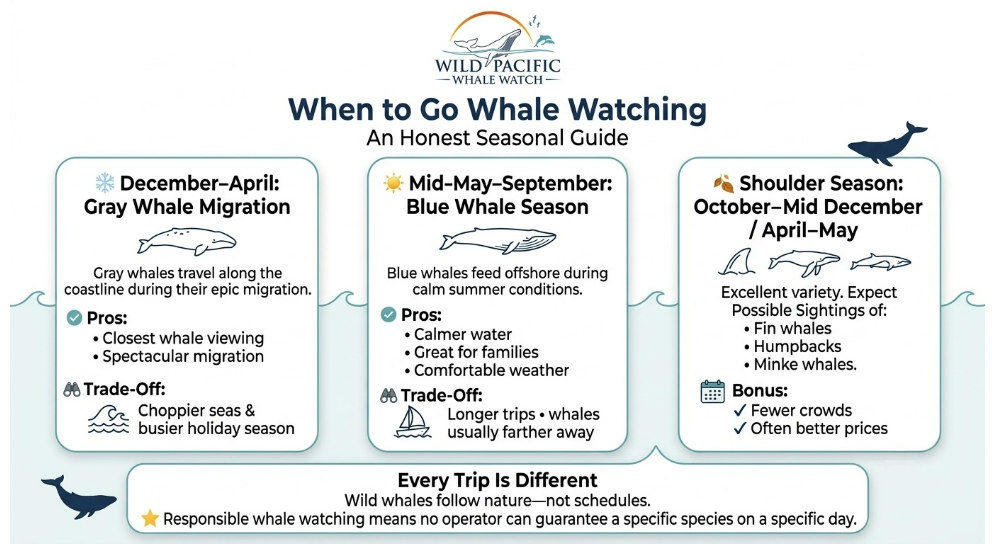
When to Go, and Why: An Honest Seasonal Breakdown
There’s no single “best” month for a reunion — there’s a best month for what your family wants to see and how much rocking your least seaworthy relative can tolerate. Here’s how the year actually breaks down, trade-offs included.
December through April — gray whale migration. Gray whales travel between Arctic feeding grounds and Baja California breeding lagoons, a round trip of 10,000 to 12,000 miles, hugging the coastline closely for navigation — which puts them within sight of San Diego boats southbound December through February and northbound March through April. The trade-off: winter seas are choppier, and pricing climbs with school breaks.
Mid-May through September — blue whale season. Blue whales arrive to feed on krill blooms concentrated in the submarine canyons off our coast, reaching lengths up to 100 feet and weights up to 200 tons, with summer sea temperatures climbing to a calm, comfortable 65-70°F — genuinely the easiest season for a mixed-age group, seasick relatives included. The trade-off: blue whales feed farther offshore than gray whales, so trips run longer and the animals are visible but rarely as close-up.
Shoulder months (October–mid-December, April–May). Less crowded and often cheaper. Fin whales, minke whales, and humpback whales can be seen in San Diego waters year-round, and individual humpbacks are documented feeding opportunistically across all seasons — meaning every season offers a chance at multiple species on one trip. One honest note across all seasons: whales are wild animals, not scheduled performers, and no responsible operator promises a specific species on a specific day.
What Wild Pacific Whale Watch Offers
We bring over 40 years of combined experience running whale watching operations in two of California’s busiest markets, San Diego and Monterey Bay — deckhand to captain, across both companies. You can read more about our story and crew here. That hands-on background matters for a reunion specifically because group logistics on a boat are their own skill: boarding forty relatives in an orderly way, keeping toddlers away from railings, and pacing narration so a six-year-old and a marine-biology-curious grandfather both stay interested.
The Boat and What It’s Built For
Our vessel, the Peregrine, is an 82-foot boat recently refitted with Tohmei anti-rolling gyro stabilizers — hardware borrowed from the yacht world specifically to cut down on the rocking that causes seasickness.
On a family trip, that’s often the difference between one relative enjoying the outing and one relative spending it in the bathroom. We also have air-conditioned indoor seating, cushioned lounges, and a full galley, which matters more than it sounds for a group spanning six-year-olds and eighty-year-olds who can’t all stand on a windy deck for three hours straight.
Where We’re Honest About Limits
Trips run 3 to 3.5 hours and depart daily from H&M Landing near Shelter Island, close enough to San Diego International Airport that fly-in relatives don’t add an extra hour to arrival day. We also offer private charters for larger reunion groups who’d rather have the boat to themselves — worth asking about directly if your group tops 20 or so people.
What we can’t control, and don’t pretend to: the exact species on a given day, or dead-calm seas every single trip, since the Pacific doesn’t take requests. Our sightings guarantee — a free return trip if you don’t see a whale — is how we handle that uncertainty honestly rather than overselling a guaranteed encounter.
What a Reunion Day on the Water Looks Like
The whale sighting is the headline, but a family trip is really made or broken by everything around it. Boarding at H&M Landing usually starts 15-20 minutes before departure, with restrooms and a snack bar on land if anyone needs a last stop before three hours at sea.
Once underway, expect running narration from our crew, not just “there’s a whale,” but context on behavior, migration, and what you’re actually looking at, which is what keeps a mixed-age group engaged rather than staring at open water. Dolphins show up on the large majority of trips regardless of season, often in pods numbering into the dozens, and sea lions, seabirds, and the occasional shark or turtle round out a typical outing. Bring layers even in summer; it’s noticeably cooler on open water than on shore.
Why a Whale Watching Trip Creates Stronger Family Memories Than Traditional Reunion Activities
A reunion built around a whale watching trip does something a hotel banquet room or a restaurant dinner can’t: it gives every generation the same unpredictable, emotionally charged moment at the same time. Research on family learning in natural settings has found that families draw on memories from earlier outdoor experiences to make sense of what they’re seeing together, with children and parents each contributing different connections — children recalling prior nature-center visits, parents linking to other life experiences — in conversations that carry meaning well after the outing ends.
That kind of shared meaning-making is harder to manufacture at a sit-down dinner, where conversation tends to default to catching up rather than discovery. Separate research on family camping and outdoor recreation has linked time spent together outdoors to stronger family functioning, built on the combination of escape from routine, shared social interaction, and genuine discovery — the same ingredients that make a boat full of relatives spotting a whale blow on the horizon feel different from a boat full of relatives making small talk.
Why the Memory Sticks Longer
Wildlife encounters specifically seem to leave a deeper mark than the average group activity. Studies of wildlife tourism have found that visitors’ memories of these encounters move through sensory impressions, emotional affinity, and reflection, a process that makes wildlife sightings unusually durable in memory compared to more passive experiences — and one that’s amplified when the encounter is shared rather than solitary.
For a reunion, that translates directly: the first whale blow on the horizon, dolphins racing alongside the bow, a blue whale surfacing nearby — these become the stories that get retold at the next reunion, not filler between meals. It’s a meaningfully different outcome than a group photo at a restaurant, and it’s part of why we built this business around giving grandparents, parents, teenagers, and young kids the same seat on the same boat at the same time.
Why the Rules Exist, and Why They Help
Federal law requires vessels to stay a minimum distance from whales and prohibits chasing or cutting off their path, and these aren’t red tape imposed on the industry from outside — they’re the reason whale watching still works as a repeatable, family-friendly activity. Whales that feel harassed change their routes; boats that ignore distance rules eventually push the animals somewhere else entirely.
Scripps researchers studying blue whales near San Diego have flagged ship traffic and noise pollution as genuine long-term risks to the population, since the whales feed in some of the busiest shipping lanes on the West Coast. A well-run tour that keeps its distance is, in a direct sense, protecting the thing your family came to see — this trip, and the one your grandkids might take someday.
Planning the Trip
Reunion planning has its own momentum problem: everyone agrees it should happen, and then nobody books anything until it’s too late for good rates. Families are increasingly choosing 6-night stays or longer to fully settle into a destination, with a documented 22% jump in demand for professionally managed lodging over peer-to-peer rentals — a sign that groups will pay more for less coordination hassle. The same logic applies to booking the boat: get it on the calendar early rather than trying to slot it in last-minute.
A simple checklist for the water portion of your reunion:
- Pick the season based on what your family wants to see (grays for reliable up-close sightings, blues for the biggest animal on Earth, shoulder months for budget and variety) — not just whichever week everyone happens to be free
- Book 6-8 weeks ahead for peak season (December–February, July–August), sooner for a private charter
- Confirm group size against boat capacity early — ask us directly about private charter minimums and pricing for groups over 20
- Plan for a half-day, not a full day: the tour runs 3-3.5 hours, plus buffer time for parking near Shelter Island and boarding with kids and grandparents
- Pack layers, sun protection, and motion sickness remedies for anyone prone to it, taken before boarding
- Confirm the cancellation and rebooking policy in case of weather
To book or ask questions ahead of your reunion, reach us at 619-821-8205 or info@wildpacificwhalewatch.com, or through our online booking system. You’ll find us at H&M Landing, near 2803 Emerson St., San Diego — close enough to Shelter Island’s other attractions to turn the whole afternoon into one outing. You can also check our FAQ page or contact page for more details.
Frequently Asked Questions
Is San Diego whale watching worth it if my family isn’t especially “outdoorsy”?
Yes — this is one of the few outdoor activities that doesn’t require fitness, hiking ability, or comfort with heat. You’re seated, often indoors with air conditioning, for a few hours, and the main physical demand is tolerating boat motion, which our stabilized vessel significantly reduces.
What’s the best month for a reunion combining reliable weather and good sightings?
Late spring (May) and early fall (September–October) often split the difference: warmer, calmer seas than winter, with a chance at blue whales, humpbacks, and dolphins in the same trip. Winter offers the most reliable gray whale sightings but choppier water and higher holiday pricing.
Can very young children and elderly relatives go on the same trip?
Generally yes, though it’s worth calling ahead about specific mobility needs — boarding ramps, restroom access, and seating near the exit. Ask us directly rather than assuming, since accommodations can vary by need.
Do we need to book a private charter for a large reunion group?
Not necessarily, but for groups over roughly 20 people, a private charter usually makes coordination easier and guarantees everyone travels together rather than splitting across public departure times.
What happens if we don’t see any whales?
We offer a free return trip if no whales are sighted. It’s a fair way to handle a genuine limitation: wildlife sightings can’t be guaranteed, no matter the season.
Are dolphins likely to make an appearance even outside whale season?
Yes — dolphin sightings, often in large pods, are common on the majority of our trips year-round, making them a near-guaranteed bright spot even on a slower whale day.
How far in advance should we book for a summer reunion?
Six to eight weeks is reasonable for standard trips in peak months; private charters for larger groups often need more lead time, especially around July 4th and other high-demand weekends.
Is it better to book directly with the operator or through a third-party site?
Booking directly with us typically gives you clearer access to group rates, private charter options, and a direct line for questions about accessibility or weather changes — useful when you’re coordinating a large, multigenerational group rather than a solo booking.
Bringing It Home
A family reunion succeeds or fails on how easy it is for everyone — six years old or eighty-six — to do one thing together and actually enjoy it. A stabilized boat, a knowledgeable crew, and a season chosen with realistic expectations turn three hours on the Pacific into the part of the trip nobody complains about, and the part they retell for years.
If gray whales, blue whales, or just a calm boat and good company sound like the right centerpiece for your family’s trip, call us at 619-821-8205 or book online to lock in your dates before the season fills up.