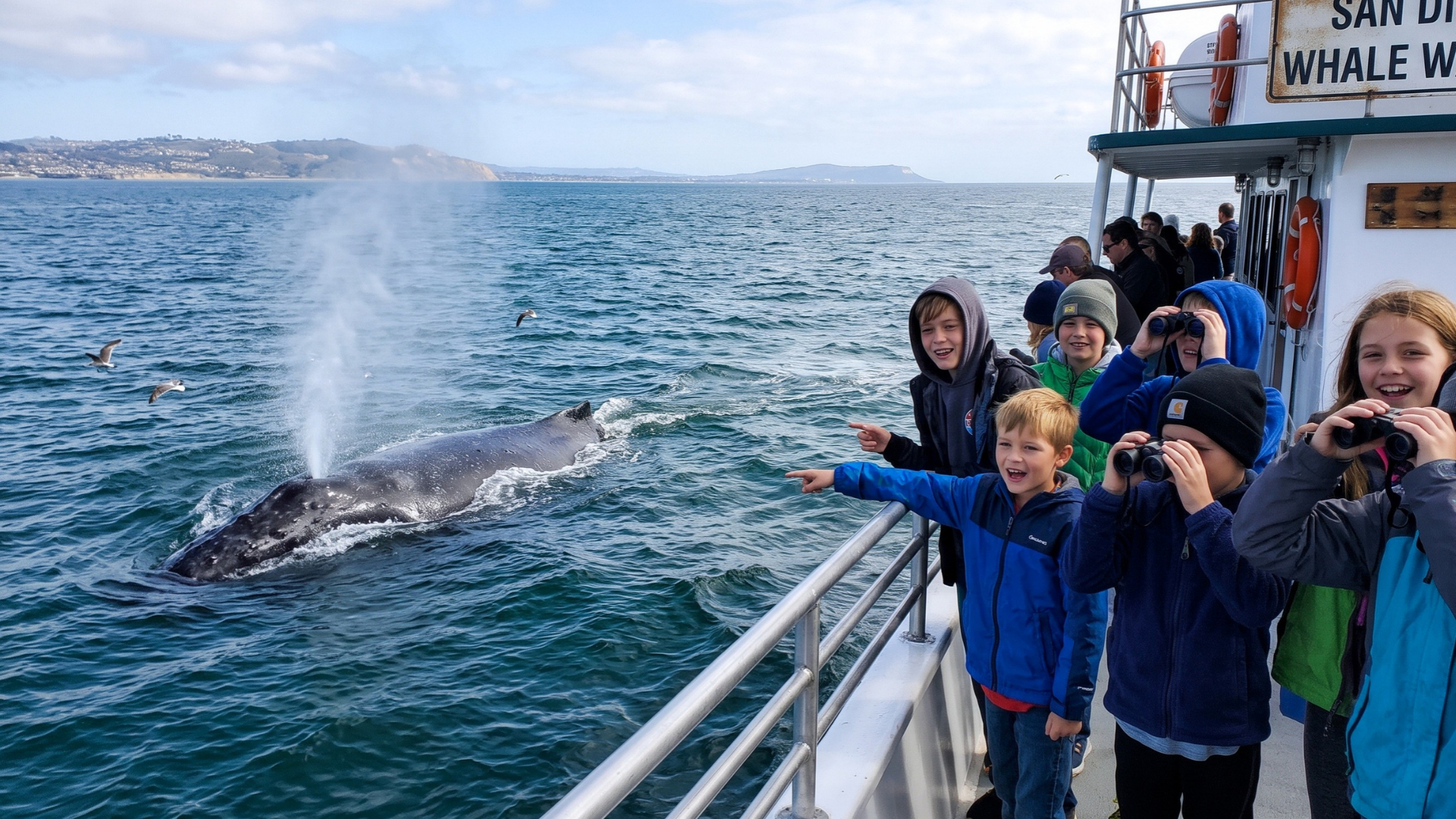
This winter could be a good one for San Diego families. In July 2026, NOAA’s Southwest Fisheries Science Center estimated the Eastern North Pacific gray whale population at about 17,750, up from about 12,890 the year before, one of the lowest counts on record. Scientists are still studying why the number jumped. The migration passes San Diego from December through April.
For parents, the big questions are practical. How young is too young? Will my kid get seasick? Do children have to wear life jackets?
At Wild Pacific Whale Watch, our owner-operators bring over 40 years of combined experience running whale watching operations in San Diego and Monterey Bay. Families are a big part of who rides with us. Here’s what we’ve learned, backed by what the experts say.
The Seasickness Myth Most Parents Believe
Many parents assume the youngest kids are the most likely to get seasick. According to the CDC, it’s the other way around.
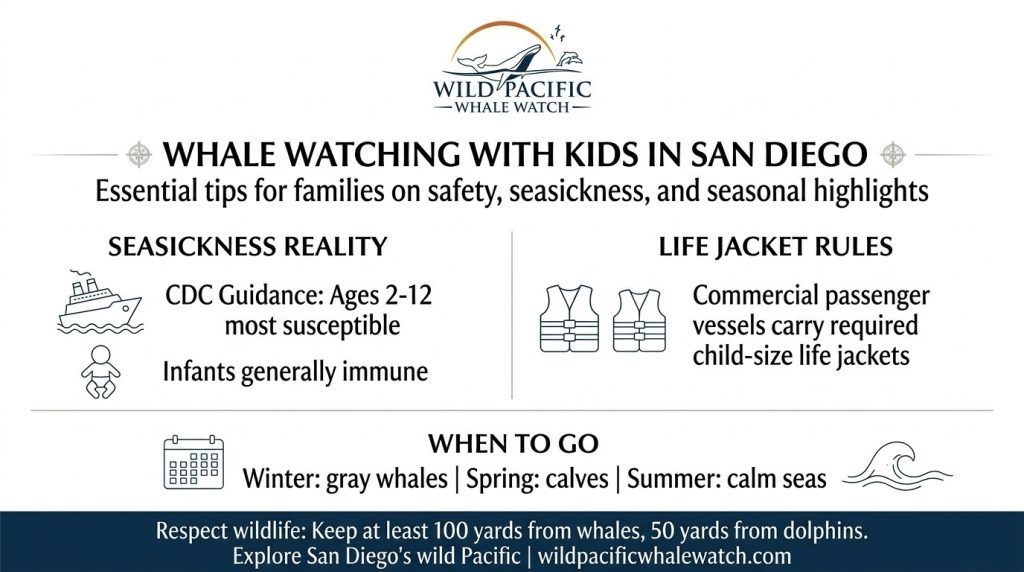
The CDC Yellow Book says children ages 2 to 12 are especially susceptible to motion sickness, while infants and toddlers are generally immune. One clinical review found that susceptibility peaks around ages 10 to 12. So your eight-year-old is more likely to feel queasy than your baby. Plan with that in mind.
Medication is a question for your pediatrician. The CDC notes that some motion sickness medicines aren’t recommended for children, and that they can make some kids very active rather than sleepy. Ask about the right product and dose well before trip day.
Do Children Have to Wear Life Jackets on Whale-Watching Boats?
The short answer: usually not throughout the whole trip, but the boat must carry life jackets that fit your child. California’s under-13 rule doesn’t cover commercial passenger vessels. Federal rules for those vessels govern what equipment they must carry, not what passengers must wear.
What California law says
Many parents assume the rules for recreational boats also apply to commercial whale-watching trips. They don’t.
Under California Harbors and Navigation Code §658.3, children under 13 must wear an approved life jacket on vessels of any length while underway. The statute has exceptions, including when the child is in an enclosed cabin.
Most importantly for families, the requirement does not apply to anyone operating a passenger vessel or small passenger vessel as defined in federal law.
What federal rules require instead
Commercial passenger vessels follow U.S. Coast Guard regulations. Under 46 CFR §180.71, a vessel must carry an adult life jacket for each person aboard, plus child-size jackets equal to at least 10% of the people permitted on board, or more if needed to fit every passenger too small for adult sizes.
There is a limited exception: child-size jackets aren’t required if the vessel’s certificate is endorsed for adults only. Larger vessels fall under a separate section of the regulations, which covers vessels carrying more than 150 passengers and contains the same child-size life jacket requirement.
The Coast Guard has interpreted the rule to mean at least 10 percent child-size jackets, or enough for every child actually on board. These are rules about what equipment the boat carries.
How a child’s life jacket should fit
California State Parks warns that life jackets designed for adults won’t work for children. Its fit test is simple:
- Check the manufacturer’s label for the right size and weight, and fasten the jacket properly.
- Have your child raise their arms while you gently pull up on the shoulders.
- If the jacket rides up over the chin or face, it doesn’t fit.
Even when wearing one isn’t legally required, you can ask the crew whether it makes sense for your child to wear one, especially a toddler or an active climber.
Child-safety booking checklist
Before booking:
- Ask which passenger-vessel regulations apply to the boat.
- Confirm that child-size life jackets are carried for your child’s weight.
- For infants, ask specifically whether infant-size jackets are on board.
- Ask whether you may bring your own Coast Guard-approved child jacket.
At boarding:
- Ask the crew to show you where child-size jackets are stowed.
- Have the crew explain how jackets are fitted and used in an emergency.
- Ask whether wearing one is advisable for your child on that day’s trip.
- Agree on a family rule that kids stay with an adult on the outer decks.
When to Go: An Seasonal Breakdown
Winter (December–April): gray whales. This is the classic family season, and it overlaps with winter break. Gray whales travel close to the coast, sometimes passing within a mile of land. That means a shorter ride before the first sighting. Winter also brings cooler air and rougher seas, so leave a backup day.
Spring (March–April): mothers and calves. As the migration turns north, spring offers a chance to see mothers and calves heading north together. Spotting a calf isn’t guaranteed, though. NOAA’s 2025 calf estimate of 85 was the lowest in its records.
Summer (May–September): blue whales and calmer seas. Our blue whale guide notes that summer brings the most activity and the calmest sea conditions. For kids prone to seasickness, calm water matters most. Blue whales feed farther offshore, so expect a longer ride out.
Fall (September–November): dolphins and deals. As part of San Diego’s Kids Free promotion, we’re offering one free child (14 and under) with each paying adult through November 8, 2026, applied automatically at checkout.
For the full calendar, see our San Diego whale watching season guide.
Why Families Choose Peregrine
Our crew has worked every job on a boat, from deckhand to captain. With kids, that experience shows: picking a calm route, knowing when to slow down, and keeping the narration interesting for a seven-year-old. You can read more about our story and crew.
Peregrine is an 82-foot vessel built for comfort. It carries twin Tohmei anti-rolling gyro stabilizers that greatly reduce roll, especially while drifting or moving slowly. That’s exactly when kids are watching whales.
There’s also air-conditioned indoor seating where little ones can warm up. On board you’ll find clean, modern restrooms and a galley with snacks and drinks for purchase. A 25-knot cruising speed means less waiting and more watching.
There are limitations to weigh:
- Trip length. Trips usually run 3 to 3.5 hours, which is long for some toddlers.
- Age recommendation. We recommend trips for ages 3 and up, and all children must be supervised at all times.
- Stabilizers have limits. They reduce motion but don’t eliminate it.
- No sightings promise. Wild animals can’t be guaranteed, but if we don’t spot whales, you get a return voucher with no expiration date that’s fully transferable.
What to Expect on the Water
Trips leave from H&M Landing near Shelter Island, minutes from San Diego International Airport. The harbor is part of the show. On a recent San Diego trip, naturalists noted sea lions lounging on harbor buoys while children watched eagerly.
Offshore, dolphins are often the first big moment. Our Sightings Log recorded about 500 short-beaked common dolphins in a feeding frenzy with lots of babies on one July 2025 trip.
Whale encounters vary by season. One July 2025 log entry describes a minke whale that breached more than 20 times. Our crew narrates throughout and tells kids when to watch for the next surfacing.
Dress for a change in temperature. It’s often 15 to 20 degrees cooler on the water.
Expect some quiet stretches while whales dive or the crew searches. Binoculars, a bird-spotting game, or a snack break indoors help pass the time.
A Note on Responsible Viewing
NOAA asks boats to stay at least 100 yards from whales and 50 yards from dolphins, and never chase, encircle, or leapfrog animals.
Following these rules produces better encounters. Animals that aren’t pressured stay calm and often surface near the boat on their own. That means longer, more natural sightings, and a real lesson for kids in sharing the ocean.
The gray whale story makes a good conversation on board. A decade ago, the population was nearing all-time highs of 27,000 whales, before a long decline and this year’s partial rebound. Our guide to responsible whale watching in San Diego covers the guidelines in more detail.
Planning Your Family Trip
Book early for gray whale season and school holidays. If your kids are prone to seasickness, aim for summer’s calmer seas and talk to your pediatrician several days ahead.
Our crew finds that morning departures often bring calmer conditions, though the ocean doesn’t keep a schedule.
Before you go, check that you have:
- Warm layers and a windbreaker for everyone
- Sunscreen, sunglasses, and hats
- Soft-soled, closed-toe shoes
- A pediatrician-approved motion-sickness plan, if needed
- Familiar snacks and water bottles
- Child-size binoculars (optional)
- A change of clothes for younger kids
Traveling with a group? Our family reunion guide and private charters give you the whole boat. For guests with limited mobility, our lower deck is accessible to most, and we ask that you contact us ahead of time.
Give Your Kids a Day on the Wild Pacific
Whale watching is one of the few San Diego outings a toddler, a teenager, and a grandparent can enjoy together. Peregrine makes it easier for families, with a stabilized ride, indoor space, restrooms, a knowledgeable crew, and a return voucher if the whales don’t show.
Ready to plan your family’s trip? Book your Wild Pacific Whale Watch tour now or call 619-821-8205 to find the right departure.
Frequently Asked Questions
What is the best age for whale watching with kids?
We recommend trips for ages 3 and up. Children around 5 to 12 often get the most out of it, since they can follow the narration and spot wildlife themselves.
Can babies come on the trip?
Yes. Infants ages 0 to 3 always ride free. The trip is long for very young children, though the CDC notes that infants rarely get motion sickness. Call ahead to confirm infant-size life jackets and any gear questions.
Will my child get seasick?
It’s possible, especially for ages 2 to 12, whom the CDC identifies as the most susceptible group. Peregrine stabilizers greatly reduce roll, and looking at the horizon can help. Ask your pediatrician before giving any medication.
Do kids have to wear life jackets on a whale-watching boat?
Usually not throughout the whole trip. California’s under-13 rule exempts federally defined passenger vessels, which instead must carry adult and child-size jackets. Ask the crew where the child-size jackets are stowed, and whether wearing one is advisable for your child.
What’s the best season for families?
Winter brings gray whales close to shore, and spring offers the best chance of seeing calves. Summer has the calmest seas. Fall has active dolphins and, through November 8, 2026, a free child ticket with each paying adult.
Are there bathrooms and food on board?
Yes. Peregrine has clean, modern restrooms and a galley with snacks and drinks for purchase. Many parents also bring familiar snacks.
What if we don’t see any whales?
Sightings are very common but can’t be guaranteed. If we don’t spot a whale, you’ll get a return voucher with no expiration date that’s fully transferable.