
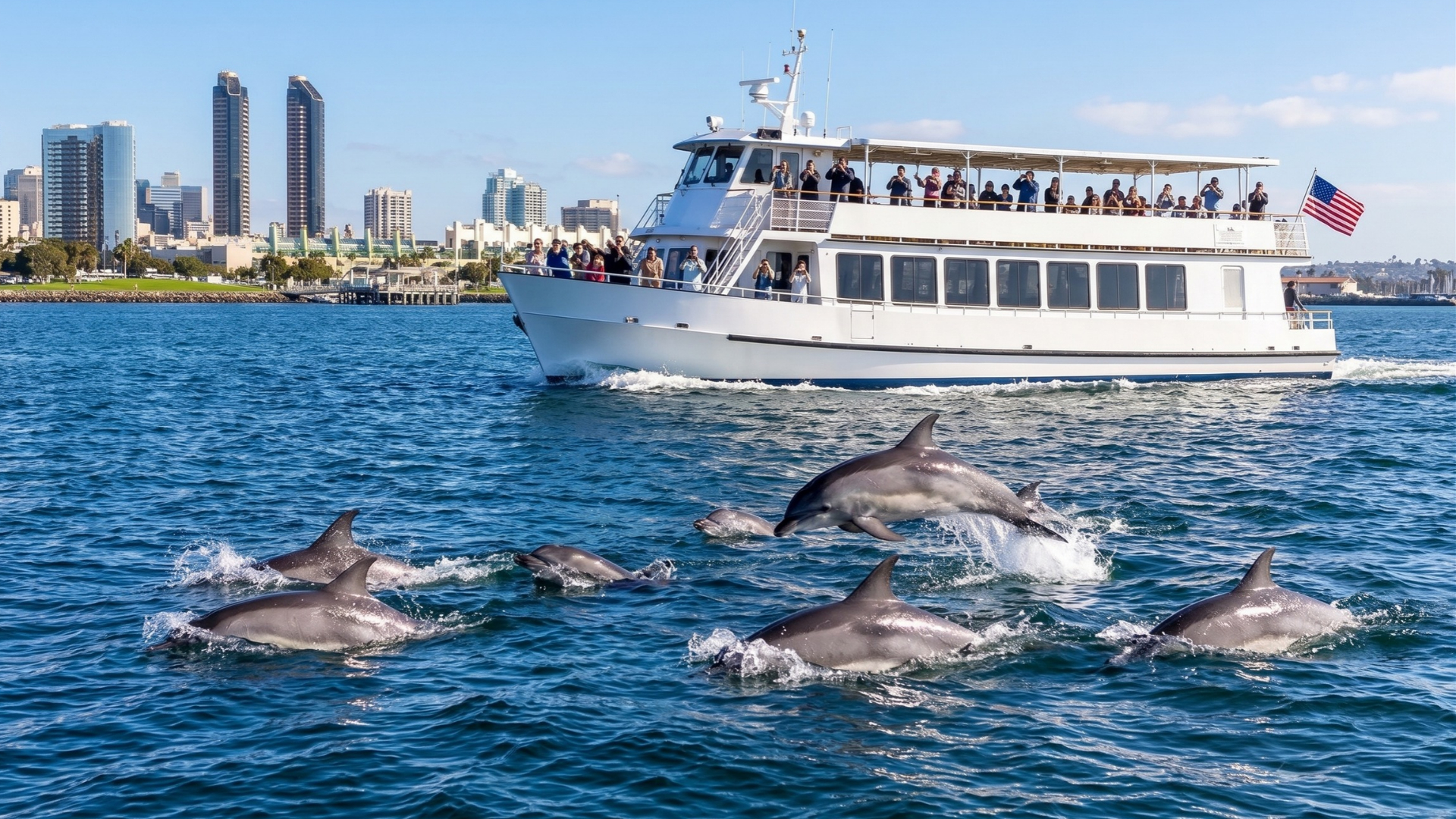
You hear a dolphin stampede before you see it. First comes a low roar of whitewater. Then the sea fills with fins, hundreds or even thousands of them, all racing the same way.
On October 16, 2025, a whale-watching crew off San Diego had exactly that experience. Domenic Biagini, owner and operator of Gone Whale Watching San Diego, estimated the group at 2,000 to 7,000 dolphins, compared with a normal common dolphin pod of about 100 to 500. ABC News ran the footage, reporting that the guides were stunned as thousands of dolphins leaped past their boat.
At Wild Pacific Whale Watch, our owner-operators bring over 40 years of combined experience in San Diego and Monterey Bay. Visitors ask us about stampedes constantly. The honest answer is that you can’t schedule one, but you can improve your odds.
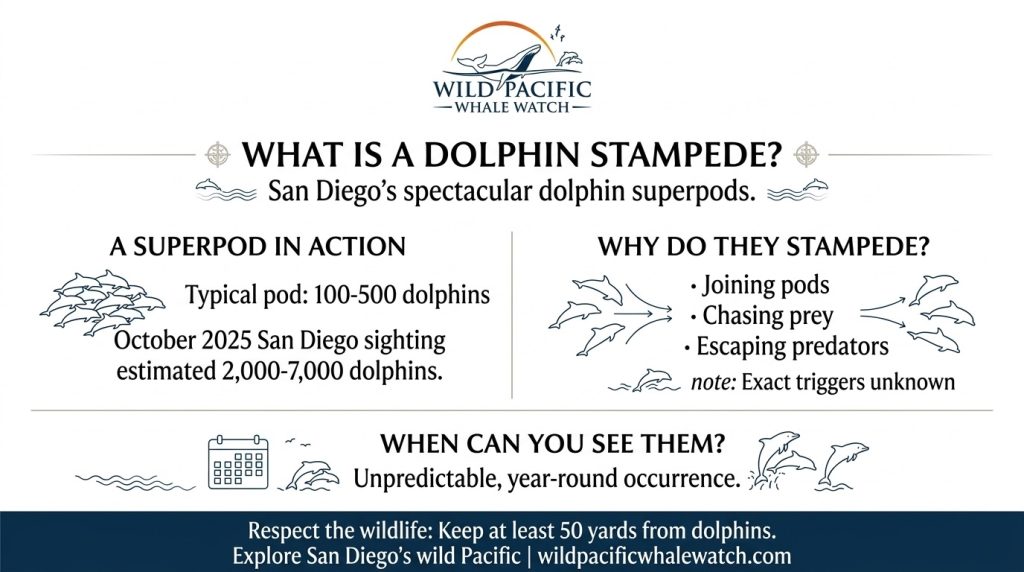
What’s a Dolphin Stampede?
“Dolphin stampede” isn’t a scientific term, scientists have named it “superpod” or “mega-pod”.
A superpod is not one giant family. According to NOAA Fisheries, short-beaked common dolphins usually travel in groups of hundreds and occasionally gather in mega-pods of up to 10,000, which are thought to be made up of subgroups of 20 to 30 animals. In other words, a stampede is a temporary merger of many smaller groups.
San Diego’s stampedes almost always involve common dolphins, not the bottlenose dolphins people know from aquariums. Two kinds live here, and even their scientific names are unsettled.
NOAA’s 2023 Pacific stock assessment lists short-beaked common dolphins as Delphinus delphis delphis and long-beaked common dolphins as Delphinus capensis capensis, while other references treat the long-beaked form as a subspecies, D. delphis bairdii, that stays nearer the coast.
Why Dolphin Superpods Are Difficult to Predict
Predicting whether dolphins will be present is easy. Predicting a stampede is not.
NOAA Fisheries studies these animals with shipboard surveys. For example, a 2009 Southwest Fisheries Science Center cruise estimated common dolphin abundance off Southern California and Baja California and characterized their habitat. Surveys like this reveal broad patterns, but they can’t forecast the day thousands of dolphins will bunch up and run.
Clarifying the winter finding. A peer-reviewed Scripps-led study analyzed 37 CalCOFI survey cruises from July 2004 to November 2013. It found that short-beaked common dolphins were most abundant in winter.
That finding is easy to misread, for three reasons:
- It measures density, not group size. “Most abundant” means more dolphins per square kilometer across the survey area. It says nothing about how many gather in one visible group on a given day.
- The survey area is enormous. The CalCOFI grid covered about 238,494 square kilometers, from nearshore waters out to 700 kilometers offshore, far beyond the reach of a half-day trip.
- Other years show a different peak. An earlier analysis of 2004–2008 data found the highest short-beaked common dolphin density in shallower waters during summer and fall.
The ocean itself shifts the picture. NOAA notes that short-beaked common dolphin abundance and distribution change with the seasons, from year to year, and with oceanographic conditions, a pattern tracked in its Pacific stock assessments.
What triggers a stampede at the moment is still unknown. Capt. Dave’s Dolphin & Whale Safari says stampedes start spontaneously, with leading theories including meeting another pod, chasing prey, or evading orcas. Orcas do hunt dolphins here, as we covered in our guide to orca watching in San Diego. One detail complicates the feeding theory: NOAA says short-beaked common dolphins usually rest by day and feed at night.
When to Go: A Seasonal Breakdown
Fall (September–November). Several high-profile stampedes have happened in fall, including the October 2025 event. Food is the likely driver. After an earlier megapod, Biagini told 10News that the bait drawing humpbacks off San Diego was likely bringing in more dolphins too.
Winter and spring (December–April). This is gray whale season, and the Scripps winter peak means good dolphin numbers as well. Seas can be rougher, so build in a backup day.
Summer (May–September). This is blue whale season, and dolphins are a dependable bonus. In July 2025, our Sightings Log recorded 150 to 600 common dolphins on most trips, including about 500 in a feeding frenzy with calves on July 17.
How often do superpods happen? In an earlier interview with 10News, Biagini said pods of 25 to 200 are common, while superpods of more than 1,000 show up roughly once every other month.
For a full month-by-month view, see our best time of year for whale watching in San Diego guide.
How Wild Pacific Approaches a Dolphin Day
Finding big dolphin groups is a skill. Our crew watches for diving birds, bait balls, current lines, and distant splashes. Our owner-operators have worked every job on a boat, from deckhand to captain.
Speed matters too. Peregrine is an 82-foot vessel with a 25-knot cruising speed for reaching offshore feeding zones quickly. When a superpod is reported miles out, that speed can decide whether you see it before it breaks apart.
Comfort is built in. The boat has air-conditioned indoor seating, cushioned lounges, clean restrooms, and a full galley. It also carries rare twin Tohmei anti-rolling gyro stabilizers that sharply reduce seasickness. You can read more about what sets us apart.
Our limitations:
- No stampede guarantee. Our guarantee gives you a free return trip if we don’t see a whale. It doesn’t cover any particular dolphin behavior.
- Stabilizers reduce motion but don’t eliminate it. If you’re prone to seasickness, still take non-drowsy medication before the trip.
- Most days aren’t superpod days. Our typical encounters run from a few hundred dolphins to about 600, which is excellent viewing but not a stampede.
What to Expect on the Water
Trips leave from H&M Landing near Shelter Island and usually last 3 to 3.5 hours, depending on wildlife, season, and sea conditions. You’ll cruise past Point Loma on the way out, often with sea lions lounging on the harbor buoys.
Once we find dolphins, expect bow-riding, leaping, and calves surfacing beside their mothers. Our log also includes Pacific white-sided dolphins, offshore bottlenose dolphins, a Laysan albatross, and an ocean sunfish.
Whales frequently share the same trip. On July 21, 2025, one of two minke whales we found breached more than 20 times. Our top whale sightings in San Diego covers what else you might see.
Dress warmly. It’s often 15 to 20 degrees cooler on the water than on land.
Would you rather stay ashore? Our hidden-gem viewing spots guide notes that locals often watch for dolphins along the shoreline from Sunset Cliffs.
Responsible Viewing Means Better Encounters
All U.S. dolphins are protected under the Marine Mammal Protection Act. NOAA asks boats to keep at least 50 yards from dolphins and never chase, encircle, or leapfrog them.
Following these rules produces better encounters. Dolphins that aren’t pressured stay relaxed and often approach the boat on their own. With engines idling, you can actually hear a stampede roar past.
Our guide to responsible whale watching in San Diego explains the guidelines in more detail.
Planning Your Trip
Book early in your visit so you have a backup day if weather cancels a trip. Check the Sightings Log for current activity, and consider a morning departure, when seas are often calmer.
Before you go, check that you have:
- Sunscreen, sunglasses, and a hat
- Warm layers and a windbreaker
- Soft-soled shoes
- A phone or camera with burst mode on
- Binoculars (optional)
- A reusable water bottle
- Non-drowsy motion-sickness medication, if you need it
Trips are recommended for ages 3 and up. The lower deck is accessible to most guests with limited mobility, so please call ahead. Groups can book private charters, and families should see our family reunion planning guide.
See the Wild Pacific for Yourself
San Diego’s dolphin superpods are one of North America’s great wildlife sights, and even an ordinary day here can bring hundreds of dolphins plus whatever whales are in season. We can’t promise a stampede. We can promise a fast, stable boat, an experienced crew, and encounters run the right way.
Ready to try your luck? Book your Wild Pacific Whale Watch trip or call 619-821-8205 to find the best departure for your dates.
Frequently Asked Questions
What is a dolphin stampede?
A dolphin stampede is a very large group of dolphins, usually many pods combined, racing in one direction and churning up whitewater. The term comes from the whale-watching industry; scientists say “superpod” or “mega-pod.” Off San Diego, stampedes almost always involve common dolphins.
How many dolphins are in a stampede?
Numbers vary widely. Local guides consider 100 to 500 a normal pod, and the October 2025 San Diego event was estimated at 2,000 to 7,000. NOAA reports mega-pods of up to 10,000, though all of these counts are visual estimates.
Why do dolphins stampede?
No one knows for certain. The leading theories are joining other pods, chasing prey, and fleeing predators such as orcas. Different stampedes may well have different causes.
Is winter the best time to see a stampede?
Not necessarily. Scripps-led surveys found short-beaked common dolphins most abundant in winter across a huge offshore area, but abundance isn’t the same as group size. Several recent stampedes happened in fall, and superpods can occur in any month.
Can you guarantee I’ll see a stampede?
No. Any operator promising one is overpromising. Our whale guarantee gives you a free return trip if we don’t see a whale, but it doesn’t cover specific dolphin behavior.
Will I get seasick?
Some people may, even on a stabilized boat. Peregrine‘s gyro stabilizers greatly reduce roll, especially while we’re drifting with wildlife. If you’re prone to motion sickness, take a non-drowsy medication beforehand and sit near the middle of the lower deck.
How close do you get to the dolphins?
We follow NOAA’s guideline of staying at least 50 yards away and never chasing dolphins. They often choose to come much closer on their own to ride the bow, and those are usually the best moments of the trip.