
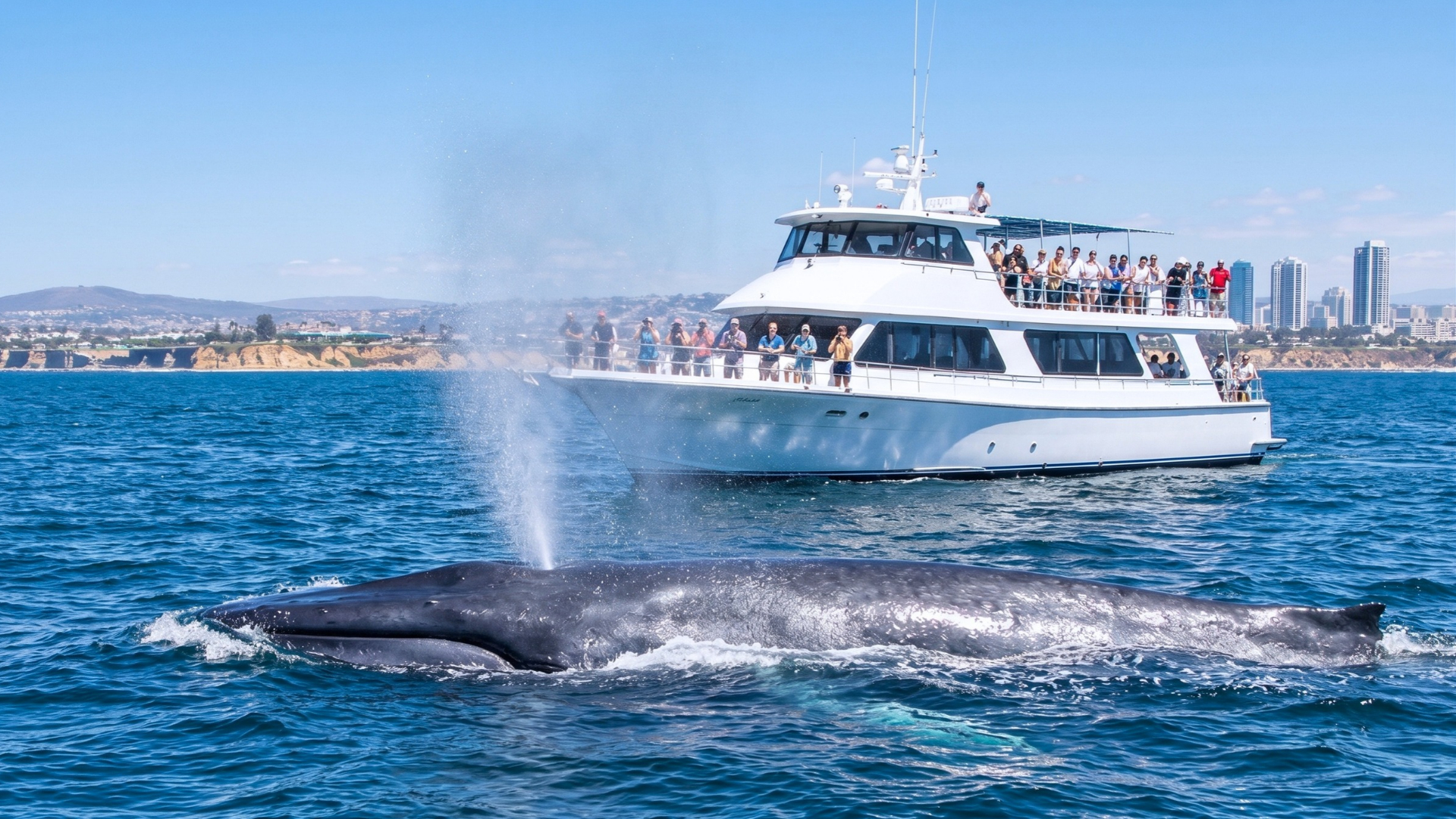
Great whale-watching days come down to one happy secret: matching your trip to what you love most. Calm-water fans can catch the gentlest seas, and photographers can chase the most gorgeous light. Pick the right departure, and the whole day clicks into place.
Just look at January 4, 2026, when both of our departures found whales! Our Sightings Log recorded 6 gray whales on the 9 a.m. trip, then a humpback cow/calf pair and a gray whale on the 1:30 p.m. trip. The whales show up morning and afternoon alike, so your departure time is really about choosing the kind of day you’ll enjoy most.
At Wild Pacific Whale Watch, we run both trips from H&M Landing on Shelter Island, and our owner-operators bring over 40 years of combined experience in San Diego and Monterey Bay. Along the way, we’ve helped countless guests find their perfect trip, and we’ve learned that the best choice comes down to wind, waves, light, and who’s joining you on board. Here’s how to pick yours.
The Misconception Worth Correcting
Whales Don’t Keep Morning Hours
Many visitors assume whales are busiest at dawn, like birds. For the hours whale-watch boats are out, the research doesn’t support that.
- Gray whales travel around the clock. NOAA biologist Wayne Perryman’s thermal-camera studies found that gray whales swim at the same speed night and day, and about 25% more pass at night during the second half of the migration.
- Blue whales shift at dark, not at noon. Cascadia Research Collective’s video tags recorded feeding dives of 250 to 300 meters in the Southern California Bight, getting progressively shallower as darkness fell.
- The big surface-time change is overnight. A later Cascadia study found that blue, fin, and humpback whales spent up to twice as long near the surface at night.
Both of our departures run in full daylight, so whale behavior is broadly similar on either one.
The Real Difference Is Wind, Waves, and Light
The National Weather Service explains that air over land heats much faster than air over water, so warm air rises and cooler air flows in from the water. That onshore flow is strongest in the afternoon, when the air over land is warmest.
Light works the other way. San Diego’s marine layer usually clears between mid-morning and early afternoon.
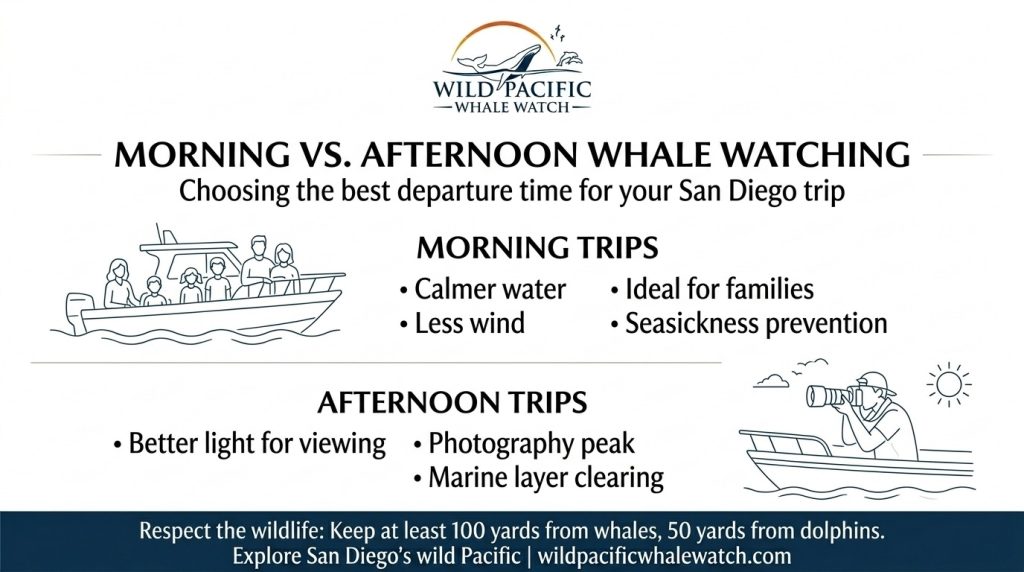
In short, mornings tend to bring smoother water, and afternoons tend to bring better light.
Best Departure by Traveler Type
| Traveler | Best bet | Why |
| Prone to seasickness | Morning | Less wind usually means less chop |
| Photographer | Afternoon, especially May–June | Marine layer has usually burned off |
| Families with young kids | Morning | Smoother decks, home by lunch |
| Older relatives or mixed ages | Morning | Easier footing, gentler ride |
| Tight schedule or first visit | Whichever fits | Whale odds are similar on both |
Peregrine helps on either trip. It carries twin Tohmei anti-rolling gyro stabilizers that greatly reduce boat roll, especially while drifting or moving slowly. Still, a calm sea does more than any stabilizer can.
Marine Forecast Decision Guide: Which Trip Will Be Calmer?
Where to Look
Start at the NWS San Diego Marine Forecasts page. It links to:
- Coastal Waters Forecast (South of San Mateo Point). The main text forecast for wind and seas, broken into periods like “today” and “tonight.”
- Graphical Wave Forecast. A map you can step through by forecast time to see how wind and waves build.
- Surf Forecast. Useful for swell direction and period, though it describes breaking waves at the beach rather than conditions offshore.
- Warnings & Advisories. Any active Small Craft Advisory or marine warning.
- San Diego Forecast Discussion. Forecasters’ reasoning, including notes on marine conditions and timing.
Check both forecast zones. NWS San Diego issues advisories separately for coastal waters out to 10 nautical miles and for waters 10 to 60 nautical miles out, including San Clemente Island. Trips to offshore feeding areas can cross both.
What to Check
| Forecast factor | What to check | Calmer-trip signal | Caution signal |
| Wind speed and direction | Whether winds strengthen in the afternoon period | Light winds holding steady all day | Winds rising “in the afternoon,” or west/northwest winds building |
| Wind waves | Whether short, choppy waves are expected | Wind waves 2 ft or less | Wind waves building through the day |
| Swell height and period | Size and spacing of swell from distant storms | Small swell, or longer periods with modest height | Large swell, even with light winds |
| Advisories | Whether a Small Craft Advisory or marine warning is in effect | No advisory during your trip window | Advisory starting or ending during your trip |
Wind Waves and Swell Are Not the Same
Waves come from two different sources, and they affect the ride differently.
- Wind waves are local. According to NOAA’s National Data Buoy Center, wind waves are produced, or were recently produced, by the local wind. They’re short, steep, and choppy.
- Swell is distant. Swells are waves not produced by the local wind, and they arrive with longer periods.
- Period tells them apart. NWS Western Region guidance notes that swell usually has periods of 10 seconds or more, while wind waves usually have periods of 8 seconds or less.
- Longer periods usually ride smoother. NWS Jacksonville explains that long periods, around 12 seconds, typically mean a smoother ride, while short periods, around 5 seconds, can be choppy, especially above 3 feet.
A low wind forecast doesn’t automatically mean smooth seas. Australia’s Bureau of Meteorology notes that the wind can stop while the waves it created keep moving outward as swell. A large swell from a distant storm can still lift and roll the boat on a windless morning.
The two also add together. NOAA notes that combined height equals the square root of the sum of the squares of the swell and wind-wave heights. A 4-foot swell plus 3-foot wind waves makes about 5-foot combined seas.
Reading the “Wave Detail” Format
You may see a newer format. NWS Western Region explains that forecasts are adding wave period and direction for each impactful wave system instead of just labeling waves as wind waves or swell. A typical line reads “West 8 feet at 14 seconds and west 5 feet at 6 seconds.”
Use the period to sort them: the 14-second system is swell, and the 6-second system is wind chop.
Cover the Whole Trip, Not Just Boarding Time
Our trips usually run 3 to 3.5 hours. Check every forecast period your trip touches:
- 9 a.m. trip: Check “today” or “this morning,” and whether winds increase before noon.
- 1:30 p.m. trip: Check “this afternoon,” and conditions through about 5 p.m.
- Either trip: Use the Graphical Wave Forecast to step through the hours your trip is on the water.
When to Check
| When | What to do |
| Evening before | Read the Coastal Waters Forecast for both zones. Note any advisory start and end times. Compare morning vs. afternoon winds. |
| Morning of the trip | Re-check advisories and the latest forecast update. Look at the Graphical Wave Forecast for your trip hours. |
| Still unsure | Call us at 619-821-8205. We’ll share what our captains are seeing. |
Quick Decision Table
| If the forecast shows… | Likely calmer pick |
| Winds increasing “in the afternoon” | Morning |
| An advisory beginning around 3–4 p.m. | Morning |
| An advisory ending mid-morning | Afternoon |
| Large long-period swell, light winds all day | Similar either way |
| Light winds and small seas all day | Either, so pick by light or schedule |
A Small Craft Advisory is a planning signal, not an automatic cancellation. Our captains make the final safety call. If conditions are unsafe, we reschedule your trip or issue a full refund.
When to Go: A Seasonal Breakdown
| Season | Usual edge | Why |
| Winter (Dec–Apr) | Morning, narrowly | Weather systems matter most; afternoons turn chilly |
| Spring (Mar–May) | Morning for comfort | Often windy afternoons |
| Early summer (May–June) | Afternoon for light | Marine layer peak |
| Mid–late summer (Jul–Sep) | Either | Calmest season overall |
| Fall (Sep–Nov) | Either | Settled weather; pack layers for afternoons |
- Winter. NOAA’s July 2026 estimate put the gray whale population at about 17,750, up from about 12,890 the year before. The sea breeze is most common in summer, when land heats much more than the sea, so in winter, fronts and swell drive conditions more than the clock does.
- Early summer. NWS meteorologist Alex Tardy has explained that May Gray and June Gloom happen as land warms much faster than the water. San Diego averages just 59% sunny days in May and 58% in June.
- Summer. Blue whales arrive from roughly mid-May through September, with the calmest sea conditions of the year.
For month-by-month species details, see our best time of year guide and whale watching season guide.
What Wild Pacific Whale Watch Offers on Either Departure
A Boat Built for Changing Conditions
Peregrine is an 82-foot vessel built with breezy afternoons in mind:
- Gyro stabilizers that reduce roll while idling near whales
- Air-conditioned indoor seating for waiting out spray
- A 25-knot cruising speed that shortens rough stretches
- A galley with snacks and drinks for the trip home
A Crew That Reads the Forecast for a Living
Our sightings log references 9 a.m. and 1:30 p.m. departures. Schedules can shift by season, so check the booking page. Our crew has worked every job on a boat and plans each route around that day’s wind and swell. Meet the team behind Peregrine or see what sets us apart.
What We Can’t Control
- Stabilizers have limits. They reduce roll, but they can’t flatten a whitecapped afternoon or a big swell.
- Forecasts can change. Conditions sometimes arrive earlier or later than predicted.
- Whales can’t be guaranteed. If we don’t spot one, you receive a return voucher with no expiration date that’s fully transferable.
What to Expect Beyond the Boat
On the Water
- Morning trips: Often cool and sometimes gray, with smoother water past Point Loma.
- Afternoon trips: Usually warmer and brighter, with the breeze building on the way out.
- On either trip: Dolphins are a frequent highlight. One July 2025 outing logged 400 short-beaked and 200 long-beaked common dolphins.
It’s often 15 to 20 degrees cooler on the water, and the gap feels larger in the afternoon wind.
Back on Shore
- After a morning trip: You have the afternoon free for Shelter Island’s waterfront. Our family reunion guide covers the area.
- After an afternoon trip: Sunset Cliffs is a local favorite for dolphins and distant whale blows near sundown, according to our hidden-gem viewing spots guide.
Doing It Responsibly Because the Rules Produce a Better Sighting
NOAA asks boats to stay at least 100 yards from whales and 50 yards from dolphins, and never chase, encircle, or leapfrog animals. It also recommends limiting time with any group of animals to 30 minutes or less.
The rules don’t change with the clock, and they produce better sightings at any hour. A whale left to its routine surfaces on a predictable rhythm. In afternoon chop, that rhythm lets our crew position calmly for the next blow. Learn more in our guide to responsible whale watching in San Diego.
Planning the Trip: Booking and Logistics
- Match your trip to your priority: morning for calm water, afternoon for light.
- Check the NWS marine forecast the evening before and again that morning.
- Book a few days ahead in gray whale season (December–April) and blue whale season (mid-May–September).
- Take motion-sickness medication before boarding if you need it.
- Pack layers, a windbreaker, a lens cloth, and a hat that won’t blow away.
- For groups, consider a private charter so you can set your own departure time.
Ready to Pick Your Time on the Water
Morning or afternoon, San Diego’s whales keep the same schedule. What you’re really choosing is calmer water or brighter light, and a few minutes with the marine forecast can tell you which day delivers which. With a stabilized boat, a crew that plans around the wind, and a return voucher if the whales don’t show, either departure is a good bet.
Check availability and book your Wild Pacific Whale Watch trip, or call 619-821-8205 and we’ll help you choose the right time for your dates.
Frequently Asked Questions
Do morning and afternoon trips see the same number of whales?
On average, the differences are small. Gray whales migrate steadily around the clock, and blue whale behavior shifts mainly around dark. Day-to-day changes in where whales are matter far more than departure time.
Does a Small Craft Advisory mean my trip is canceled?
Not necessarily. The advisory is aimed at small boats, and Peregrine is an 82-foot vessel. Our captains make the call based on actual conditions, and we reschedule or refund if seas are unsafe.
What does “8 feet at 14 seconds” mean?
It means a wave system about 8 feet high with 14 seconds between crests. Periods of about 10 seconds or more usually indicate swell, while 8 seconds or less usually indicates local wind chop. Longer periods generally feel smoother, but large swell still causes motion.
Does wind make whales harder to spot?
It can. Whitecaps look a lot like whale blows from a distance, and spray makes scanning from the outer decks less comfortable. Our crew spots whales in a wide range of conditions, but calm water is easier for first-time spotters.
Are dolphins more active at a particular time of day?
Not in a way that favors either trip. NOAA notes that short-beaked common dolphins usually rest during the day and feed at night, so both departures catch them during their daytime routine.
Can I switch departures if the forecast changes?
Call us at 619-821-8205 and we’ll do our best to help, depending on availability.
Is the whale guarantee the same for both departures?
Yes. If we don’t spot a whale on either trip, you receive a return voucher that doesn’t expire and is fully transferable.