
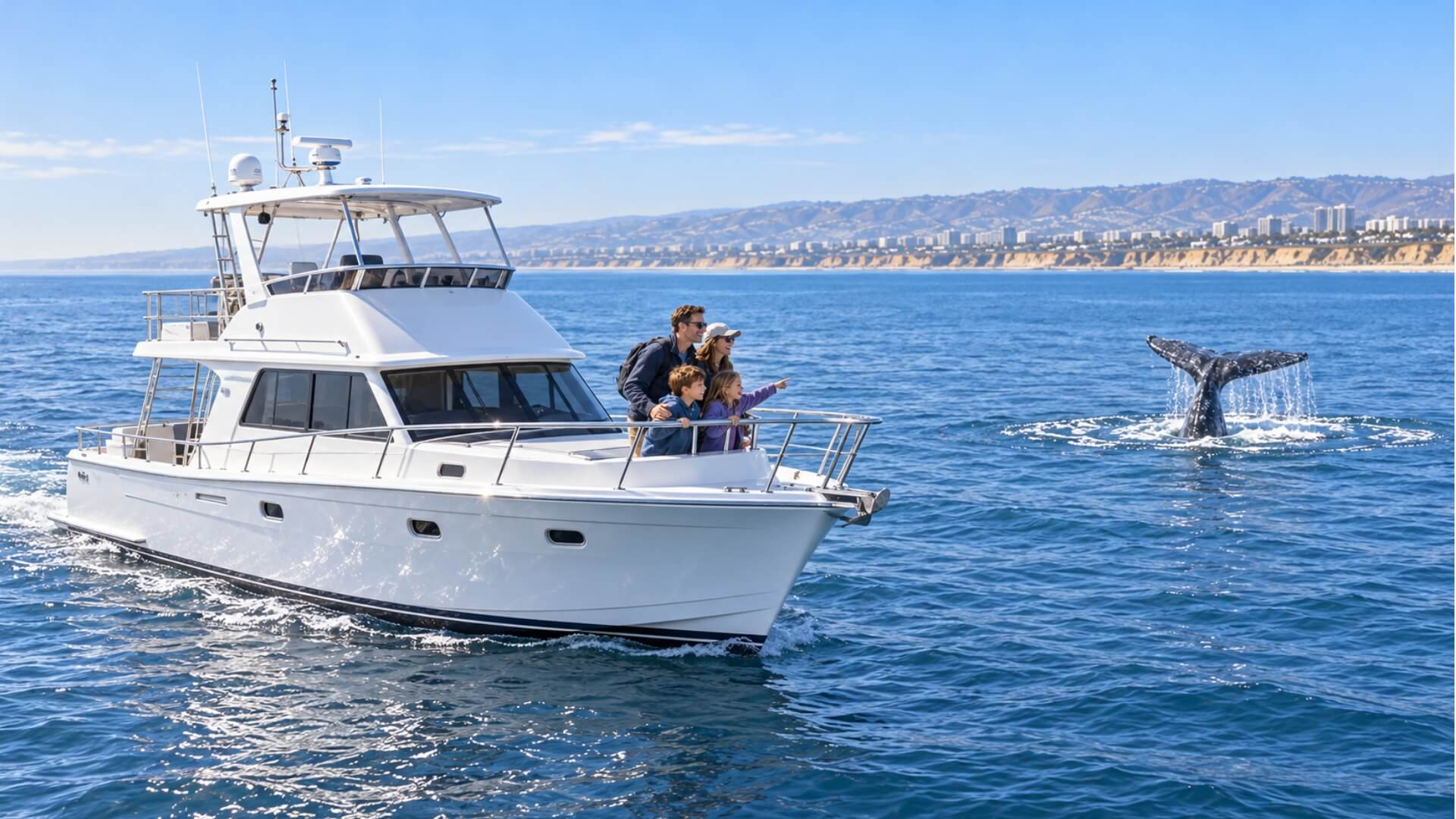
San Diego has a reputation as one of the most family-friendly cities in the country, and the numbers back it up. The city welcomed roughly 32.5 million visitors in 2024, an 8.3% jump from the year before, and a large share of that traffic is families chasing the same combination: mild weather, real beaches, and enough variety to keep a six-year-old and a sixteen-year-old both interested on the same trip.
Most family itineraries here follow a predictable script, the zoo, then a theme park, then a museum, then the beach. That’s a fine plan, but it misses one of the city’s best-kept family secrets: San Diego sits directly on a marine mammal migration route, and a short boat trip can outdo half the attractions on a typical checklist.
We run those trips daily at Wild Pacific Whale Watch, a locally owned operator working out of Shelter Island, and it’s one piece of a bigger family puzzle worth mapping out properly.
The Misconception Worth Correcting
A Whale-Watching Trip Isn’t Just “More Sitting”
Parents often assume a boat tour means more of what a theme park already delivers — long lines, scheduled shows, kids strapped into a seat. It’s actually the opposite kind of experience, and that’s worth understanding before writing it off.
According to NOAA Fisheries, gray whales are known for their curiosity toward boats in some locations and are a central focus of whale watching and ecotourism along the west coast of North America. Unlike a stage show with a fixed script, nobody — including the crew — knows exactly what a given trip will show, which tends to hold a child’s attention differently than scheduled entertainment does.
The Scale Is the Kind of Fact Kids Remember
The specifics also do a lot of the work. Gray whales make one of the longest annual migrations of any mammal, traveling roughly 10,000 miles round-trip and in some cases upwards of 14,000 miles, per NOAA Fisheries’ gray whale profile.
In summer, blue whales — the largest animals that have ever lived, reaching up to about 100 feet long — feed in the same waters. Those are the kinds of numbers that stick with an eight-year-old long after a roller coaster does.
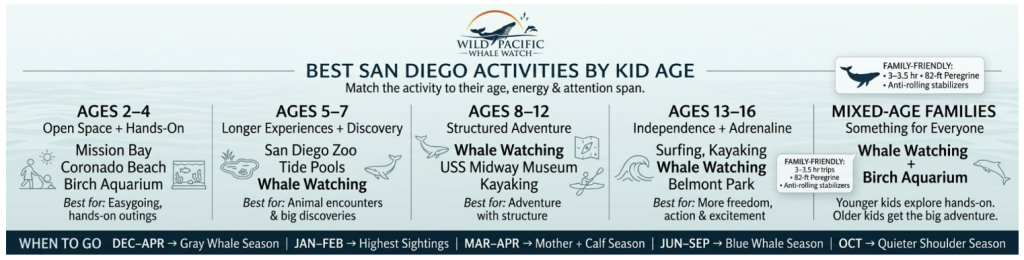
Best San Diego Activities by Kid Age
Choosing where to go matters less than choosing what actually fits your child’s age and attention span. A preschooler happiest digging in tide pools may not have the patience for a full-day theme park, while a teenager may need something with real independence or adrenaline built in.
Ages 2–4: Open Space and Hands-On Basics
Easygoing outings work best here — Mission Bay, Coronado Beach, and Birch Aquarium all combine open space with manageable, low-pressure experiences. Mission Bay in particular offers extensive walkways, playgrounds, sandy beaches, and eight designated swimming areas, though the City of San Diego advises parents to watch young children closely around the water. Birch Aquarium also runs marine-life programs built specifically for children as young as 2 through pre-kindergarten, including guided animal exploration and live-animal touching.
Ages 5–7: Longer Experiences, Bigger Discoveries
Kids in this range can generally handle a longer outing, which opens up the San Diego Zoo, tide pools, and whale watching — all activities that pair animals with genuine discovery rather than passive viewing. This is also roughly the age where a boat trip starts to click, since kids are old enough to sit still for a few hours but young enough to still be thrilled by “we might see a whale.”
Ages 8–12: Structured Adventure
Kids this age are often ready for something with more structure and stakes, which makes whale watching, the USS Midway Museum, and kayaking strong choices.
The Midway in particular runs a Junior Pilot Program alongside a family audio tour, interactive exhibits, and activities built specifically for younger visitors — kids complete a task sheet at stops throughout the ship and earn Junior Pilot Wings from a volunteer docent at the end.
Ages 13–16: Independence and Adrenaline
Teenagers tend to want activities that offer some independence or a bit of an adrenaline hit — surfing, kayaking, whale watching, and Belmont Park’s rides all fit that bill better than a slow museum walk-through.
Mixed-Age Families
For families with kids spanning several of these age brackets, whale watching paired with Birch Aquarium tends to work especially well: younger kids get an accessible, hands-on marine-life experience at the aquarium, while older kids have a bigger wildlife adventure to look forward to on the water. Thinking in these terms — matched to the specific kids coming along — tends to produce a better day than working off a generic “top ten” list.
When to Go: An Honest Seasonal Breakdown
San Diego doesn’t have a true off-season, but different months genuinely suit different family trips.
Winter and Early Spring — Whale Season, Fewer Crowds
The best time for whale watching in San Diego is December through April, when over 20,000 California gray whales migrate along the coast, with January and February delivering the highest concentration of sightings. Winter temperatures typically run 50–65°F with calm seas, which makes for a smoother, more comfortable boat ride — a real consideration with kids prone to seasickness. It’s also the cheapest, least crowded stretch of the year to visit generally.
March and April — Mother-Calf Season
From late February through April, gray whales head north with newborn calves swimming close beside them, producing some of the most memorable sightings of the year and a genuinely good story for a kid to tell at school.
Summer — Bigger Animals, Bigger Crowds, Higher Costs
From roughly mid-June through September, blue whales move into San Diego’s waters to feed on krill, with June and July the strongest months. This is also San Diego’s busiest season — July and August alone bring roughly 4.0 million and 3.8 million visitors respectively — so expect higher hotel rates and longer lines everywhere, including at the zoo and SeaWorld.
Fall — The Locals’ Secret
October is a strong pick: it’s shoulder season, so attractions are less busy, and several San Diego attractions run reduced or free kids’ admission promotions that month. Warm weather holds, crowds thin, and dolphins are visible on the water essentially year-round regardless of the month you pick.
What Wild Pacific Whale Watch Offers Families
Built With Comfort in Mind
Wild Pacific operates the Peregrine, an 82-foot vessel recently refitted with Tohmei anti-rolling gyro stabilizers that noticeably reduce the rocking motion most likely to cause seasickness. The vessel has air-conditioned indoor seating, cushioned lounges, and clean bathrooms, so there’s a comfortable place to retreat if a child needs a break from the open deck. Trips run 3 to 3.5 hours and depart daily from H&M Landing near Shelter Island, close to most downtown hotels and a short drive from the airport.
Where We’re Honest About What We Can’t Promise
No wildlife tour can guarantee what a specific animal will do on a specific afternoon, and any operator claiming otherwise is overselling it. What Wild Pacific can promise is effort and transparency: the crew tracks recent activity on our sightings log and shares real-time context throughout the trip, and the tour backs itself with a guarantee — if you don’t see a whale, your next trip is free.
Our owner-operators bring 40-plus years of combined experience between San Diego and Monterey Bay, two of the state’s top whale-watching regions.
A Note on Kids Specifically
Wild Pacific markets itself as family-friendly for all ages, and most kids who can sit through a movie handle the trip comfortably. Very young children or kids prone to motion sickness may do better on a morning departure, when seas tend to be calmer — it’s worth calling ahead to talk through your child’s age before booking. Private charters are also available if you’d rather have the boat to just your family.
What to Expect Beyond the Whales
On the Water
The whales are the headline, but they’re rarely the whole show. Dolphins are visible in San Diego’s waters essentially every month of the year and frequently ride a boat’s wake, often drawing louder reactions from kids than the whale sighting itself. Sea lions hauled out near the harbor, seabirds, and views of the Coronado skyline round out a trip that’s rarely just “watch and wait.”
Pairing It With the Rest of the Day
A whale-watching trip works best as one piece of a bigger day. Pair a morning departure with an afternoon at Birch Aquarium, the public exploration center for Scripps Institution of Oceanography at UC San Diego, where kids can handle starfish at the touch pool and watch Little Blue Penguins. Or combine it with Balboa Park, a 1,200-acre space dating to 1868 that holds 17 museums alongside the San Diego Zoo.
If the Weather or the Whales Don’t Cooperate
The USS Midway Museum lets kids explore more than 60 exhibits and climb into aircraft cockpits, with the Junior Pilot audio tour keeping younger visitors engaged for 2 to 3 hours. Torrey Pines State Natural Reserve offers coastal hiking trails suited to a range of ages, and it costs nothing beyond parking.
Doing It Responsibly Because It’s Also the Better Show
Federal guidelines require boats to keep their distance from whales, and that distance requirement is also, practically speaking, what produces the calmest and most natural sightings.
NOAA Fisheries recommends maintaining a minimum distance of at least 100 yards from large whales and limiting observation time to 30 minutes or less, guidance laid out in its marine life viewing guidelines. NOAA also notes that whale watching activity may disturb whales and affect their behavior when boats crowd too close.
A whale that isn’t being chased keeps behaving normally — surfacing, diving, feeding at its own pace — which makes for a better sighting and photo. It’s also a useful, low-key lesson for kids about why boundaries with wild animals matter, without turning the trip into a lecture.
Planning the Trip: Booking and Logistics
A few practical notes that make a family outing easier to plan:
- Book 1–2 weeks ahead for winter weekends during peak gray whale season (January–February), when morning departures fill quickly.
- Choose morning departures for younger or seasick-prone kids — seas are typically calmer earlier in the day.
- Dress in layers. Ocean wind runs noticeably cooler than shore temperature, even on a warm day.
- Arrive 20–30 minutes early for parking and boarding at H&M Landing near Shelter Island.
- Call ahead with your child’s age if you’re unsure whether the trip length or motion is a good fit.
- Pair the trip with an age-matched second activity — Birch Aquarium for younger kids, the USS Midway Museum for ages 8–12, Balboa Park for the whole group.
You can check current departure times, pricing, and family policies at wildpacificwhalewatch.com, by phone at 619-821-8205, by email at info@wildpacificwhalewatch.com, or in person at 2803 Emerson St., San Diego, CA 92106. Common questions are also answered on our FAQ page.
Frequently Asked Questions
What age is appropriate for a whale-watching trip with kids?
Most kids who can comfortably sit through a movie handle the trip well, roughly ages 5 and up. Very young children or those prone to motion sickness may do better on a calmer morning departure — call ahead and describe your child’s age so the crew can advise honestly.
Which San Diego activities work best for toddlers versus teenagers?
Ages 2–4 do best with open, low-pressure spaces like Mission Bay, Coronado Beach, and Birch Aquarium’s early-childhood programs. Teenagers tend to prefer activities with more independence or adrenaline, such as surfing, kayaking, or whale watching.
What’s the best month to visit San Diego with kids overall?
October is a strong pick — it’s shoulder season with lighter crowds and discounted kids’ admission at several attractions. Winter (December–February) is best specifically for whale watching, while summer offers the widest range of open attractions but the heaviest crowds and prices.
Do we need to book the whale-watching trip in advance?
Advance booking is strongly recommended, especially for weekend and peak-season departures between December and April, since morning trips during gray whale season fill quickly.
What if we don’t see a whale?
It happens, and any honest operator will tell you so — sightings are never guaranteed on a wildlife tour. Wild Pacific backs its trips with a guarantee that if you don’t see a whale, your next trip is free.
Is the boat comfortable for kids who get seasick?
The Peregrine’s anti-rolling gyro stabilizers and calmer morning seas both help reduce motion sickness. If your child has a history of seasickness, a morning departure and a seat near the boat’s center tend to help most.
How long does the tour run, and can we fit in other activities the same day?
Trips run 3 to 3.5 hours, which leaves room to pair a morning departure with an afternoon at Birch Aquarium, Balboa Park, or the USS Midway Museum, all a reasonable drive from the harbor.
What’s a good combination for families with kids of very different ages?
Whale watching paired with Birch Aquarium tends to work well for mixed-age groups — younger kids get an accessible, hands-on marine-life experience, while older kids have a bigger wildlife adventure on the water to look forward to.
Ready to Plan Your Family’s Day on the Water
San Diego gives families a rare mix: mild weather nearly year-round, activities matched to almost any age group, and — for a few key months — a wildlife migration dramatic enough to hold a child’s attention better than most theme park lines. Winter and early spring are when the odds and the comfort line up best, but the trip works as a strong addition to any season’s itinerary.
Check current departure times and book your family’s trip with Wild Pacific Whale Watch.