
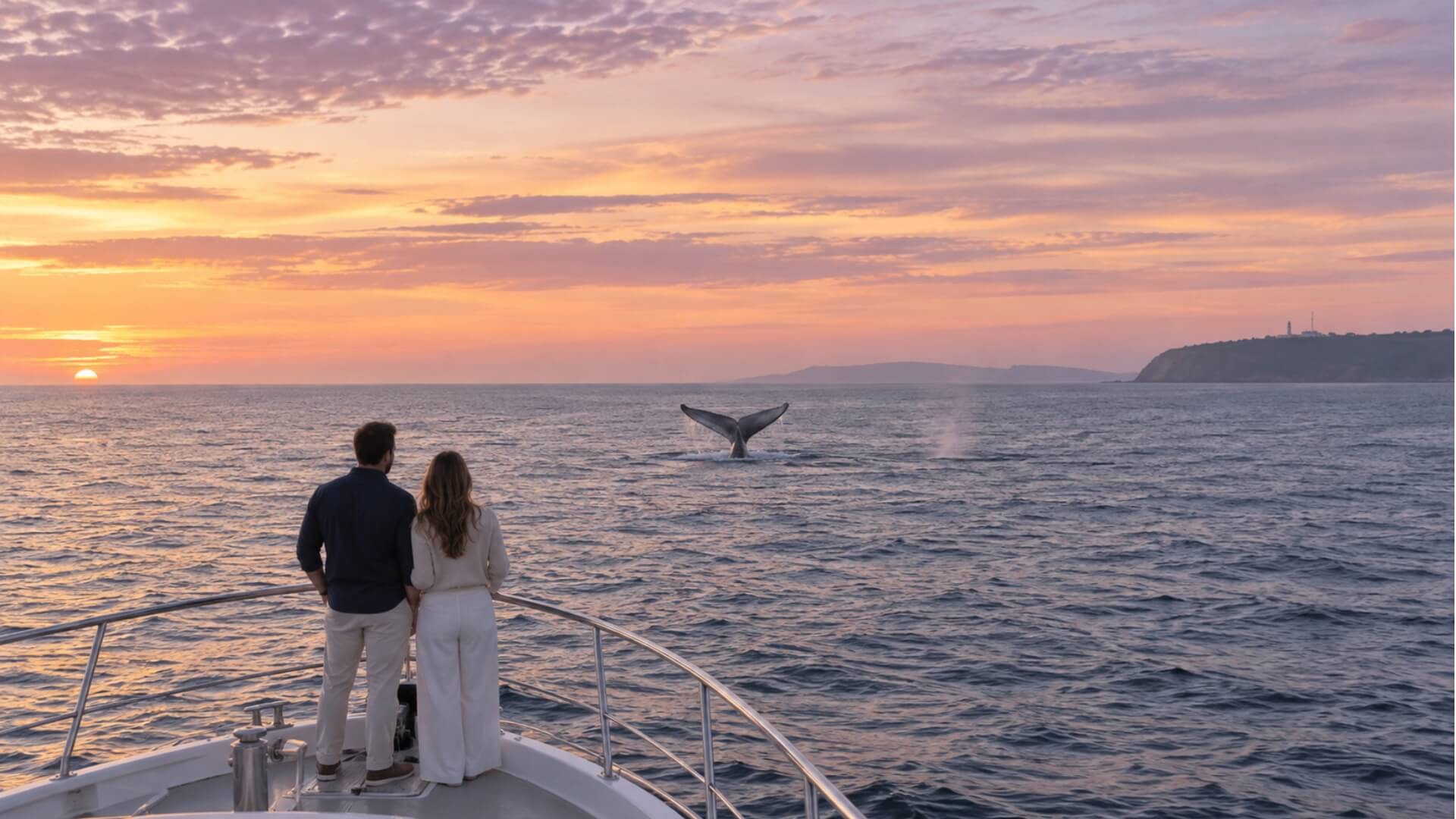
San Diego doesn’t need much dressing up to feel romantic. Sixty-five miles of coastline, a marine layer that turns every sunset into a slow build, and a climate that rarely punishes anyone for planning an outdoor date — it’s a city built for couples, whether you’re celebrating an anniversary or seeing if a second date deserves a third.
The timing question is where most couples get it wrong, though. San Diego welcomed roughly 32.5 million visitors in 2024, an 8.3% increase from 2023’s 30.0 million visitors, and a good share of them show up assuming summer is the romantic sweet spot. It isn’t necessarily. Marine layer regularly keeps La Jolla’s coastal areas overcast until noon or later in May and June, and parking at popular spots fills fast on summer weekends.
The better-kept secret is winter and early spring, when the crowds thin out, the light gets softer, and — if you know where to look — the Pacific puts on a show most visitors never plan a date around: the gray whale migration. We track that season closely at Wild Pacific Whale Watch, San Diego’s newest whale-watching operator, and it’s worth building an evening around, not treating as an afterthought.
The Misconception Worth Correcting
Whale Watching Isn’t Just a Family Outing
Most people mentally file whale watching next to aquariums and zoos — a kid’s activity, not a date idea. That’s a miscalculation specific to San Diego’s geography.
Gray whales migrating along the Southern California coast swim unusually close to shore. According to NOAA Fisheries, gray whales are known for their curiosity toward boats in some locations and are a focus of whale watching and ecotourism along the west coast of North America. That proximity changes the experience — it’s often a close, quiet encounter rather than a long ride punctuated by one distant spout.
The Migration Itself Is the Real Draw
The biology is genuinely striking. Gray whales make one of the longest annual migrations of any mammal, traveling about 10,000 miles round-trip and in some cases upwards of 14,000 miles, according to NOAA Fisheries’ gray whale species profile.
Calves are born during migration or in the shallow lagoons and bays of Mexico from early January to mid-February, and from mid-February to May, eastern North Pacific gray whales can be seen migrating northward along the U.S. West Coast — often with a calf close beside them.
That detail tends to land differently once you’re actually watching a mother and calf move past the boat together.
When to Go: Season-by-Season Breakdown
San Diego doesn’t really have a bad season, but different months suit different kinds of dates.
December Through February — Cool, Clear, and Quiet
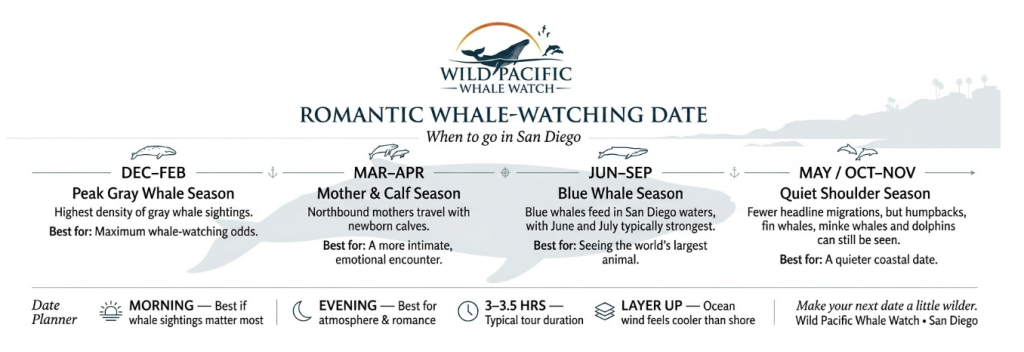
This is peak gray whale season. The best time for whale watching in San Diego is December through April, when over 20,000 California gray whales migrate along the coast, with January and February offering the highest density of sightings. Winter conditions are calmer too — winter temperatures range from 50-65°F, with calm seas and excellent visibility typical of San Diego’s mild climate. It’s also the cheapest, least crowded time to visit the city generally.
March and April — When the Calves Arrive
From late February through April we see the northbound whales heading home, with mothers now traveling slowly, newborn calves tucked close to their sides. Mother-calf pairs appear closer to shore for protection during this stretch — arguably the most emotionally resonant sighting window of the year, and a strong pick if you’d rather watch from Point Loma than a boat.
Summer — Bigger Animals, Bigger Crowds
From roughly mid-June through September, blue whales — the largest animals that have ever lived, reaching up to about 100 feet long — move into San Diego’s waters to feed on dense krill blooms, with June and July usually the strongest months. The tradeoff: this is also peak tourist season. July and August alone bring roughly 4.0 million and 3.8 million visitors respectively, so book dinner and hotels well ahead.
Shoulder Months — Quieter, Still Worthwhile
No headline migration in May, October, or November, but fin whales, minke whales, and humpbacks are seen year-round, and dolphins show up in every month. This is when locals themselves tend to do their coastal dates, precisely because it’s calmer.
What Wild Pacific Whale Watch Offers
Any operator who promises a guaranteed sighting is overselling it — the ocean doesn’t run on a schedule. What we can speak to honestly is how the trip is built to give couples the best realistic odds and the right atmosphere.
The Boat and the Crew
Wild Pacific runs its tours aboard the Peregrine, an 82-foot vessel recently refitted with Tohmei anti-rolling gyro stabilizers to smooth the ride and reduce seasickness, with air-conditioned indoor seating and a full galley.
Trips depart daily from H&M Landing near Shelter Island — a short drive from most downtown hotels and just minutes from the airport — and run 3 to 3.5 hours, giving you real time on the water rather than a rushed loop. Our owner-operators bring over 40 years of combined experience between San Diego and Monterey Bay, two of California’s top whale-watching regions.
Where We’re Honest About Limits
Sightings are never contractual, and December through April simply gives you better odds than August does. That said, Wild Pacific backs its trips with a whale-watching guarantee — if you don’t see a whale, your next trip is free — which is our way of putting some skin in the game rather than just hoping. Check current activity on our sightings log before booking, and if seeing a whale matters more to you than the setting, a winter morning departure is the better choice; we’ll say so honestly if you call.
A Note for Couples Specifically
If you’re planning something bigger than a date — a proposal, an anniversary trip — it’s worth a look at our San Diego proposal ideas guide and our roundup of the best proposal spots in San Diego, both written by our team specifically for couples timing a trip around peak season. Private charters are also available if you want the boat to yourselves.
What to Expect Beyond the Whales
A whale-watching date isn’t just the sighting — it’s the two or three hours around it, and San Diego makes that part easy.
Before You Board
A pre-boat coffee near Shelter Island, a slow walk along the water while you wait, and — if you’ve booked an evening departure — dinner reservations timed for right after you dock, so the conversation carries over from the boat to the table.
On the Water
Expect more than the marquee attraction. Dolphins are visible essentially year-round and often ride the boat’s wake before or after a whale sighting — usually the moment that gets couples laughing rather than just reaching for their phones. Sea lions, seabirds, and, depending on route, the Coronado skyline round out the trip.
After You Dock
La Jolla’s Cove for swimming, Children’s Pool for seal-watching, and the wide sands of La Jolla Shores are a short drive from most harbor departure points and make a natural second stop, with Sunset Cliffs close behind for the golden hour after an afternoon tour.
Doing It Responsibly Because It Produces Better Sightings
Federal guidelines exist for a reason, and following them tends to produce the encounter people actually want. NOAA Fisheries recommends boaters maintain a minimum distance of at least 100 yards from large whales and limit observation time to 30 minutes or less, guidance detailed in its marine life viewing guidelines.
NOAA also notes that whale watching along the North American coast may lead to disturbance and affect gray whale behavior when boats crowd in too closely.
A whale that isn’t being chased behaves normally, surfacing, diving, and moving at its own pace, which almost always makes for a better photo and a calmer memory than a boat that’s pushed in and spooked the animal into an early dive. The rules work in your favor, not despite you.
Planning the Date: Booking and Logistics
A few practical notes worth knowing before you book:
- Book winter and holiday-week dates 1–2 weeks ahead. Peak gray whale season (January–February) fills fast, especially weekend mornings.
- Choose morning departures if the sighting matters most; evening departures if the atmosphere matters most.
- Dress in layers. Ocean wind runs 10–15 degrees cooler than shore temperature, even on a warm day.
- Arrive 20–30 minutes early for parking and boarding near H&M Landing.
- Call ahead for a specific occasion — an anniversary, a proposal, a first date you want to get right. We can often arrange quieter seating with advance notice.
You can check current departure times, pricing, and availability, or ask which trip fits your date, at wildpacificwhalewatch.com, by phone at 619-821-8205, by email at info@wildpacificwhalewatch.com, or in person at 2803 Emerson St., San Diego, CA 92106. Full trip details and FAQs are also on our FAQ page.
Frequently Asked Questions
Is whale watching actually a good date idea, or is it mainly for families?
It works especially well for couples because gray whales swim close to the San Diego coast, making for a closer, quieter experience than most people expect. Evening and sunset-timed departures in particular lean toward atmosphere over volume of sightings.
What’s the single best month for a romantic whale-watching date?
January and February offer the highest density of gray whale sightings. March and April are better if you want the emotional pull of mother-and-calf pairs, which NOAA data shows moving north through May.
Do we need to book in advance, or can we walk up?
Advance booking is strongly recommended, especially for weekend and peak-season departures between December and April, since morning trips during gray whale season fill quickly.
What should we wear?
Layer up — ocean wind is noticeably colder than shore temperature even on a mild day. A windbreaker, closed-toe shoes, and sunglasses cover most conditions year-round.
Is there a chance we won’t see anything?
Yes, and any honest operator will tell you that. Winter migration months offer the best odds, and Wild Pacific’s guarantee means a missed sighting gets you a free return trip. Dolphins and sea lions are seen far more consistently than whales if you’d rather lower the risk entirely.
How long do the tours run, and can we build a full day around one?
Trips run 3 to 3.5 hours, which pairs naturally with a pre-boat breakfast near Shelter Island or a dinner reservation after, plus a stop at La Jolla Cove or Sunset Cliffs.
Is the boat manageable for a partner who gets seasick easily?
The Peregrine’s anti-rolling gyro stabilizers and morning’s typically calmer seas both help. Call ahead to discuss seating if seasickness is a real concern, since conditions vary by day.
Is summer worth it if we can’t get a winter date?
Yes — blue whales, the largest animals to have ever lived, feed off San Diego from roughly mid-June through September, a different but equally striking kind of encounter. It’s also the year’s busiest season, so book restaurants and hotels early.
Ready to Plan Your Date on the Water
San Diego gives couples a rare combination: mild weather nearly year-round, a coastline built for long walks and slow dinners, and — for a few key months — one of the most striking wildlife migrations on the planet passing close enough to watch from a boat rail. The season you choose changes the experience more than most guides admit, but there’s no wrong time to build a date around this coastline.
If a winter or spring trip is on the table, that’s when the odds and the atmosphere line up best. Check current departure times and book your date at Wild Pacific Whale Watch.