
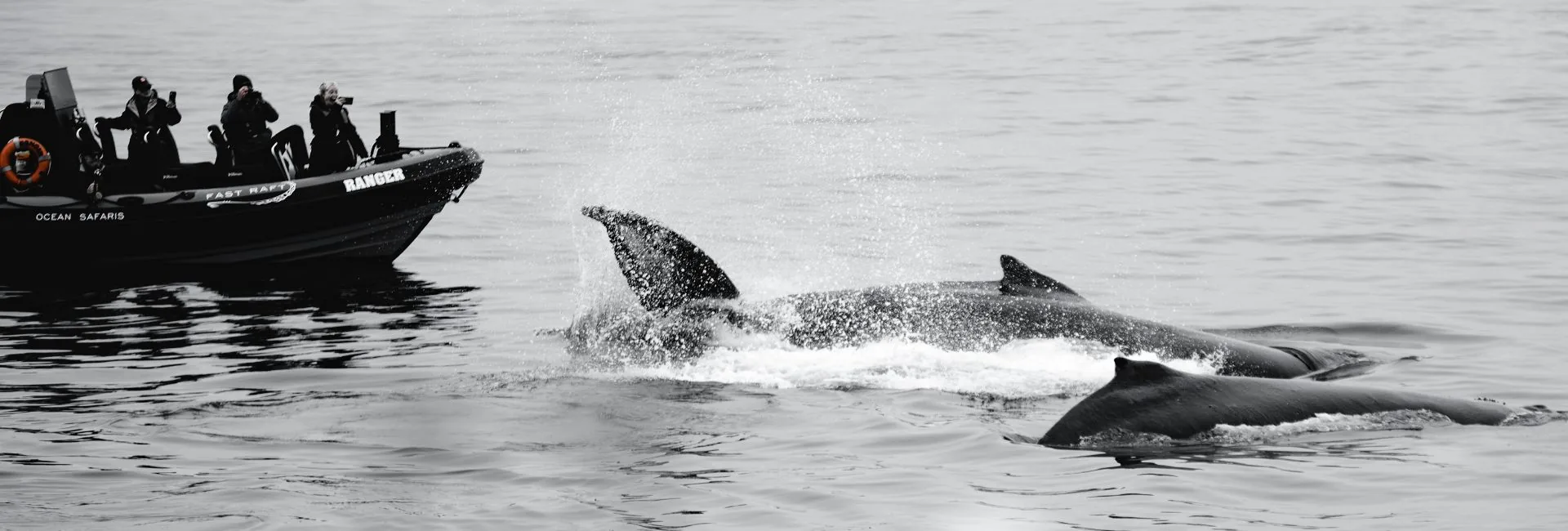
Is whale watching worth it? If you are asking, you have probably seen the price of a ticket, pictured three hours on a rocking boat, and wondered whether the whales will even show up. It is a fair question. A tour costs real money and a real chunk of your day, and nobody wants to spend either one staring at empty water.
The honest answer is that it depends on where you go, when you go, and who takes you out. In San Diego, those three factors align better than almost anywhere else along the California coast. Whales pass this stretch of the Pacific in every season, which is why whale watching tours here run daily, year-round, rather than for a few short months.
This article walks through what determines whether a trip pays off, five specific reasons San Diego clears that bar, and a few situations where you might want to wait for a better day. By the end, you will know whether a tour belongs on your itinerary or not.
What Makes a Whale Watching Trip Worth the Money?
A whale-watching trip comes down to four variables: the odds of seeing whales, the variety of wildlife, the comfort of the vessel, and the quality of the crew narrating what you see.
Most disappointing trips fail on one of those four points. The boat goes out in the wrong season and finds nothing. The vessel is cramped and half the passengers spend the trip fighting seasickness. Or the crew points at a distant spout, says “there’s one,” and leaves you to figure out the rest.
When all four variables work in your favor, the trip delivers something no screen can reproduce. Watching a blue whale surface fifty yards off the bow is an experience of scale, and scale does not translate to video.
So the real question is not whether whale watching can be worth it. It is whether the specific trip you are considering stacks those four variables in your favor. Here is how San Diego does:
5 Reasons Whale Watching in San Diego Is Worth It
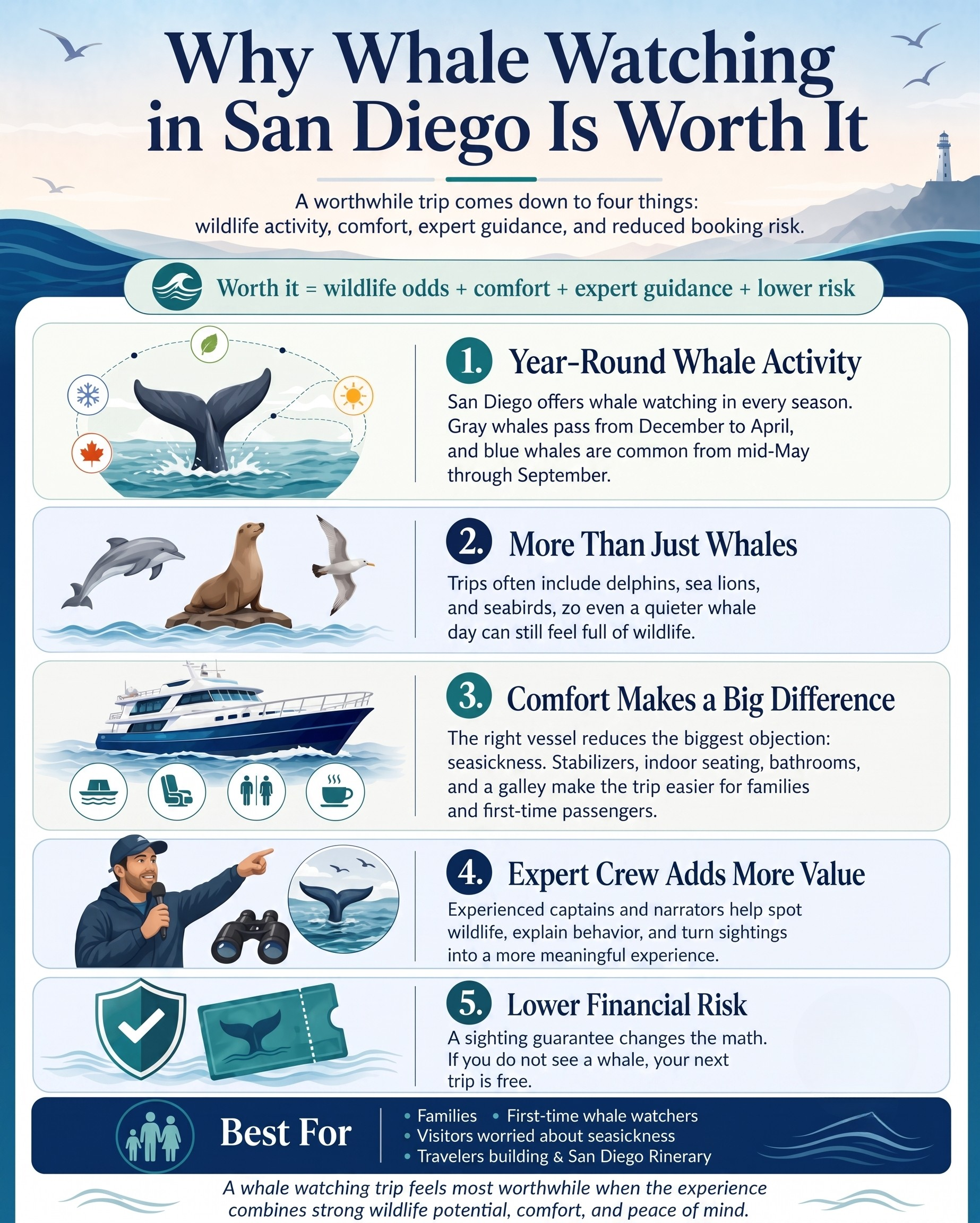
1. You Can See Whales Every Month of the Year
San Diego sits directly on one of the longest mammal migration routes on Earth. According to NOAA Fisheries, gray whales make one of the longest annual migrations of any mammal, covering roughly 10,000 miles round trip between Arctic feeding grounds and breeding lagoons in Baja California, with some individuals traveling upwards of 14,000 miles. From December through April, thousands of them pass close to the San Diego coast.
When gray whale season ends, blue whale season begins. From mid-May through September, blue whales feed on krill in the waters just offshore. These are the largest animals that have ever lived, reaching lengths of up to 100 feet and weights of up to 400,000 pounds.
Humpback whales, fin whales, and minke whales appear through winter and spring as well. The practical result is that there is no off-season here. Many whale watching destinations operate for a three- or four-month window.
San Diego operators run trips every day of the year because the wildlife justifies it. You can check what boats have encountered recently in the Wild Pacific sightings log before you book.
2. The Wildlife Goes Well Beyond Whales
A common worry behind the “is it worth it” question is the fear of a quiet ocean. In San Diego, whales are the headliners, but they are rarely the only act.
Up to six different species of dolphins live in or pass through these waters, and they often travel in large, energetic pods that surround the boat and ride the bow wake. For many passengers, especially kids, the dolphins are the most memorable part of the trip.
Sea lions are another near constant presence around the bay and coastline. If you want to know where they haul out and what their behavior looks like up close, the crew has covered it in detail in their guide to sea lions in San Diego. Seabirds, and on lucky days rarer visitors, round out the picture. Even a trip with modest whale activity tends to deliver a full slate of marine life.
3. The Right Boat Removes the Biggest Objection
Seasickness keeps more people off the water than ticket prices do. It is the most common reason travelers decide a tour is not worth the risk, and on the wrong vessel, that caution is justified.
This is where Wild Pacific Whale Watch made a deliberate bet. Their vessel, the Peregrine, is 82 feet long, was recently refitted as a yacht, and carries Tohmei anti-rolling gyro stabilizers, a technology that is rare on whale-watching boats and dramatically reduces the rolling motion that triggers seasickness.
The rest of the vessel follows the same logic. Air-conditioned indoor seating, cushioned lounges, clean bathrooms, and a full galley mean that the hours between sightings are comfortable rather than endured. The Peregrine also cruises at 25 knots, which gets you to offshore feeding zones faster and leaves more of your 3 to 3.5 hour trip for wildlife time instead of transit.
4. An Expert Crew Turns Sightings Into Understanding
A whale spout on the horizon means very little without context. What species is it? Why is it here in June? What does the spy hop, or the raised fluke before a deep dive, signal? The difference between a boat ride and an education is the crew.
The owner-operators at Wild Pacific bring over 40 years of combined experience from two of California’s top whale watching regions: San Diego and Monterey Bay. They have worked every job on a boat, from deckhand to captain, and the trips are narrated by handpicked crew members who share real-time insights as the wildlife appears.
That depth matters in practice. Experienced captains read the water, know the seasonal patterns, and position the boat for better viewing while respecting the animals. You can read more about the team’s background and approach on their page, which covers what sets them apart.
5. A Sighting Guarantee Removes the Financial Risk
The strongest answer to “is whale watching worth it” is a company willing to bet its own money on the outcome. Wild Pacific Whale Watch offers a straightforward guarantee: if you do not see a whale on your trip, your next trip is free.
That policy only makes sense for an operator with a high success rate. No business offers free repeat trips if it expects to give many away. The guarantee converts the worst-case scenario from “wasted money” to “a free second chance,” which changes the math for the entire decision.
Combine that with daily departures from H&M Landing near Shelter Island, just minutes from San Diego Airport, and the logistics are about as low friction as a wildlife excursion gets.
When a Whale Watching Trip Might Not Be Worth It
A fair assessment includes the other side. There are a few situations in which you should adjust expectations or choose a different day.
Wildlife is wild. Even in San Diego, no trip can promise a specific species or a breach on cue. If your trip is only worth it to you with a guaranteed acrobatic show, nature does not sell that ticket, and any operator who claims otherwise is overpromising.
Weather and sea conditions vary, particularly in winter. Summer tends to bring the calmest, sunniest conditions, which is part of why it suits families and first-time passengers so well. And if you have less than four hours in your schedule, do not try to squeeze in a trip. Rushing the experience undercuts the reason you came.
If you want full control over the schedule, route, and guest list, a private charter solves that problem better than a public tour, especially for celebrations, corporate outings, or small groups.
How to Get the Most Out of Your Trip
A little preparation raises the value of the same ticket. Dress in layers, because the ocean runs cooler than the shore even on warm days. Bring sunscreen and sunglasses for the glare off the water.
Check the sightings log before booking so you know what has been active that week. Arrive early enough to board without rushing. And once you are out there, put the phone down between photos. The trips run 3 to 3.5 hours, and the moments you remember will be the ones you watched with your own eyes.
If you are prone to motion sickness, choosing a stabilized vessel matters more than any wristband or pill. It is worth asking any operator directly what their boat does to manage roll.
Ready to See for Yourself?
The question “is whale watching worth it” gets answered on the water, not in an article. If you are in San Diego, the conditions for a worthwhile trip are already in place: year-round whale activity, six species of dolphins, a stabilized and recently refitted yacht, a crew with four decades of combined experience, and a guarantee that protects your money if the whales do not show.
Wild Pacific Whale Watch runs daily 3 to 3.5 hour trips from H&M Landing near Shelter Island. Book your whale watching tour and find out what is swimming past America’s Finest City this week.
Frequently Asked Questions
Is whale watching in San Diego worth the money?
Whale watching in San Diego is worth it for most visitors because whales can be seen year-round. Gray whales pass the coast from December through April, blue whales feed offshore from mid-May through September, and dolphins appear year-round. Operators like Wild Pacific Whale Watch back this up with a guarantee that your next trip is free if you do not see a whale.
What is the best time of year for whale watching in San Diego?
There is no single best time, because San Diego has two distinct peak seasons. Gray whale season runs December through April, while blue whale season runs from mid to late May through September. Summer also tends to offer the calmest sea conditions, which makes it a strong choice for families and anyone worried about seasickness.
How long is a whale watching trip in San Diego?
Whale watching trips with Wild Pacific Whale Watch last 3 to 3.5 hours. The Peregrine cruises at 25 knots, which shortens the run to offshore feeding zones and leaves more time for wildlife viewing.
What should I do if I get seasick easily?
A stabilized vessel is the most effective defense against seasickness on a whale watching trip. The Peregrine carries Tohmei anti rolling gyro stabilizers that significantly reduce rolling motion, along with air-conditioned indoor seating if you need a break from the deck. Booking during calm summer conditions also lowers the chance of a rough ride.
Can kids and grandparents go on a whale-watching tour?
Yes, San Diego whale watching tours are designed for all ages. The Peregrine has cushioned lounges, clean bathrooms, indoor seating, and a full galley, so multigenerational groups can stay comfortable for the full trip. Families who want a fully private experience can also book the vessel as a private charter.