
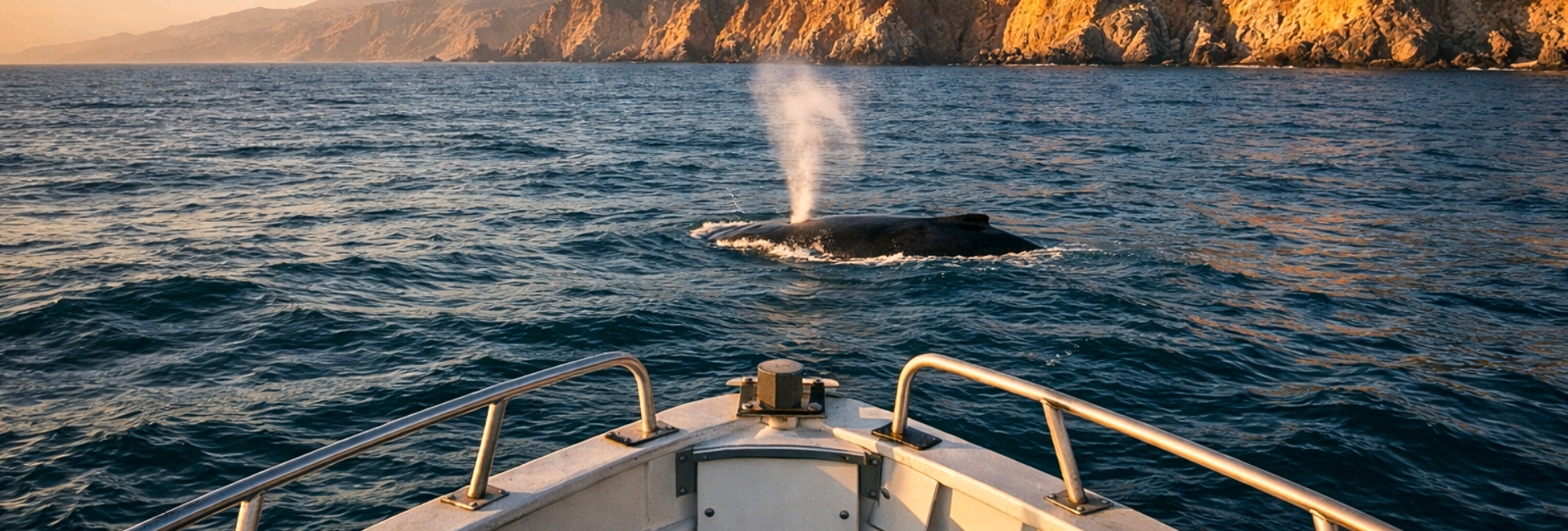
California sits directly along one of the most productive whale migration corridors on the planet. According to NOAA Fisheries, roughly 20,000 gray whales travel the length of the coast between Alaska and Baja California each year.
Blue whales, the largest animals on Earth, feed in cold upwelling waters off the central and southern coast each summer. Humpbacks, orcas, fin whales, and minke whales fill in the calendar across the remaining months. The result is a state where whale watching is genuinely possible in every season, from every coastal region.
Choosing the right location depends on which species you want to see and when you plan to travel. This guide covers the ten best spots from south to north, with honest assessments of what each offers and when to go.
1. San Diego
San Diego is the southernmost major whale watching departure point in California and one of the most well-rounded, combining gray whale migration, summer blue whale feeding, year-round dolphin activity, and increasingly frequent appearances by the Eastern Tropical Pacific orca pod that has been returning to Southern California since 2017.
The geography works in its favor. San Diego Bay’s protected harbor water provides a calm departure regardless of season, and deep offshore waters are reached quickly once the vessel clears the bay. The city’s position at the start of the migration corridor means blue whales and humpbacks often appear here first before moving north, and gray whales in full southbound migration pass close to the coast from December through April.
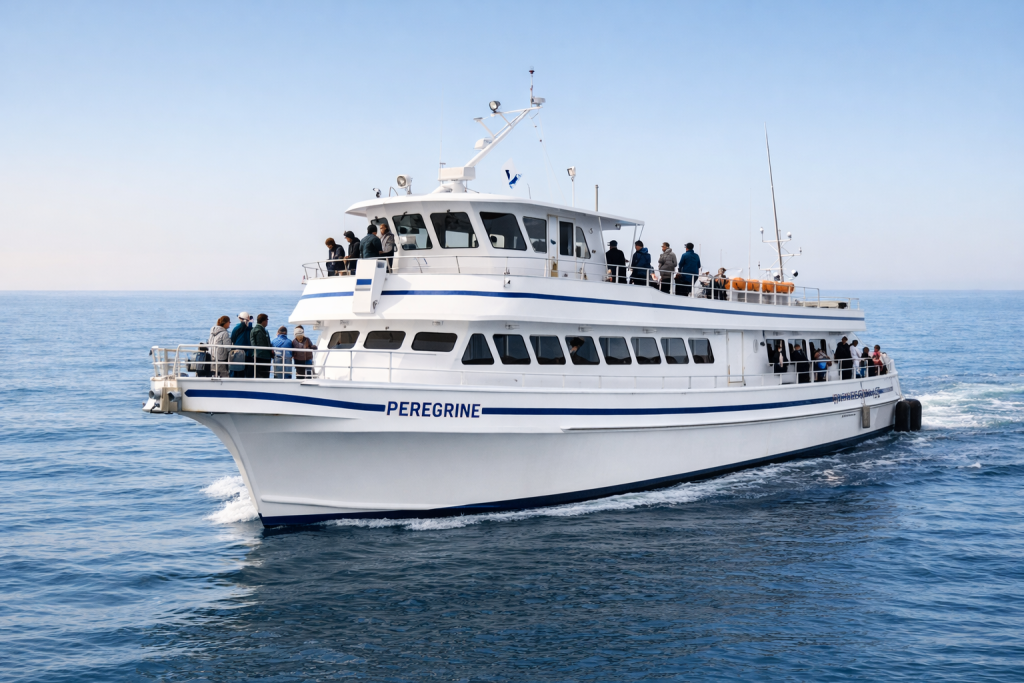
Wild Pacific Whale Watch operates the Peregrine, an 82-foot yacht with twin Tohmei anti-rolling gyro stabilizers, air-conditioned interior seating, a full galley, and a crew with over 40 years of combined experience in San Diego and Monterey Bay waters. Tours run three to three and a half hours year-round from H&M Landing near Shelter Island, minutes from San Diego International Airport. The experienced crew tracks real-time conditions and communicates with other operators on the water. The sightings log is updated regularly with current species activity.
Best for: Gray whales (December through April), blue whales (mid-May through September), humpbacks (year-round with peaks in fall and spring), ETP orcas (December through April and September through October)
Practical note: For private groups or those who want a dedicated departure time, private charter options are available. For visitors exploring the La Jolla coastline, tours pass directly through some of the most productive offshore waters in Southern California.
2. Dana Point
Dana Point holds two formal distinctions worth understanding before you book. It is the first Whale Heritage Site in the Americas, as designated by the World Cetacean Alliance, and carries the trademarked title of Dolphin and Whale Watching Capital of the World. Organized whale watching has operated out of Dana Point Harbor since 1971, longer than almost anywhere else in California.
Coastal canyons and large kelp beds sit within a mile of the shoreline, providing habitat that attracts cetaceans year-round. According to the World Cetacean Alliance, Dana Point has more dolphins per square mile than anywhere on Earth, and its Festival of Whales, held annually in March, is the longest-running whale festival in the United States.
Best for: Gray whales (November through May), blue whales (May through November), year-round dolphin activity
3. Monterey Bay
Monterey Bay is widely regarded among marine biologists as the most reliably productive whale watching location in California. The Monterey Submarine Canyon reaches depths of over two and a half miles at some points. It runs directly up to the shoreline, creating a cold, nutrient-dense upwelling that pulls enormous concentrations of krill and anchovies to the surface. In summer, humpback whales feed here by the hundreds.
Monterey Bay Whale Watch, led by marine biologist Nancy Black, owner and lead naturalist with over 30 years of experience studying the bay’s marine mammals, offers year-round departures from Fisherman’s Wharf. April and May represent the strongest window for orca sightings.
Best for: Humpbacks (April through December, peak summer), blue whales (July through October), gray whales (December through May), orcas (April through May most reliably)
4. Point Reyes National Seashore
Point Reyes is the premier land-based whale watching location in California. The peninsula extends roughly ten miles into the Pacific Ocean, placing shore-based observers significantly closer to migrating gray whales than virtually any other accessible point on the coast.
Studies cited by the National Park Service and the Golden Gate National Parks Conservancy indicate that 94 percent of migrating Pacific gray whales pass within one mile of the Point Reyes headlands. In January, peak southbound migration brings over 1,000 gray whales past this point on a single day. The National Park Service operates shuttle buses to the lighthouse during peak season due to visitor volume.
Best for: Gray whales from land (December through February southbound, March through May northbound), humpbacks (summer and fall offshore)
5. Channel Islands
The Channel Islands offer whale watching alongside one of the most biologically rich marine sanctuaries in North America. Of the 78 species of whales, dolphins, and porpoises documented globally, 29 have been recorded in the waters near the Channel Islands National Marine Sanctuary. In 2023, the Santa Barbara Channel received a Whale Heritage Site designation from the World Cetacean Alliance, one of only two such sites in the United States alongside Dana Point.
Tours depart from Ventura Harbor and Channel Islands Harbor in Oxnard. Island Packers offers winter gray whale cruises and summer blue whale and humpback departures, with the option to extend trips to land on Anacapa or Santa Cruz Island.
Best for: Gray whales (December through April), blue whales and humpbacks (summer), a diverse variety of species year-round
6. Los Angeles and Long Beach
The Los Angeles and Long Beach harbor area offers whale watching that is often overlooked by visitors focused on Monterey or San Diego. Deep offshore waters produce strong blue whale activity from June through October, and the gray whale migration passes close to the Palos Verdes Peninsula from December through mid-May.
Harbor Breeze Yacht Charters and Cruises operates from the Long Beach waterfront adjacent to the Aquarium of the Pacific. Point Vicente Interpretive Center on the Palos Verdes Peninsula provides one of Southern California’s best land-based vantage points for the gray whale migration.
Best for: Blue whales (June through October), gray whales (December through mid-May)
7. Santa Cruz
Santa Cruz sits at an underappreciated intersection of a deep submarine canyon and an accessible coastline. A mile-deep canyon sits directly offshore, creating cold-water upwelling that supports year-round marine life. Gray whales, humpbacks, and blue whales all pass through at different times of year alongside dolphins, sea otters, and harbor seals.
For a land-based option, the stretch of Highway 1 north toward Davenport offers accessible coastal bluffs at spots like Panther Beach and Hole in the Wall, where gray and humpback whales are visible from shore during migration months.
Best for: Gray whales (winter), humpbacks (spring through fall), year-round marine diversity
8. Newport Beach
Newport Beach is centrally located in Orange County, between Los Angeles and San Diego. It offers daily year-round departures from Newport Harbor. Newport Landing Whale Watching and Davey’s Locker each operate multiple trips daily from the Balboa Peninsula.
Year-round blue whale, gray whale, fin whale, humpback, and minke whale sightings are documented, alongside Pacific white-sided, bottlenose, Risso’s, and common dolphins. It serves as a practical alternative departure point for visitors based in Los Angeles or Orange County.
Best for: Year-round whale watching with convenient Southern California access
9. Mendocino
Mendocino is California’s northernmost accessible whale watching destination and one of the few places in the state where elevated coastal bluffs make shore-based viewing genuinely effective without a boat. The town sits on bluffs directly above the gray whale migration corridor.
Peak viewing from land runs from December through April for southbound and northbound gray whales. Point Arena Lighthouse, located about 15 miles south, offers one of the most dramatic land-based positions on the Northern California coast. Mendocino also hosts an annual whale festival each March with guided viewing sessions led by naturalists.
Best for: Land-based gray whale watching (December through April), humpbacks visible in spring and summer
10. Bodega Bay and the Sonoma Coast
The Sonoma Coast provides 55 miles of accessible shoreline along one of California’s least-visited whale watching regions. Bodega Bay’s Spud Point Marina offers charter departures, and Gualala Point Regional Park at the northern end features a viewpoint named Whale Watch Point on the bluffs above the Pacific.
Humpbacks are present along the Sonoma Coast in spring, summer, and fall. Mother-calf pairs traveling north in spring tend to stay closer to shore than southbound adults, making March through May particularly productive for nearshore viewing.
Best for: Gray whale migration (February through May), humpbacks (spring through fall), uncrowded land-based viewing
Planning Your California Whale Watching Trip
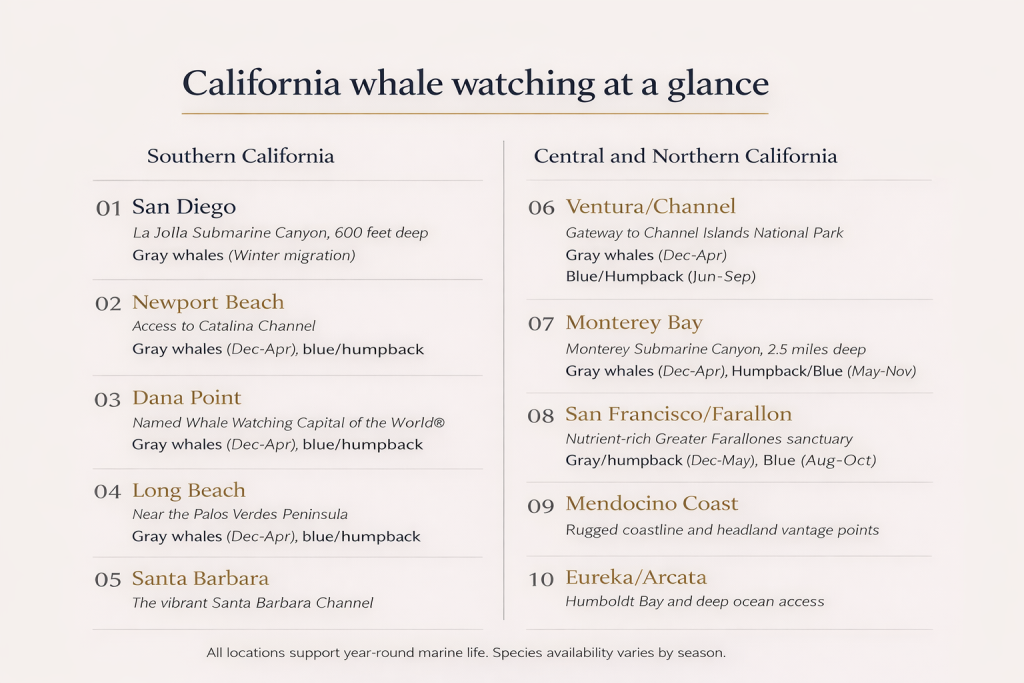
Gray whales anchor the winter and spring calendar across the full length of the coast. Blue whales take over offshore in summer. Humpbacks overlap both windows and extend into fall. The season you are traveling in shapes which location offers the most value.
Book in advance during gray whale migration (December through April) and peak blue whale season (June through August), as departures fill quickly. Morning departures generally offer the calmest sea conditions regardless of location. Review the Wild Pacific FAQ page for practical guidance on what to bring and what to expect on the water.
If you are considering San Diego as your base, Wild Pacific Whale Watch offers year-round tours with a naturalist aboard every departure. Contact the team to discuss timing, group size, and private charter availability.
Frequently Asked Questions
What is the best time of year for whale watching in California?
California offers whale watching year-round, but the best season depends on the species. Gray whale migration peaks from December through April along the full coast. Blue whales feed offshore from May through October, with June through August most productive. Humpback sightings span spring through fall. Planning around a specific species produces the most consistent results.
Which California location has the most whale species?
The Channel Islands area has documented 29 of the world’s 78 cetacean species in its surrounding waters, the highest recorded species diversity at any California whale watching destination. Monterey Bay is the most consistent for reliably large numbers of individual animals, particularly humpbacks in summer.
Is whale watching in California good for families?
Yes. Most tour operators run vessels suited for all ages, and the gray whale migration brings whales close enough to shore that land-based viewing from headlands works for children. San Diego’s protected harbor departure and the Peregrine’s gyro stabilizers make the boat ride accessible for guests prone to seasickness.
Do California whale watching tours operate in bad weather?
Most operators monitor sea conditions daily and will cancel or reschedule departures if conditions are unsafe. Wind and swell are the primary factors, not rain. Operators typically contact ticket holders in advance of any cancellation. Morning departures benefit from the calmest conditions of the day before afternoon winds build.
Do I need to book a tour, or can I watch from shore?
Both are viable. Point Reyes, Dana Point Headlands, Cabrillo National Monument at Point Loma in San Diego, Point Vicente on the Palos Verdes Peninsula, and the Mendocino bluffs all offer productive land-based viewing during gray whale migration. Boat tours produce closer encounters and access to offshore species like blue whales that rarely approach the shoreline.
Start Planning Your California Whale Watching Trip
California’s whale watching corridor runs the full length of the coast and delivers a different experience depending on the season, the species, and how close you want to get. Every location on this list has a legitimate case for being the right choice under the right conditions.
If you are basing your trip in San Diego, Wild Pacific Whale Watch runs year-round departures aboard the Peregrine from H&M Landing near Shelter Island, with a naturalist on every trip and a crew that has spent decades learning these waters. Contact the team to discuss timing, current sightings, and private charter availability.