Adventure whale watching in San Diego starts where the harbor cruise ends. Plenty of boats will take you in slow circles around the bay, point out a sea lion on a buoy, and call it a wildlife tour. If what you want instead is open ocean, a fast run to offshore feeding zones, and a blue whale surfacing close enough to hear the blow, you are looking for a different kind of trip.
San Diego supports that trip every day of the year. The migration routes of gray whales, blue whales, humpbacks, and fin whales all pass this coastline, and up to six species of dolphins live in or move through these waters. The raw material for a real adventure is here. The variable is the boat and crew you choose.
This guide explains what separates an adventure trip from a sightseeing loop, what you can encounter offshore in each season, and what “up close” honestly means on the water. If you would rather skip ahead, Wild Pacific Whale Watch runs daily offshore whale watching tours from H&M Landing, minutes from San Diego Airport.
What Counts as Adventure Whale Watching?
The phrase gets used loosely, so it helps to define it. An adventure trip is built around reaching wildlife, not around the route. That means leaving the bay, covering real distance to where whales are feeding or migrating, and spending the bulk of the trip with the animals rather than in transit.
Three things make that possible. First, a vessel fast enough to reach offshore zones and still leave time for viewing. Second, a crew that reads current conditions and recent activity rather than running a fixed loop. Third, enough hours on the schedule to let the ocean deliver. Trips with Wild Pacific run 3 to 3.5 hours, which is the window a genuine offshore search requires.
None of this requires you to be an adrenaline athlete. It requires a boat and a team built for finding wildlife. The adventure is the encounter itself.
Speed Is the Difference Between Transit and Wildlife Time
Every whale watching trip has a fixed length. The question is how much of it you spend getting somewhere and how much you spend watching animals. Vessel speed decides that split.
The Peregrine, the 82-foot yacht operated by Wild Pacific Whale Watch, cruises at 25 knots. That speed shortens the run to offshore feeding zones and converts transit minutes into viewing minutes. When a captain gets a report of blue whales several miles out, a fast vessel can act on it. A slow one watches the opportunity expire.
Speed also widens the search area. More water covered means better odds of finding active animals, especially on days when the wildlife is spread out. The crew tracks what has been encountered on recent trips, and you can preview that activity yourself in the sightings log before you book.
What You Can Encounter Offshore
San Diego runs on two headline seasons, with strong supporting wildlife in both.
Winter and Spring: The Gray Whale Migration
From December through April, thousands of gray whales pass San Diego on their migration between Arctic feeding grounds and the breeding lagoons of Baja California. NOAA Fisheries notes that gray whales are known for their curiosity toward boats, and their surface activity includes spy hops that bring their heads vertically out of the water. Humpback whales, fin whales, and minke whales appear through the same months.
Summer: Blue Whales Offshore
From mid-May through September, blue whales feed on krill in the waters off San Diego. These are the largest animals that have ever lived, reaching up to 100 feet in length and weighing up to 400,000 pounds. Watching one surface, blow, and arch into a dive is the kind of encounter that recalibrates your sense of scale.
Year-Round: Dolphins and Sea Lions
Up to six species of dolphins travel these waters, often in large, high-energy pods that ride the bow wake and surround the boat on their own initiative. Sea lions haul out around the bay and coastline in every month of the year. If pinnipeds interest you, the crew has written a full guide to sea lions in San Diego covering where and when to find them.
How Close Is Up Close?
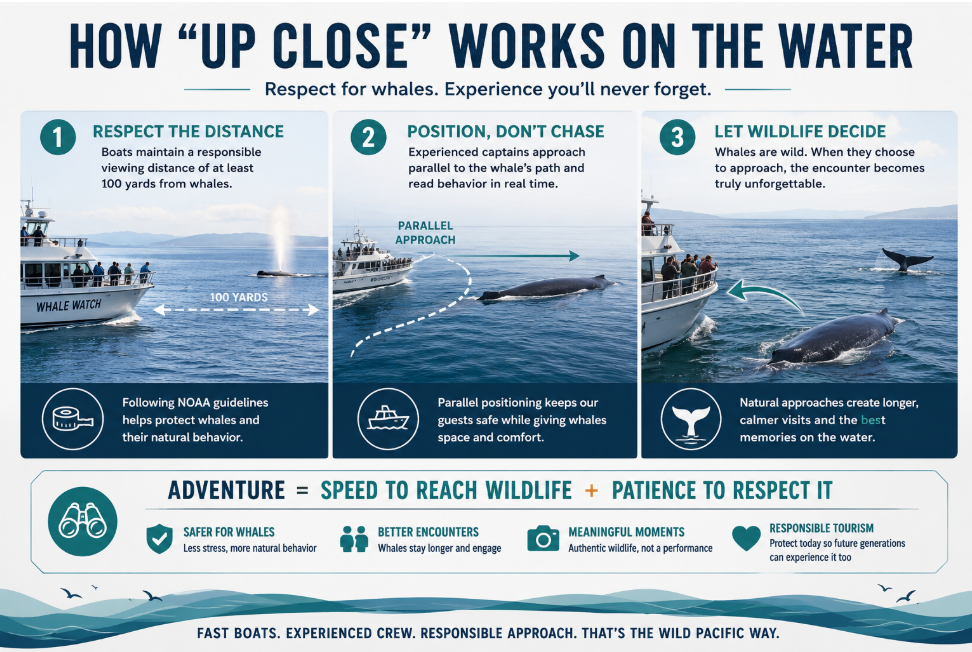
Here is the part most adventure marketing leaves out. Whales on the West Coast are federally protected, and NOAA guidelines direct vessels to stay at least 100 yards from whales, about the length of a football field, and to approach parallel rather than head-on or from behind.
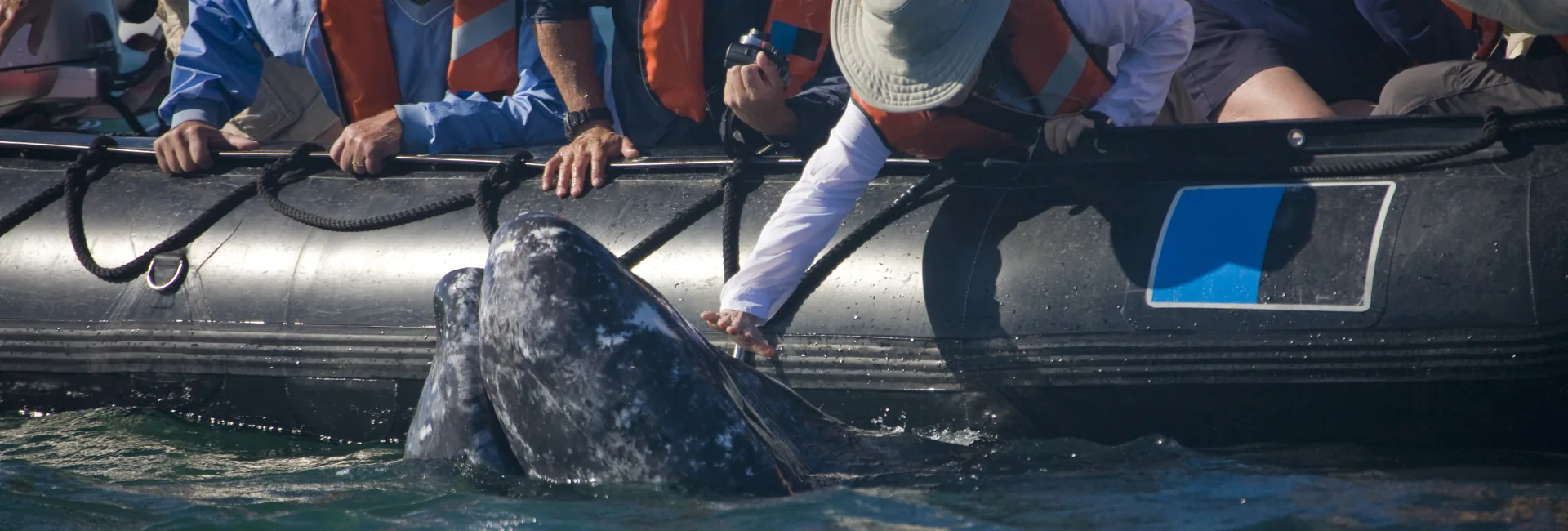
That might sound like it ruins the promise of an up-close encounter. In practice, it does the opposite. A responsible captain positions the boat at a respectful distance and lets the animals decide. Gray whales in particular are documented for their curiosity, and whales are known to close the gap with a quiet, well handled vessel on their own. There is no rule against a whale approaching you.
A whale that decides to come look at the boat gives you a better encounter than a chase ever could. It surfaces calmly, stays longer, and behaves the way whales behave when nothing is bothering them. And the distance matters less than people expect. A blue whale is 100 feet long. Even a full football field away, it fills your field of vision.
This is also where crew experience pays off. The Wild Pacific team brings over 40 years of combined experience from San Diego and Monterey Bay, and that background shows in how the boat is positioned, how long encounters last, and how much you learn while they happen. Their approach to wildlife and guests is laid out in what sets them apart.
Adventure Without the Rough Ride
Open ocean does not have to mean misery. The most common reason people avoid offshore trips is seasickness, and it is a solvable problem.
The Peregrine was recently refitted as a yacht and carries Tohmei anti rolling gyro stabilizers, a technology rare on whale watching vessels that dramatically reduces the rolling motion responsible for most seasickness. The rest of the vessel keeps the same priority: air conditioned indoor seating, cushioned lounges, clean bathrooms, and a full galley.
That combination matters for mixed groups. The thrill seeker in your party gets a fast offshore run and big animals. The cautious one gets a stable deck and a comfortable cabin to retreat to. Nobody has to sit the trip out, and that includes kids and grandparents.
Book Your San Diego Adventure
Adventure whale watching in San Diego does not depend on luck so much as on the right setup. Whales pass this coast in every season, six species of dolphins live in these waters, and the Peregrine covers the distance at 25 knots with a crew carrying four decades of combined experience. Behind all of it sits a guarantee. If you do not see a whale on your trip, your next trip with Wild Pacific is free.
Trips depart daily from H&M Landing near Shelter Island, just minutes from San Diego Airport. Book your adventure whale watching trip and get offshore this week, or reserve the Peregrine as a private charter if your group wants a fully customized route and schedule. Either way, the open Pacific is a short run from the dock, and something enormous is moving through it right now.
Frequently Asked Questions
What is adventure whale watching in San Diego?
Adventure whale watching is an offshore trip focused on reaching active wildlife rather than touring the bay. In San Diego, that means a fast run to feeding and migration zones where gray whales, blue whales, humpbacks, fin whales, and large dolphin pods are found. Wild Pacific Whale Watch runs these trips daily, year-round, lasting 3 to 3.5 hours.
How close do whale watching boats get to whales?
NOAA guidelines direct vessels on the West Coast to stay at least 100 yards from whales, roughly the length of a football field. Whales themselves sometimes approach a quiet, well-positioned boat much closer on their own, and there is no rule against an animal choosing to investigate you. Experienced captains rely on that curiosity rather than pursuit.
Is a high speed whale watching boat safe and comfortable?
Yes, speed and comfort are separate questions, and a well-built vessel delivers both. The Peregrine cruises at 25 knots for fast offshore access and carries Tohmei gyro stabilizers that sharply reduce rolling motion, plus air-conditioned indoor seating for anyone who wants a break from the deck.
Do I need to be physically fit or experienced for an offshore trip?
No special fitness or boating experience is required for an offshore whale watching trip. Passengers spend the trip on open decks or in indoor seating, and the crew handles everything else. Guests of all ages join these trips, from young kids to grandparents, and the stabilized vessel keeps the ride manageable for first-timers.
What whales can you see in San Diego right now?
Gray whales dominate San Diego waters from December through April, and blue whales take over from mid-May through September. Humpback, fin, and minke whales appear alongside both seasons. The Wild Pacific sightings log posts recent encounters so you can check current activity before booking.