
| Date | Season | Whale Sightings | Dolphin Sightings | Other Species |
| 6/11/2025 | Spring | 3 | 8 |
San Diego’s coastline is more than just sun, surf, and sealions—it’s part of a thriving marine corridor traveled by some of the ocean’s most iconic creatures. From the deck of our premier whale watching vessel, the view opens up to a world of spouts, splashes, and the occasional spectacular breach. Whether you’re scanning the horizon for migrating gray whales or witnessing the majestic spout of a blue whale, every trip offers something new.
As naturalists, we get to witness this ocean theater up close—and we love sharing it. San Diego is a year-round hotspot for cetaceans, from reliable regulars to rare and unexpected visitors.
Here’s a guide to the whales and dolphins you’re most likely to encounter off our coast—some familiar, some fleeting, but each one unforgettable.
Gray Whale (Eschrichtius robustus)
Season: December–April
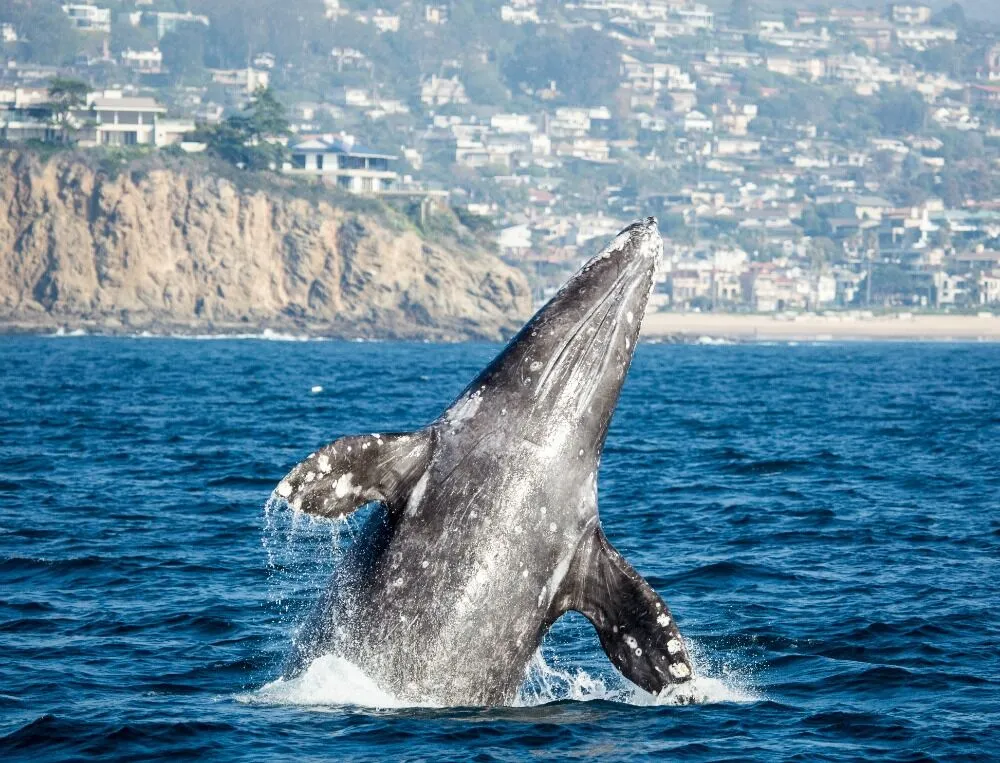
These friendly cetaceans make the longest migration compared to any mammal! They travel close to shore on their epic journey from the cold Arctic seas (summer feeding grounds) to the warm lagoons of Baja California (winter breeding grounds). We can see them each year during their northbound and southbound migration. Sometimes we’re lucky enough to see mother/calf pairs as they make their way back north!
Naturalist Note: Look for a heart-shaped spout and rhythmic up-down dives with their tail fluke waving goodbye.
Humpback Whale (Megaptera novaeangliae)
Season: Spring–Fall (sometimes year-round)
Humpback whales are well known for acrobatic breaches and soulful hymns. They love to put on a show. They often follow schools of baitfish, devouring thousands of anchovies at a time! We typically find them hanging out with dolphins, sea lions, and diving birds. Some of these feeding frenzies make us feel like we’re witnessing National Geographic in person.
Naturalist Note: Their long pectoral fins & distinct hump on the leading edge of their dorsal fin are easy ID clues.
Blue Whale (Balaenoptera musculus)
Season: May- September
Our summer love, the mighty blue whale is the largest mammal to have ever lived. They are larger than any dinosaur! San Diego is one of the best places in the world to find these gentle giants relatively close to the coast, usually found near areas with cold-water upwelling. Only 1% of the human population is lucky enough to ever witness these majestic cetaceans in their entire lifetime. Our blue whale friends return each summer to feast on krill. Seeing one is a humbling experience—their blow can reach 30 feet high!
Naturalist Note: Watch for a long, bluish-gray back that seems to go on forever.
Fin Whale (Balaenoptera physalus)
Season: Year-round mostly Spring
Second in size only to the blue, fin whales are fast, sleek, and elegant. They are the greyhounds of the sea. They can travel at speeds up to ~29 miles per hour! Although they’re less dramatic than humpbacks, their size and speed are awe-inspiring. Fin whales are found in oceans across the world but they love San Diego for our cool-temperate waters.
Naturalist Note: Asymmetric coloration—white lower jaw on the right side—is a unique feature.
Common Dolphin (Delphinus spp.)
Season: Year-round
A crew favorite is the boat-friendly common dolphin. These energetic dolphins travel in large pods, often leaping, bow-riding, surfing alongside our boat and putting on a show. It’s not uncommon to see hundreds at once. Just imagine witnessing a massive dolphin stampede! Common dolphins are small but speedy. They are one of the fastest dolphin species out there, traveling at burst speeds up to ~35 miles per hour.
Naturalist Note: Two species visit our waters—short-beaked and long-beaked—distinguished by length, rostrum shape, and behavior.
Bottlenose Dolphin (Tursiops truncatus)
Season: Year-round
Familiar from aquariums and movies—but here, they’re wild and free. Coastal bottlenose are often spotted near the surf zone, while offshore pods might show up during a trip.These guys are absolutely massive, weighing up to ~2500 lbs. Their top speed is about ~18 miles per hour.
Naturalist Note: Smart, social, and often curious—they sometimes swim alongside the boat for a closer look at us.
Risso’s Dolphin (Grampus griseus)
Season: Year-round but a rare sighting usually found once or twice a month
These ghostly dolphins are covered in white scars (from squid battles!), giving them a striking appearance. They earn their unique scaring and coloration over time. Older Risso’s are typically lighter in coloration with more white scars. When calves are first born they are dark gray. Each Risso’s dolphin has a unique pattern of scars sharing their life story of hunting squid! They prefer deep water and are less playful than other dolphins, but mesmerizing to watch.
Naturalist Note: That blunt, rounded head and tall dorsal fin are key identifiers.
Pacific White-Sided Dolphin (Lagenorhynchus obliquidens)
Season: Late Fall–Spring
Bold, beautiful, and full of energy, these dolphins show up in cooler months and love surfing alongside the boat. They can be found in mixed pods with common dolphins. They are a bit more elusive compared to common dolphins but we love seeing their unique bicolored dorsal fins and adorable stubby beaks!
Naturalist Note: Their distinct black-and-white coloring and tall dorsal fin make them easy to spot.
Occasional Visitors
Minke Whale – Small, fast, and shy. Seen year-round but tricky to spot. Smallest baleen whale that is part of the rorqual whale family.
Bryde’s Whale – Tropical cousin of the fin whale, occasionally seen in warmer months.
Orcas – Rare but thrilling. Usually transient pods on the hunt.
False Killer Whales – Show up during warm-water events like El Niño.
No matter the season, San Diego’s ocean is alive with possibility—and there’s no better way to experience it than out on the water with us. At Wild Pacific Whale Watch, we’re passionate about connecting people to the incredible wildlife just beyond our coast. Every trip offers a new encounter, a fresh perspective, and the chance to witness something unforgettable.
Whether you’re hoping to catch your first whale spout or you’re a seasoned marine mammal enthusiast, we’d love to welcome you aboard. Come join our team of expert naturalists and see what the Pacific has in store.