Burial at sea in Southern California means something different depending on who is asking. For some families, it means scattering cremated remains offshore in a private ceremony. For others, it means a traditional full-body sea burial, a practice governed by a separate and more demanding set of federal requirements. Both are legal along the Southern California coast, and both deserve a clear explanation before families begin planning.
The Cremation Association of North America reported that California’s cremation rate reached 72.4% in 2023, one of the highest in the nation. For the growing number of Southern California families who choose cremation, ocean scattering has become one of the most personally significant ways to complete that process.
Southern California’s coastline runs from the Mexican border north through San Diego, Orange County, Los Angeles, and into Ventura County. Each stretch of coast offers access to the open Pacific, but the departure points, vessel options, and local conditions vary considerably.
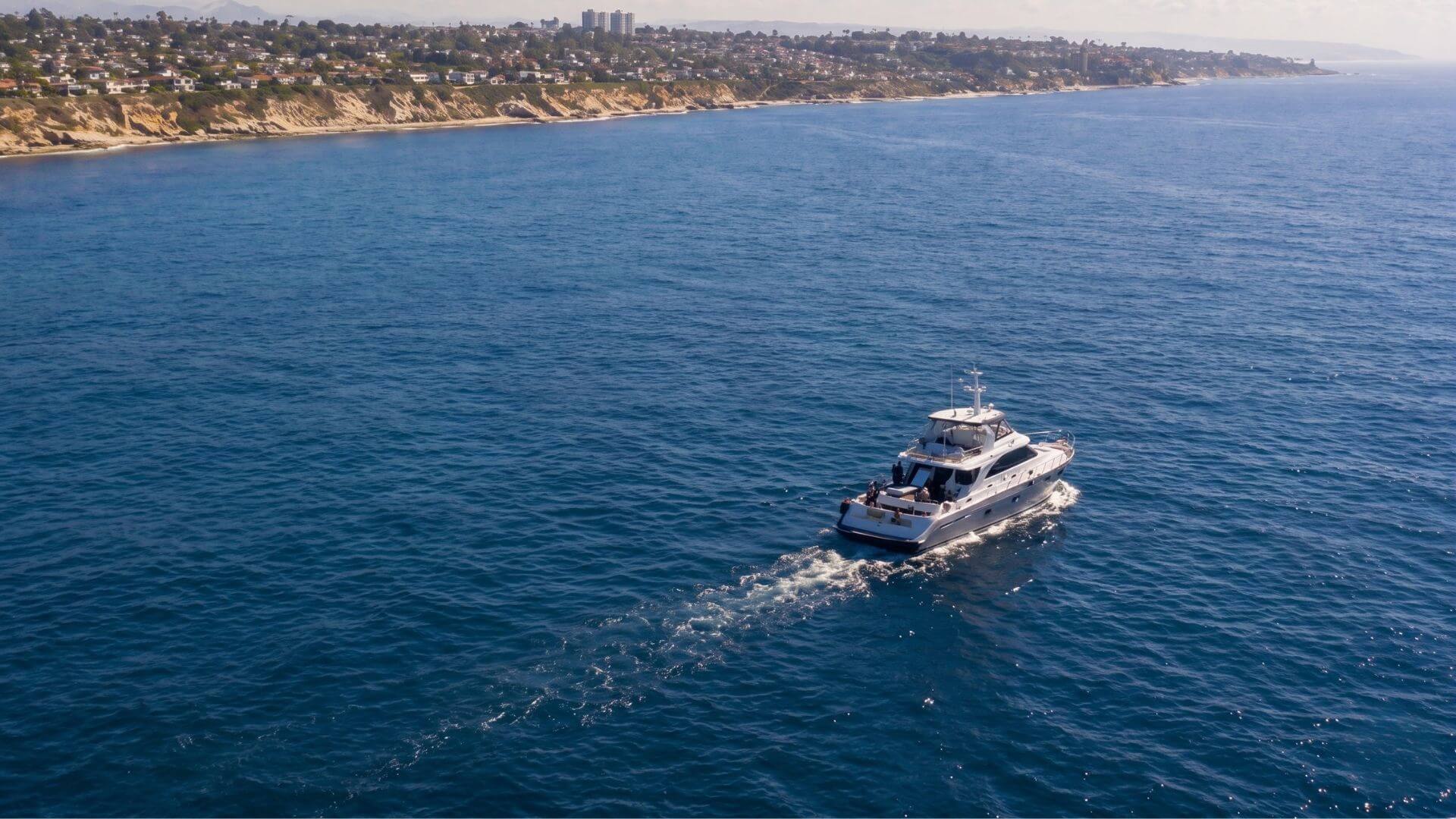
Wild Pacific Whale Watch operates private burial at sea and ash scattering services from H&M Landing in San Diego, serving families throughout the Southern California region aboard the Peregrine, an 82-foot Coast Guard-certified vessel with over 40 years of combined maritime experience on the crew.
Cremation Scattering vs. Full-Body Burial at Sea: Understanding the Difference
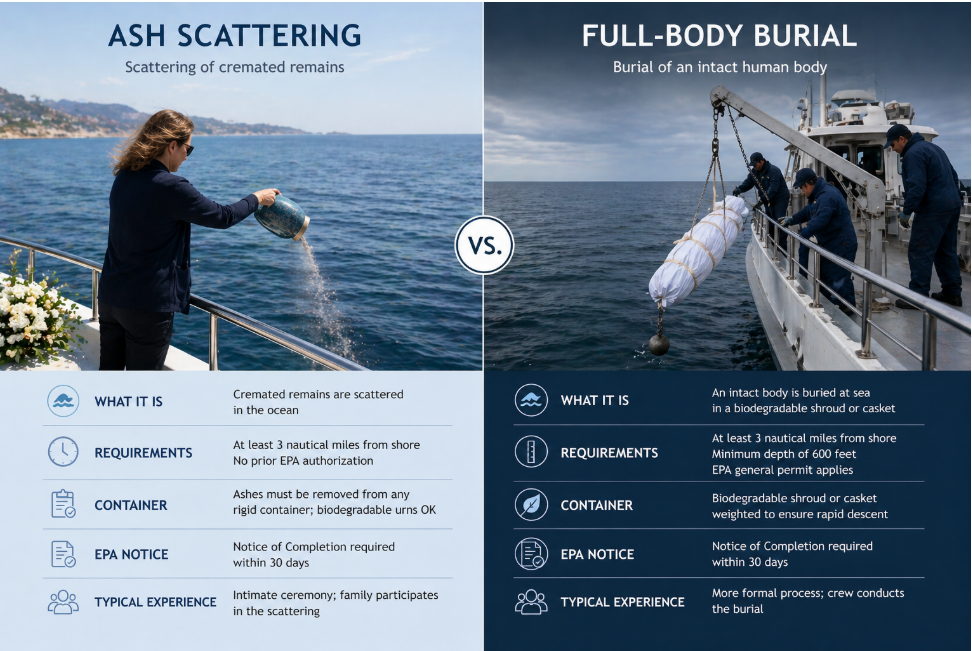
These two services are frequently conflated but are governed by entirely different legal frameworks, and their planning processes are distinct.
Ash Scattering at Sea
Scattering cremated remains offshore is the more common of the two and is subject to a simpler regulatory structure. Under the Marine Protection, Research, and Sanctuaries Act (MPRSA), cremated remains may be scattered at least three nautical miles from the nearest shoreline without prior EPA authorization.
California also requires a VS-9 Disposition Permit from the county health department before the ceremony. Following the scattering, families must file a Notice of Completion with the U.S. EPA within 30 days using the agency’s Burial at Sea Reporting Tool.
Full-Body Burial at Sea
A traditional burial at sea involving an intact body is substantially more regulated. Under 40 CFR 229.1, the EPA’s general permit under the MPRSA authorizes full-body burials at sea in ocean waters at least three nautical miles from shore and at a minimum depth of 600 feet. All measures must be taken to ensure that the remains sink rapidly and permanently, and that the container is biodegradable.
The 30-day EPA notice requirement applies here as well. Most charter operators in Southern California specialize in ash scattering rather than full-body interment; families seeking the latter should confirm the operator’s specific experience and licensing well before a planned ceremony date.
Why Southern California Is Well Suited for Burial at Sea
The Southern California coastline offers practical advantages that fewer coastal regions can match. The Pacific off San Diego, Los Angeles, and Ventura County is accessible year-round; winter storms that close ports in Northern California and the Pacific Northwest rarely prevent departures here.
Coastal temperatures range from 60 to 75 degrees Fahrenheit for most of the year, which matters for family members with health considerations or limited cold tolerance. The region’s major airports, San Diego International, Los Angeles International, John Wayne in Orange County, and Burbank in the San Fernando Valley, connect to most major U.S. cities with direct service.
For a ceremony that may draw relatives from across the country, that access removes one layer of complexity from an already demanding process.
The marine environment itself adds context that many families find meaningful. Depending on the season, dolphins, sea lions, gray whales, and blue whales share these waters with the vessels conducting ceremonies. These encounters are incidental, but families who experience them consistently describe them as among the most affecting parts of the day.
Burial at Sea Departure Points Along the Southern California Coast
San Diego
San Diego offers the most developed infrastructure for private burial-at-sea services in Southern California. H&M Landing in Point Loma is the primary departure point for most operators, including Wild Pacific Whale Watch.
The passage from the harbor to three nautical miles offshore is calm by most Southern California standards, and the location sits approximately four miles from San Diego International Airport.
The Peregrine departs from H&M Landing year-round and is fitted with twin Tohmei anti-rolling gyro stabilizers, a technology found on fewer than a handful of U.S. charter vessels, which reduces vessel motion significantly on the open ocean.
For families bringing elderly guests or anyone prone to seasickness, this matters considerably. For a detailed look at vessel options, the ceremony experience, and permit logistics specific to San Diego, the guide to ash scattering in San Diego covers all that ground.
Los Angeles and Orange County
Los Angeles area departures typically operate from Marina del Rey, San Pedro, or Long Beach Harbor.
Orange County services generally depart from Dana Point or Newport Beach. These locations offer access to the open Pacific within a similar transit window to San Diego, though harbor conditions and offshore swells vary more than they do along the protected Point Loma channel.
Vessel quality and crew experience vary considerably across operators in this corridor, and families should verify Coast Guard certification, CRD licensing, and permit handling before booking.
Ventura and Santa Barbara Counties
The northern edge of Southern California, including Ventura Harbor and the waters of the Santa Barbara Channel, offers a quieter departure environment. The Channel Islands lie within reach of these ports, providing a distinctive offshore backdrop for families who want a more remote setting for the ceremony.
Choosing a Burial at Sea Operator in Southern California
Not every charter company operating in Southern California is equipped or licensed to provide burial-at-sea services. When evaluating options, families should confirm each of the following before booking.
The operator should hold a Cremated Remains Disposer (CRD) license issued by the California Cemetery and Funeral Bureau. This is a state-specific credential required for any business in California that handles and disposes of cremated remains. Any operator who cannot confirm a current CRD license should not be handling cremated remains in California.
The captain should carry a U.S. Coast Guard Merchant Marine Officer certification, and the vessel should be Coast Guard-documented and inspected for the number of passengers it will carry. Liability insurance should be current and available on request.
The operator should manage the acquisition of the VS-9 permit and the filing of the EPA notice on the family’s behalf. Families who are asked to handle these requirements themselves are dealing with a service that is not fully equipped for memorial work.
Wild Pacific Whale Watch holds all required credentials, manages all permit and filing requirements, and has conducted memorial services for families across Southern California from its base at H&M Landing in San Diego. A full account of what sets the vessel and crew apart is available on the What Sets Us Apart page.
What a Private Burial at Sea Ceremony Involves
Before the Day
Preparation begins with permit acquisition. Wild Pacific Whale Watch handles the VS-9 permit and coordinates the post-ceremony EPA filing.
Families are responsible for providing the original death certificate and confirming whether they want an attended ceremony with family aboard or an unattended service conducted by the captain on the family’s behalf.
Families combining the ceremony with a land-based reception can find waterfront venue options in the guide to celebration of life venues in San Diego.
On the Water
Boarding takes place at H&M Landing. The Peregrine transits through San Diego Bay before heading to the open ocean. At the scattering site, the captain positions the vessel relative to wind direction, and the ceremony proceeds according to the family’s wishes. Readings, music, prayers, and floral tributes are all accommodated. There is no imposed format and no timeline pressure on a private charter.
Wild Pacific Whale Watch records GPS coordinates and issues a Memorial Certificate that documents the date, time, and location of the ceremony, providing families with a permanent record of where the scattering took place.
After the Ceremony
The EPA Notice of Completion must be filed within 30 days. Wild Pacific Whale Watch manages this on behalf of every family. Families who use the private charter option for a larger group will also receive any photography documentation arranged in advance.
Planning a Southern California Burial at Sea: Key Considerations
Families should allow at minimum one week of lead time for permit processing and vessel scheduling. Morning departures are recommended across all Southern California ports; offshore conditions are typically calmer in the first half of the day.
Group size determines vessel requirements. The Peregrine accommodates groups ranging from a handful of family members to large gatherings, with accessible lower-deck seating for guests with mobility limitations.
All materials placed in the water must be fully biodegradable. Fresh flowers, biodegradable paper, and water-soluble urns are acceptable. Plastic, foam, wire, and synthetic materials are prohibited under EPA marine protection regulations.
For detailed answers to logistics questions, the FAQ page covers weather policies, what to bring, accessibility, and what happens if conditions require rescheduling.
Begin Planning with Wild Pacific Whale Watch
Southern California families arranging a burial at sea have more options today than at any previous point. The range of departure ports, vessel types, and service formats means that geography, group size, and budget can all be accommodated. What does not vary is the importance of choosing an operator with the credentials, experience, and care that a memorial at sea requires.
Captain John Mayer and Chief Operations Officer Britt Simon founded Wild Pacific Whale Watch on the principle that every trip offshore deserves the same standard of preparation and respect, whether it is a wildlife charter or a family’s final farewell.
Whether your family is departing from San Diego or traveling from elsewhere along the Southern California coast, that standard is what every ceremony aboard the Peregrine reflects.
Contact the team to discuss dates, service formats, and ceremony details.
Frequently Asked Questions About Burial at Sea in Southern California
What is the difference between ash scattering and burial at sea in California?
Ash scattering involves dispersing cremated remains at least three nautical miles offshore and requires a VS-9 state permit plus an EPA notice filed within 30 days. A full-body burial at sea under 40 CFR 229.1 requires the remains to be interred at a minimum depth of 600 feet and at least three nautical miles from shore, with the same 30-day EPA notice. Most Southern California charter operators specialize in ash scattering rather than full-body interment.
How far from shore must remains be placed in Southern California?
Federal law under the MPRSA requires both ash scattering and full-body burial to occur at least three nautical miles from the nearest shoreline. This rule applies uniformly along the entire Southern California coastline from San Diego to Ventura County.
What licenses should a Southern California burial at sea operator hold?
Operators should hold a California Cremated Remains Disposer (CRD) license, U.S. Coast Guard Merchant Marine Officer certification for the captain, current Coast Guard vessel documentation, and comprehensive liability insurance. Families should confirm all four before booking.
Can I arrange a burial at sea from Los Angeles or Orange County instead of San Diego?
Yes. Operators depart from Marina del Rey, San Pedro, Dana Point, and Newport Beach, among other ports. Wild Pacific Whale Watch operates from H&M Landing in San Diego and serves families traveling from across Southern California. Families based in Los Angeles or Orange County should carefully verify operator credentials, as service quality and licensing vary considerably across the corridor.
Can a family member who cannot travel still arrange a ceremony?
Yes. Unattended ash scattering services allow a licensed captain to conduct the ceremony offshore without family present. Wild Pacific Whale Watch provides the family with a Memorial Certificate containing GPS coordinates and full documentation after every unattended service.
How long does a private burial at sea charter typically take?
Most private ash scattering charters from H&M Landing in San Diego run between 1.5 and 2 hours from departure to return, including transit to and from the scattering site. Larger groups or ceremonies with additional elements may run slightly longer. Wild Pacific Whale Watch provides timing estimates when families book.