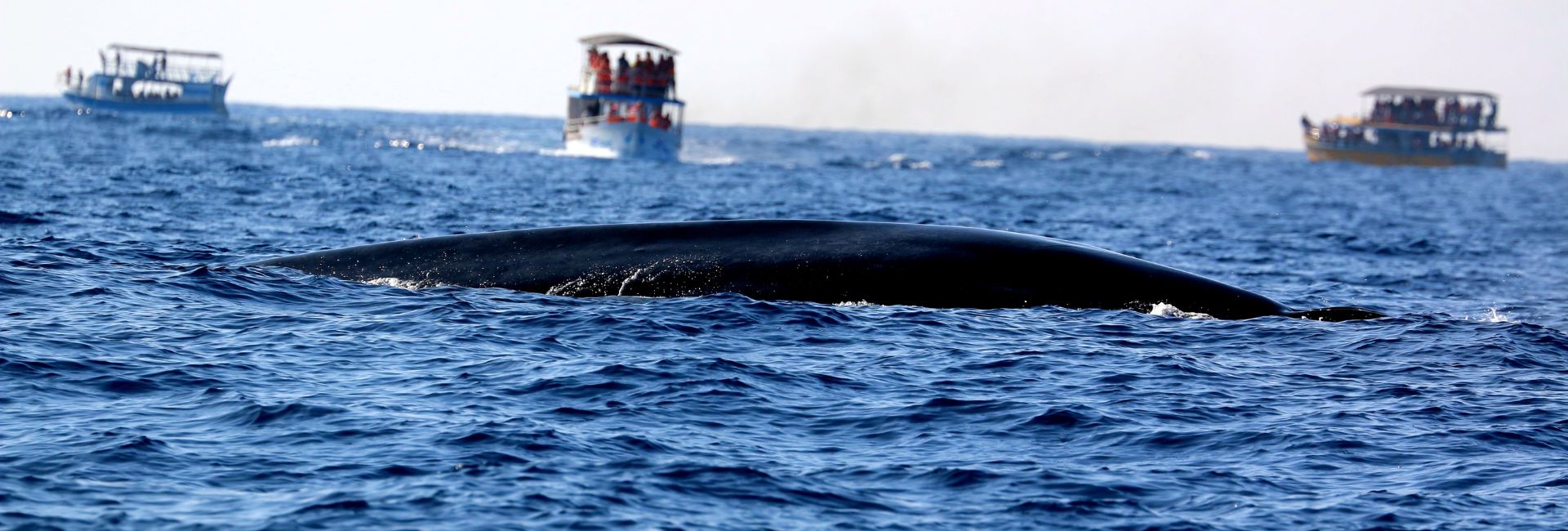
The best place for blue whale watching in the United States is the California coast. A blue whale can reach 100 feet and weigh as much as 400,000 pounds, and there are only a handful of places on Earth where you can reliably see one. Most of them line the U.S. West Coast.
Every summer, blue whales leave their winter grounds off Mexico and Central America and head north to feed on the krill that blooms along the California coast, staying into the fall. A whale that size has to eat enormous amounts of krill each day, and California’s summer waters produce it in the density that makes the long trip worth it. For a few months, these giants feed within a boat ride of San Diego, Santa Barbara, and Monterey.
This guide compares California’s top blue whale locations, explains what makes a spot worth the trip, and makes an honest case for where to go. Wild Pacific Whale Watch runs daily whale watching tours out of San Diego, so once you have settled on a destination, getting on the water is the simple part.
What Makes a Place Good for Blue Whale Watching?
A location is only as good as the odds it gives you, and four things decide those odds.
- The feeding population has to show up reliably, not as a rare stray but as a seasonal pattern you can plan around.
- The whales need to feed close enough to reach on a half-day trip rather than an overnight expedition.
- The season should be long enough that a single trip during your visit has a real chance of working.
- The place needs the right boats and crews, because a productive feeding ground is useless if you cannot get to it or do not know what you are looking at.
California clears the first three across several locations. The fourth comes down to the operator you choose, which is where the locations start to diverge.
Why California Is One of the World’s Most Reliable Blue Whale Destinations
California’s coastline aligns with the summer feeding grounds of the eastern North Pacific blue whale, the best-studied population of the species. NOAA Fisheries describes these whales as the largest animals ever to live, with the biggest individuals eating up to six tons of krill a day. A 2021 study of the same population estimated daily intake during the foraging season at close to 16 metric tons, which helps explain why these whales travel so far to reach California’s krill.
According to the Marine Mammal Center, blue whales concentrate their California feeding around the Channel Islands, Monterey Bay, and the Farallones, with San Diego among the reliable spots farther south. Those waters are among the most dependable blue whale feeding grounds on the West Coast, which makes California the standout choice for seeing one in the United States.
Comparing California’s Top Blue Whale Locations
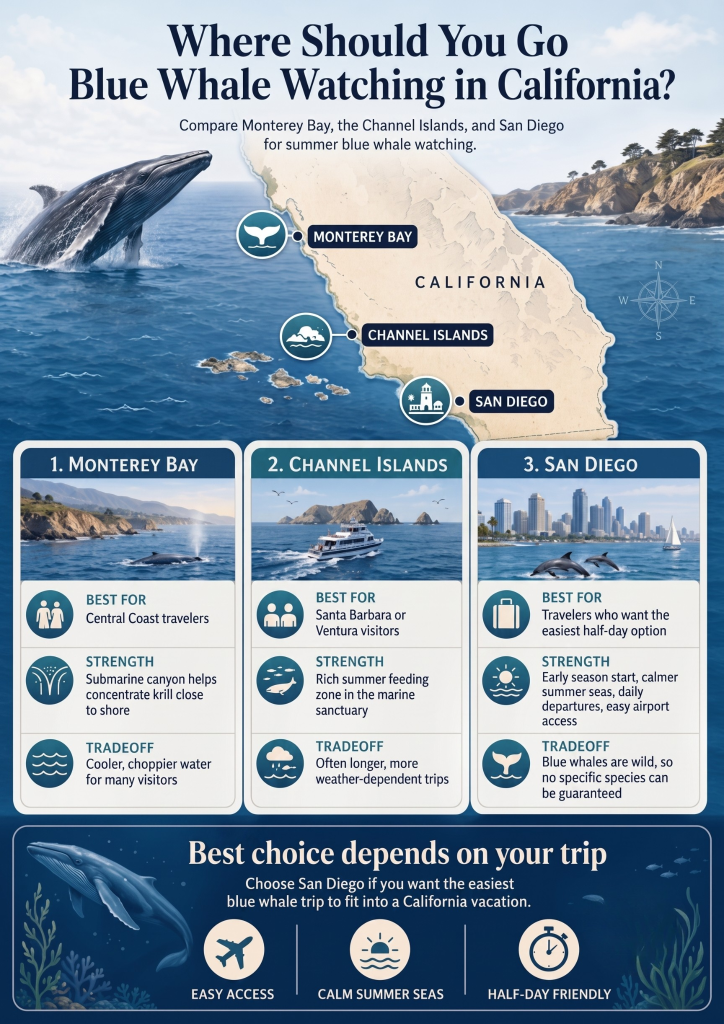
These locations are not ranked, because the best one depends on where you are starting from and what kind of trip you want. Here they are from north to south.
Monterey Bay
The Monterey Submarine Canyon, one of the deepest off North America, funnels cold, nutrient-rich water close to shore and concentrates krill within a short run of the harbor. That geography makes Monterey one of the most productive blue whale feeding areas in the state, with a season that runs through summer and into fall.
The tradeoff is climate and distance. The water tends to run cooler and choppier than Southern California, and for most travelers Monterey is a destination in its own right, several hours north of San Diego. If you are already on the central coast, it is hard to beat.
The Channel Islands
The waters around the Channel Islands, reached from Santa Barbara and Ventura, draw blue whales to the krill that gathers in the channel each summer. The marine sanctuary surrounding the islands is one of the richer feeding zones on the West Coast, and trips here can pair blue whales with other large whales.
Island runs are longer, though, often full-day outings, and departures depend more on weather. For visitors based near Santa Barbara who want a longer expedition, the extra time on the water pays off.
San Diego
San Diego sits at the southern end of the eastern North Pacific feeding range, and the blue whale season here opens around mid-May. The bigger draw for most visitors is access. Trips leave from H&M Landing near Shelter Island, minutes from San Diego International Airport, which turns a blue whale outing into something you fold into a normal visit rather than a trip you build a vacation around.
Summer also brings the calmest, sunniest sea conditions of the year along this coast, which matters more than people expect on an offshore trip. The wildlife reaches well past blue whales, too. Fin whales, the second largest animal on the planet, feed in the same summer waters, and up to six species of dolphins travel the area in large pods year-round. You can see what recent trips have encountered in the sightings log.
San Diego operators also run trips daily, year-round, so the schedule bends to yours rather than the other way around. The crew at Wild Pacific Whale Watch has worked the waters of both San Diego and Monterey Bay across more than 40 years of combined experience, which is part of why this comparison can be honest rather than a sales pitch. Their background is laid out in what sets them apart.
How to Choose and Plan Your Blue Whale Trip
Start with access, because the best place for blue whale watching is partly the one you can realistically get to. If you are based in or flying into San Diego, the short run to the dock and the early season start make it an easy choice. If you are on the central coast, Monterey is right there.
Then weigh the boat, which decides how much of the day you spend with whales. The Peregrine, the 82-foot yacht operated by Wild Pacific, cruises at 25 knots, reaching the offshore feeding zones faster and leaving more of the 3- to 3.5-hour trip for viewing.
Open water can also make a trip uncomfortable, so the vessel carries Tohmei anti-rolling gyro stabilizers that sharply reduce rolling and help prevent seasickness, as well as air-conditioned indoor seating. You can see how the vessel is set up for long offshore runs.
Finally, plan around the season. Blue whales feed off California from roughly mid-May through September, so a summer trip gives you the strongest odds wherever you go.
Book Your Blue Whale Watching Trip in San Diego
California is the answer for where to watch blue whales, and within it, San Diego offers the rare combination of an early-season start, easy access, calm summer seas, and a fast, stable boat with a seasoned crew. For a traveler who hopes to see a blue whale for themselves without building a whole vacation around it, that is a strong place to start.
Wild Pacific Whale Watch departs daily from H&M Landing near Shelter Island, minutes from the airport, and backs every trip with a guarantee: if you do not see a whale, your next trip is free. Book your blue whale watching tour and see what the season has brought in this week.
Frequently Asked Questions
Where is the best place to see blue whales in California?
California’s most reliable blue whale locations are the Channel Islands, Monterey Bay, the Farallones, and San Diego, all along the summer feeding range of the eastern North Pacific population. The best one for you depends on access and the kind of trip you want. San Diego stands out for its early start to the mid-May season and its proximity to a major airport.
Is San Diego or Monterey better for blue whale watching?
Both are excellent, and neither is objectively better, since they suit different trips. Monterey’s deep submarine canyon brings krill very close to shore and is famously productive, though the water runs cooler and the city is a destination in its own right. San Diego offers easier access, calmer summer seas, and an early season, which makes it the simpler choice for most visitors flying in.
When is blue whale season in California?
Blue whales feed off the California coast from roughly mid-May through September, peaking in summer. San Diego, the southernmost of the major California spots, tends to see the season open around mid-May. This is separate from gray whale season, which runs December through April.
Can you see blue whales from shore?
Blue whales are very rarely visible from shore because they feed in offshore waters where krill is concentrated. Seeing one almost always requires a boat capable of reaching the feeding zones several miles out. A faster vessel spends less of the trip in transit and more of it near the whales.
Are blue whale sightings ever guaranteed?
No operator can guarantee a specific species, because blue whales are wild animals that follow their food. Wild Pacific Whale Watch does guarantee a whale sighting, though, and if you do not see one, your next trip is free. Booking during the summer peak gives you the best odds of a blue whale specifically.