
Most first-time visitors to San Diego run the same script — the Zoo, SeaWorld, the beach, maybe Balboa Park — and leave without realizing they saw a fraction of what the city offers. That’s not a knock on those spots; it’s just volume. San Diego pulled in roughly 32.5 million visitors in 2024, an 8.3% increase over 2023, and that much foot traffic naturally funnels everyone toward the same handful of headline attractions.
A meaningful share of the city’s best experiences sit just outside that funnel — some tucked inside places like Balboa Park that most visitors only see the busy corners of, and some literally offshore, invisible unless you get on a boat.
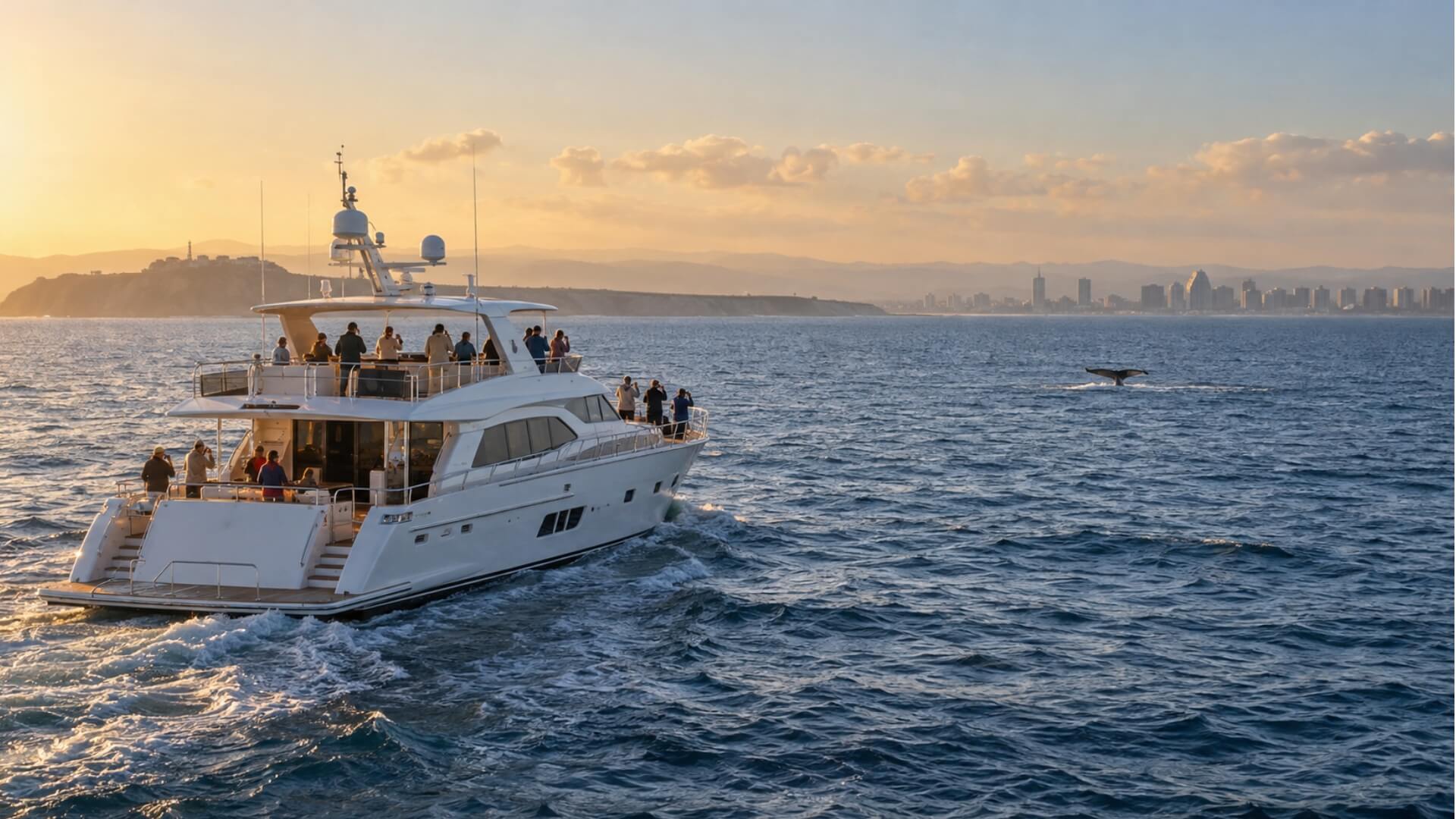
We run one of those offshore experiences daily at Wild Pacific Whale Watch, departing from Shelter Island, and it’s a good case study in how San Diego’s most distinctive experiences usually aren’t secret — they’re just underused compared to how good they are.
The Misconception Worth Correcting
“Unique” Doesn’t Have to Mean Hard to Reach
Travelers tend to assume distinctive experiences require real effort — a long drive, insider knowledge, advance planning. In San Diego, that’s often untrue.
The Spreckels Organ Pavilion in Balboa Park houses the world’s largest outdoor pipe organ, and the City of San Diego and the Spreckels Organ Society have hosted free public concerts there every Sunday at 2 p.m. since 1917, rain or shine, with no ticket or reservation required. It sits a short walk from the crowds at the Zoo, and most Zoo visitors never hear it.
Wildlife-Watching Belongs in the “Underrated” Category Too
The same pattern holds offshore. Most visitors don’t realize San Diego sits directly on a major marine mammal migration corridor. According to NOAA Fisheries, gray whales are known for their curiosity toward boats in some locations and are a central focus of whale watching and ecotourism along the west coast of North America — meaning this isn’t a niche activity for wildlife obsessives, it’s a mainstream draw that simply doesn’t get the marketing budget of a theme park.
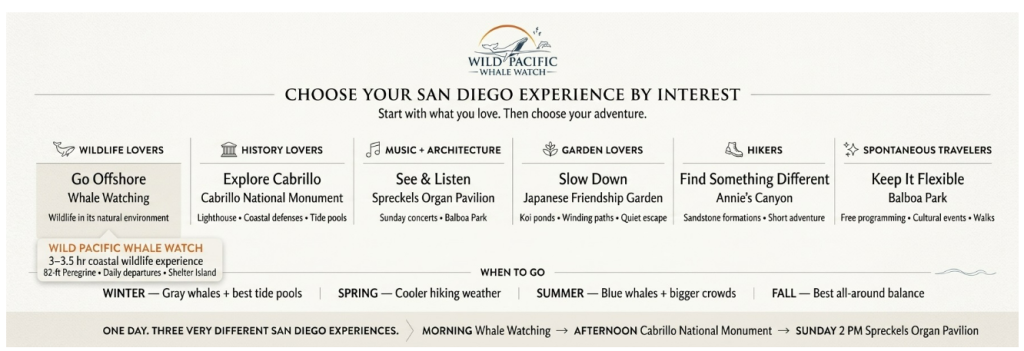
Choose Your San Diego Experience by Interest
Rather than treating San Diego’s lesser-known attractions as one long, undifferentiated list, it helps to start from the kind of experience you actually want and work backward.
For Wildlife Lovers: Go Offshore
A whale-watching trip is built around observing animals in their natural environment, not behind glass or in a managed enclosure — the entire draw is that nothing about the encounter is staged.
For History-Minded Travelers: Cabrillo National Monument
Cabrillo, on the southern tip of Point Loma, combines the Old Point Loma Lighthouse, coastal defense installations, and small museums with sweeping Pacific views and its own whale-watching overlook, blending maritime and military history in one stop. The National Park Service also highlights the monument’s tide pools as one of the richest ways to experience a rocky intertidal ecosystem, with sea stars, anemones, and crabs visible during the right low tides.
For Music and Architecture Enthusiasts: Spreckels Organ Pavilion
The Sunday 2 p.m. concerts at Balboa Park’s Spreckels Organ Pavilion require essentially no planning — just showing up — making it one of the lowest-effort, highest-payoff unique experiences in the city.
For Garden Lovers: The Japanese Friendship Garden
A slower, more contemplative counterpoint to Balboa Park’s busier museum row, with koi ponds and winding paths that reward an unhurried visit.
For Hikers Wanting Something Different: Annie’s Canyon
The narrow, sculpted sandstone formations of Annie’s Canyon in Solana Beach feel more like a slot-canyon hike in the Southwest than a typical coastal trail — a genuinely different texture from San Diego’s usual beach-and-bluff hikes.
For the Spontaneous Traveler
If committing to a full-day, ticketed attraction isn’t appealing, Balboa Park’s broader free programming — organ concerts, cultural events, and ranger-led or horticultural walks — offers several ways to experience the city without locking in a major plan ahead of time.
The advantage of sorting experiences this way, rather than by neighborhood or by “top 10” ranking, is that it lets you choose based on what you actually want to feel or discover on a given day.
When to Go: An Honest Seasonal Breakdown
Several of these experiences have real timing considerations worth knowing before you build an itinerary around them.
Winter: Best for Both Whales and Tide Pools
December through April is peak gray whale season, when over 20,000 California gray whales migrate along the coast, with January and February producing the highest concentration of sightings. Convenient timing: the National Park Service recommends fall and winter specifically for Cabrillo’s tide pools too, since the lowest daylight tides occur during those months — in spring and summer, the tide typically stays high enough to cover the pools during park hours, and the extreme low tides that do occur happen after dark.
Spring: Cooler Days for Exposed Trails
Spring offers milder temperatures for hikes like Annie’s Canyon, where the narrow, sun-exposed rock sections are far more comfortable to navigate before summer heat sets in.
Summer: Blue Whales, But Bigger Crowds Everywhere
From roughly mid-June through September, blue whales — the largest animals ever to have lived, reaching up to about 100 feet — feed off the San Diego coast, with June and July the strongest months. It’s also the city’s busiest season; July and August alone bring roughly 4.0 million and 3.8 million visitors respectively. This is exactly when the Spreckels Organ Pavilion, the Japanese Friendship Garden, and similar lower-profile spots pay off most, since they see a fraction of the traffic hitting the Zoo and SeaWorld.
Fall: The Best All-Around Window
Fall combines warm weather, thinner crowds, and daylight low tides at Cabrillo, making it arguably the strongest single season for stacking a boat trip with several land-based stops in one visit.
What Wild Pacific Whale Watch Offers
A Different Kind of San Diego Outing
Wild Pacific operates the Peregrine, an 82-foot vessel recently refitted with Tohmei anti-rolling gyro stabilizers that noticeably smooth the ride and reduce seasickness. Trips run 3 to 3.5 hours and depart daily from H&M Landing near Shelter Island, a working charter dock operating since 1935 — giving the trip an authentic working-harbor feel rather than a manufactured attraction one.
Where the Expertise Shows Up
Our owner-operators bring over 40 years of combined experience running whale-watching operations between San Diego and Monterey Bay, two of California’s premier wildlife-viewing regions. That experience matters most in the parts guests don’t see — reading conditions and positioning the boat — tracked openly through our sightings log.
Being Honest About the Tradeoff
Unlike a museum or a garden, a wildlife trip can’t promise a fixed outcome — that unpredictability is part of what makes it feel genuinely unique, but it also means managing expectations honestly. No operator can guarantee a specific sighting on a specific day, so Wild Pacific backs its trips with a guarantee: if you don’t see a whale, your next trip is free.
What to Expect Beyond the Headline Sighting
The Parts Most People Don’t Anticipate
Dolphins are visible in San Diego’s waters essentially every month of the year and frequently ride the boat’s wake — often the moment that draws the loudest reaction on board, whale sighting or not. Sea lions near the harbor mouth, coastal seabirds, and skyline views of the Coronado Bridge round out a trip that rarely feels like waiting for one single thing to happen.
Stacking a Full Day Around It
A morning boat trip pairs naturally with an afternoon at Cabrillo National Monument for the lighthouse, coastal defenses, and — depending on the season — the tide pools. On a Sunday, timing an afternoon around the Spreckels Organ Pavilion’s 2 p.m. concert adds a completely different kind of experience to the same day at essentially no extra cost.
Doing It Responsibly Because the Rules Improve the Experience
Federal guidelines require boats to maintain distance from whales, and that requirement is also, practically, what produces the calmest and most natural sightings. NOAA Fisheries recommends staying at least 100 yards from large whales and limiting observation time to 30 minutes or less, detailed in its marine life viewing guidelines.
The same principle extends to Cabrillo’s tide pools: the National Park Service asks visitors not to collect rocks, shells, or marine life, since the protected rocky intertidal zone stays rich specifically because visitors leave it undisturbed. In both cases, the restraint is what keeps the experience worth having in the first place.
Planning the Trip: Booking and Logistics
A few practical notes before building a day around these stops:
- Book whale-watching dates 1–2 weeks ahead during peak season (December–April), especially winter weekend mornings.
- Check the tide chart before visiting Cabrillo’s tide pools — aim for a tide of 0.7 feet or lower, ideally in fall or winter, during daylight park hours.
- No booking needed for the Spreckels Organ concerts — just arrive by 2 p.m. on a Sunday.
- Dress in layers for the boat trip. Ocean wind runs 10–15 degrees cooler than shore temperature.
- Arrive 20–30 minutes early for parking near H&M Landing on Shelter Island.
- Pair the boat trip with one land-based stop, not several — Cabrillo, the Japanese Friendship Garden, or Annie’s Canyon each deserve unhurried time rather than a rushed drive-by.
Check current departure times, pricing, and availability at wildpacificwhalewatch.com, by phone at 619-821-8205, by email at info@wildpacificwhalewatch.com, or in person at 2803 Emerson St., San Diego, CA 92106.
Frequently Asked Questions
How do I decide which of San Diego’s unique experiences to prioritize?
Start with what you actually want to feel, not a ranked list — wildlife lovers should head offshore, history-minded travelers should go to Cabrillo National Monument, and anyone wanting something spontaneous can lean on Balboa Park’s free Sunday programming. Matching the experience to your interest tends to produce a better day than checking off a generic top-10.
When is the best time to see both whales and Cabrillo’s tide pools on the same trip?
Winter works well for both — gray whale sightings peak in January and February, and the National Park Service recommends fall and winter for Cabrillo’s tide pools because the lowest tides occur during daylight park hours in those months.
Do I need reservations for the Spreckels Organ Pavilion concerts?
No — the concerts are free and open to the public every Sunday at 2 p.m., with no ticket or reservation required, though donations are welcome.
Is whale watching really considered “unique,” or is it just another tourist activity?
It’s genuinely underused relative to how good it is — most visitors default to the Zoo or SeaWorld without realizing San Diego sits directly on a major whale migration route, with sightings often closer and more personal than a typical wildlife attraction.
Do I need to book the whale-watching trip in advance?
Advance booking is strongly recommended, especially for weekend and peak-season (December–April) departures, since morning trips during gray whale season fill quickly.
What if we don’t see a whale on our trip?
It happens, and any honest operator will say so — sightings are never guaranteed on a wildlife tour. Wild Pacific backs its trips with a guarantee: if you don’t see a whale, your next trip is free.
Is Cabrillo National Monument worth visiting outside of tide pool season?
Yes — the lighthouse, coastal defenses, and museums are open year-round, and the Coastal Trail’s ocean views are worthwhile even in spring and summer when the tide pools themselves are mostly submerged during park hours.
How long should we plan for the boat trip if we also want to fit in a land-based stop?
Trips run 3 to 3.5 hours, leaving room for one unhurried stop afterward — Cabrillo National Monument, the Japanese Friendship Garden, or a Sunday afternoon at the Organ Pavilion — rather than trying to cram in several.
Ready to See the San Diego Most Visitors Miss
San Diego’s most memorable experiences aren’t hidden so much as overlooked — sitting a short walk or a short boat ride from the places every visitor already goes, without the marketing budget to match. A morning on the water paired with one well-chosen stop tends to produce a far more distinctive trip than working through the standard checklist.
Check current departure times and book your whale-watching trip with Wild Pacific Whale Watch.