
A Migration in Flux
Every December, San Diego’s coastline turns into a front-row seat for one of the animal kingdom’s longest journeys, eastern North Pacific gray whales moving south from the Bering and Chukchi Seas toward the breeding lagoons of Baja California.
But the story behind this year’s migration is more complicated than the postcard version suggests. NOAA Fisheries’ most recent counts put the population at roughly 15,930 to 20,530 whales for the 2025–2026 season — an apparent rebound from a low of about 11,700 to 14,200 the previous winter — though scientists caution that the swing may not simply reflect births and deaths.
That volatility is exactly why timing your visit well, and going out with people who track the migration closely, matters more than it used to. At Wild Pacific Whale Watch, that tracking happens daily aboard the Peregrine out of H&M Landing, where naturalist guides log sightings each trip rather than relying on last year’s calendar.
The Number Everyone Repeats — and Why It’s Outdated
Most whale-watching guides in San Diego still quote “20,000 gray whales” as the size of the migrating population. It’s a comfortable, round number, and it was accurate for a while. It’s also increasingly out of date.
From Peak to Decline
NOAA Fisheries recorded the population climbing to an estimated peak in 2015–2016 of between 24,890 and 29,760 whales before a sustained die-off pushed numbers down sharply. By the 2024–2025 count, the estimate had fallen to about 13,000 animals — the lowest since the 1970s, according to the agency’s Southwest Fisheries Science Center.
Aimee Lang, NOAA’s lead gray whale researcher, told the Lincoln Chronicle that the pattern breaks from history: past downturns had always been followed by a clear rebound, and “we’re just not seeing that this time.”
Why the Arctic Matters More Than San Diego
The likely culprit isn’t San Diego’s waters at all — it’s the Arctic. Gray whales rely on amphipods in Bering and Chukchi seabed sediment to fuel their entire round trip, and reporting from Alaska Native News points to ecosystem changes in those Arctic feeding areas as the likely root cause.
Smithsonian Magazine and the nonprofit PEER have both reported elevated stranding numbers in 2025 and 2026, with marine ecologist Rick Steiner describing the pattern as concerning enough to call it a second “catastrophic mortality event” this decade.
The correction to make here isn’t cause for alarm about whether you’ll see whales this season, sightings in San Diego remain strong — but it’s worth knowing that the whales gliding past Point Loma are part of a population under more pressure than most guidebooks let on.
Why Gray Whales Travel So Close to Southern California
One of the reasons San Diego is considered one of the best places in the country to watch gray whales without traveling far offshore is that much of the migration hugs the coast rather than cutting a straight line through open water.
What the Research Shows
Eastern North Pacific gray whales generally follow the continental shelf, and a multi-year study by NOAA researchers, archived in NOAA’s institutional repository, found that an increasing share of the population used this nearshore corridor through the Southern California Bight during the seven migration seasons it tracked, particularly off Santa Barbara and Los Angeles.
It’s worth being precise about what that study actually shows: the data run from 2008–2009 through 2014–2015, and the sightings stations were positioned off LA and Santa Barbara, not San Diego specifically. But the same shelf and coastal corridor the whales were using in that stretch of the Bight continues south past San Diego, which is why the broader pattern still applies here.
A Biological Clock, Not a Weather Forecast
What’s genuinely interesting in that research is what didn’t move the needle. The study’s authors tested whether short-term environmental factors — local water temperature in the Bight, or the timing of Arctic sea ice — shifted when whales passed through. Neither did.
Their conclusion was that migration timing looks driven more by an internal biological clock than by that year’s ocean conditions, at least over the seasons they measured.
The same paper also found real variation between individuals: most whales stay close enough to shore to be easily visible, but some route farther out through the Channel Islands before rejoining the coastal path further south. That’s a big part of why experienced boat captains keep adjusting course based on where whales were actually spotted the day before, instead of running the same route all season on the assumption that history will repeat itself exactly.
When and Why: A Season with Two Distinct Halves
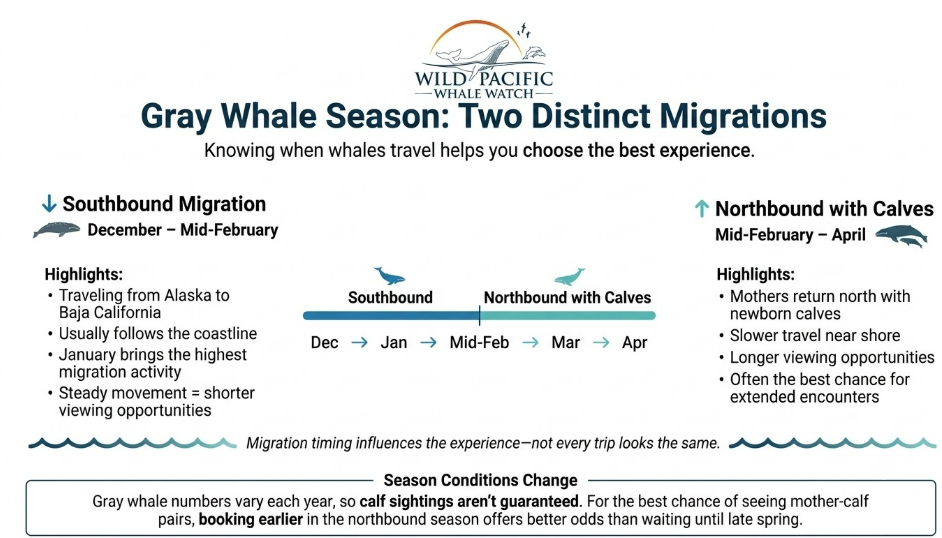
San Diego’s gray whale season isn’t one long window — it’s really two migrations stitched together, and the reasoning behind the split matters for planning your trip.
December Through Mid-February: Southbound
This is the outbound leg, when whales are moving with purpose from Alaska toward Baja California’s calving lagoons. Consistent with the nearshore-corridor research above, they tend to travel closer to the coastline during this leg, likely because following the shelf is a navigational shortcut and offers some protection from deeper-water predators like orcas.
Peak density typically falls in January, when NOAA’s coastal counting stations in central California log the highest daily passage rates of the year.
Mid-February Through April: Northbound, With Calves
After a roughly 13-month gestation, cows give birth in the lagoons and nurse calves for several months before starting the return trip north. Mother-calf pairs move slower and hug the shoreline even more tightly than adults traveling alone, since near-shore water offers cover for calves still building strength and swimming stamina.
This is the stretch when San Diego boats most often report extended, close encounters — not because more whales are present, but because the ones that are present are moving at a pace that favors long looks rather than quick passes.
The Honest Caveat
Gray whale numbers vary meaningfully year to year, and the population instability described above means some seasons run lighter than others. Recent NOAA counts reported by Alaska Native News found that only about 85 calves migrated past central California in one recent year — the lowest number since records began in 1994.
A slower calf season generally means fewer mother-calf pairs later in spring, so if that’s specifically what you want to see, booking earlier with an operator that adjusts routes based on daily sightings is a better bet than counting on a guaranteed April encounter.
Choosing an Operator: What Changes Your Odds
The Vessel and the Guides
Wild Pacific Whale Watch runs its tours from H&M Landing aboard the Peregrine, an 82-foot vessel fitted with twin Tohmei anti-rolling gyro stabilizers — hardware that meaningfully reduces the rolling motion that causes seasickness, rather than just marketing copy about a “smooth ride.” That matters more than it sounds on a three- to four-hour trip, especially during winter swells.
Naturalist guides aboard narrate behavior and identify species in real time, which is the difference between watching a distant blow and understanding what the whale is likely doing next — a distinction that matters more given how much individual variation the NOAA nearshore-corridor research found in whale routes.
What No Operator Can Promise
It’s worth being upfront about the limits, too. No stabilizer eliminates motion entirely in rough seas, and no operator — however experienced — can guarantee a sighting on any single trip, because these are wild animals moving through open ocean, not a scheduled attraction.
What consistent operators can offer is a track record: daily logs of what’s been seen, routes adjusted to where whales were spotted that morning or the day before, and crews who know the difference between an average January and a slow one. That’s the realistic version of a “sighting guarantee” — informed positioning, not certainty.
What to Expect Beyond the Whales
A gray whale trip out of San Diego is rarely just about gray whales.
The Supporting Cast
Common bottlenose dolphins are seen on the majority of winter trips, often riding the bow wave of the boat. California sea lions haul out and forage near the harbor entrance and offshore kelp beds. Brown pelicans, cormorants, and other seabirds frequently cluster over bait balls, which is often the first visual clue that something larger is feeding nearby.
Reading the Whales
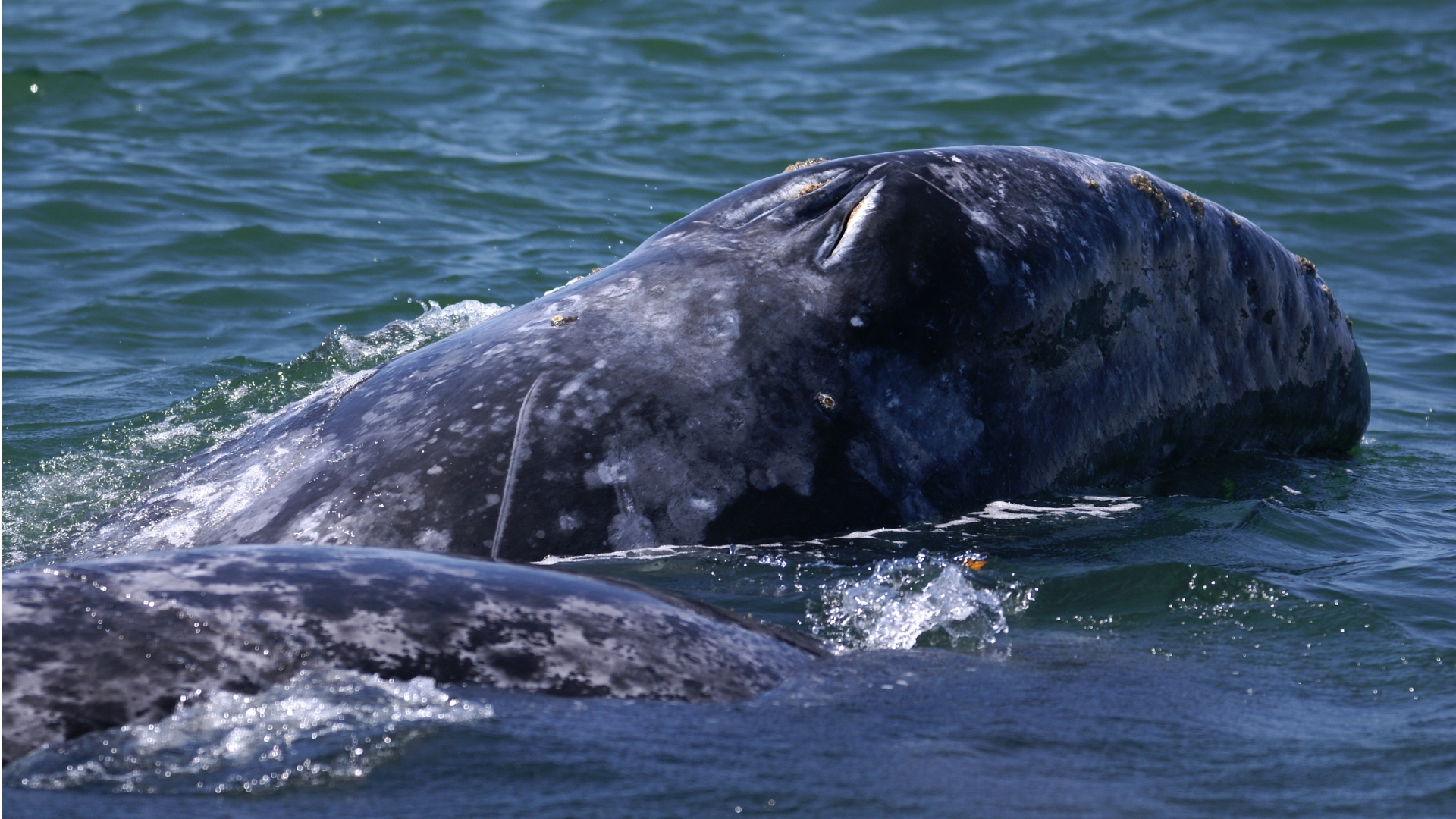
Gray whales are identifiable at a distance by their mottled gray skin, patches of barnacles and whale lice, and a distinctive heart-shaped blow when the two blowholes release air together.
During the December–February window you’re mostly watching adults on the move — spouting, occasionally lifting a fluke before a deep dive. In the mother-calf window, expect more surface time and slower, more deliberate movement.
Practical Trip Details
Trips run three to four hours round trip, with indoor seating and restrooms aboard for guests who need a break from the deck. Layered clothing is worth packing regardless of the air temperature on land — wind chill on open water drops the felt temperature noticeably, even on a mild 65°F January afternoon.
Why the Rules Make the Whale Watching Better, Not Worse
NOAA sets minimum approach distances and speed restrictions around gray whales, and reputable operators follow them closely rather than treating them as a ceiling to push against.
The Case for Distance
That’s not just regulatory box-checking — it produces a better experience. Whales that aren’t repeatedly approached too closely behave more naturally: they surface on their own schedule, stay in an area longer, and don’t associate boats with being chased.
Crews who hold back and let a whale set the pace tend to get longer, calmer encounters over a season than ones who close distance aggressively for one dramatic pass.
A Privilege Worth Protecting
The same NOAA nearshore study noted that a growing concentration of whales using the coastal corridor “could increase the negative anthropogenic impact on this species” — a reminder that near-shore access is a privilege that depends on operators managing it responsibly.
Given that the population is already under stress from Arctic food scarcity, giving individual whales room to feed, rest, and migrate undisturbed isn’t a tradeoff against a good trip — it’s part of what keeps sightings strong for the whole season.
Planning Your Trip
Winter weekday mornings tend to have calmer seas and lighter passenger loads than weekend afternoons, which is worth factoring in if you have flexibility.
Because sighting patterns can shift within a season — especially with the current instability in gray whale numbers — booking closer to your travel date (rather than months in advance) can let you take advantage of whichever week is currently producing the strongest activity.
Booking checklist:
- Book online at wildpacificwhalewatch.com/whale-watching or by phone at 619-821-8205
- Departures leave from H&M Landing, near 2803 Emerson St., San Diego, CA 92106
- Questions before booking: email info@wildpacificwhalewatch.com
- Dress in layers, bring sunscreen and polarized sunglasses, and take motion-sickness medication 30–60 minutes before departure if you’re prone to it
- Ask staff what the last few days of trips have actually seen before booking, rather than relying on general seasonal averages
- For free shore-based viewing as a backup or supplement, Cabrillo National Monument offers elevated views of the coastal migration corridor from late December through mid-March
Frequently Asked Questions
When is the single best week to see gray whales in San Diego?
Late January into early February typically offers the highest concentration of southbound adults, based on historical coastal counts. That said, current population volatility means some years run stronger or weaker than average, so checking recent trip logs before booking is worth the extra step.
Will I definitely see a whale if I book a tour?
No operator can promise that, since these are wild animals in open ocean. Experienced crews improve your odds substantially by tracking recent sightings and adjusting routes daily, but sighting rates vary by week and season.
Are gray whale numbers declining, and should that worry visitors?
Yes, the population has declined significantly from its mid-2010s peak, and NOAA is actively studying why. It doesn’t mean sightings in San Diego will disappear — the migration is still substantial — but it does mean guides quoting outdated “20,000+” figures aren’t reflecting the most current science.
Why do gray whales swim so close to the San Diego coast?
Research on the nearshore migration corridor through the Southern California Bight found whales increasingly using shelf waters close to shore, likely for navigation and predator avoidance, though most of that specific data comes from stations near LA and Santa Barbara rather than San Diego itself.
How close will the boat get to the whales?
Boats follow NOAA-set minimum approach distances, and actual proximity depends on how the whale behaves. Curious individuals sometimes approach boats on their own; crews won’t close the gap themselves beyond permitted limits.
Is the trip suitable for kids or people prone to seasickness?
Yes to both, with some preparation. Vessels with stabilization technology like the Peregrine’s gyro system reduce roll noticeably, and indoor seating gives seasickness-prone or younger guests somewhere to retreat. Taking medication before departure helps further.
Can I see other whale species during gray whale season?
Occasionally. Fin whales, minke whales, and even orcas are possible in winter, though gray whales dominate sightings from December through April. Dolphins and sea lions are common on nearly every trip regardless of season.
How long is a typical tour, and what should I bring?
Most trips run three to four hours. Bring layered clothing, sunscreen, sunglasses, and a camera with zoom capability if you want photos — though many guests find watching directly more rewarding than shooting through a screen the whole trip.
Ready to See Them for Yourself?
Gray whale season in San Diego rewards a bit of planning — knowing which half of the migration you’re catching, understanding why the whales run so close to this stretch of coast, and recognizing that this year’s numbers are part of a bigger and more uncertain story than the brochure version suggests.
Wild Pacific Whale Watch runs those trips daily aboard the stabilized Peregrine out of H&M Landing, with naturalist guides who can tell you what’s actually been showing up that week. Book your gray whale tour now and see the migration while this season’s numbers are still telling their story.