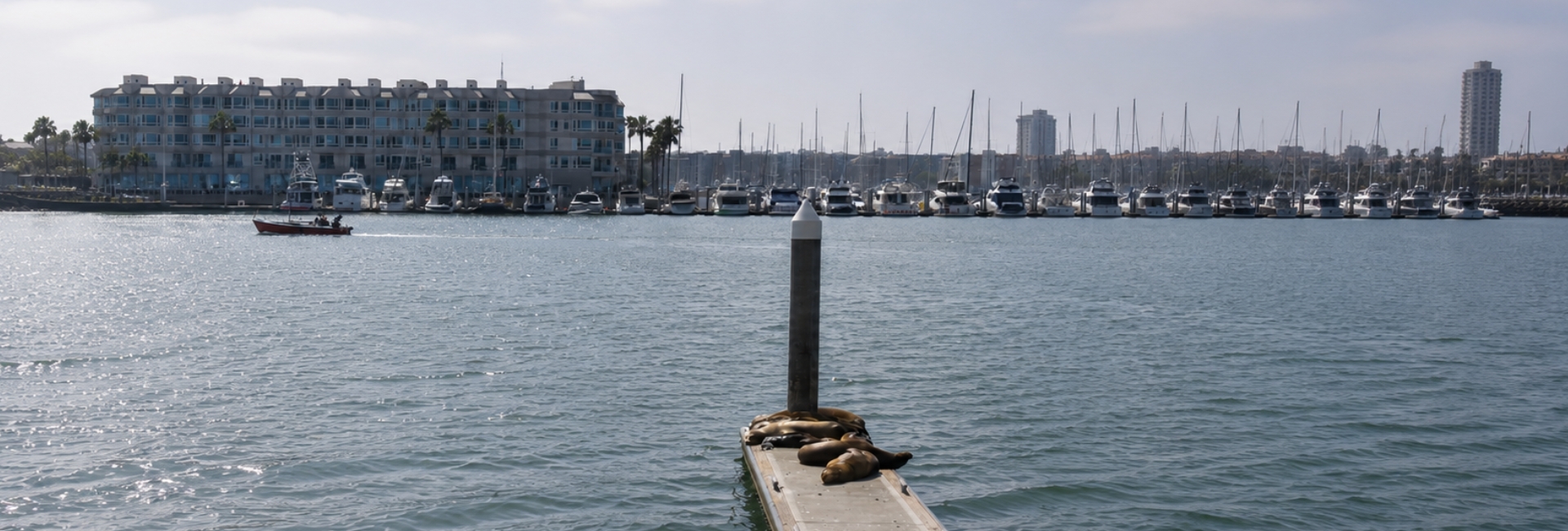
Stand at the edge of La Jolla Cove on any given morning and you’ll hear them before you see them — a raspy, rolling chorus of barks rising from the rocks below. One dark, glistening body flops dramatically off a ledge. Another cranes its neck and stares back at you with the unabashed confidence of an animal that knows it owns the place.
San Diego is genuinely one of the best cities in the world for watching California sea lions in their natural habitat — from shore, from a kayak, and from offshore aboard a vessel like Wild Pacific Whale Watch‘s Peregrine, which departs year-round from H&M Landing near Shelter Island.
Our crew brings over 40 years of combined experience on San Diego and Monterey Bay waters, which means when sea lions are around, we know exactly where to find them. But before you book anything, here’s what’s worth understanding first.
Seals vs. Sea Lions: The Difference Matters
Most visitors use the terms interchangeably, but they’re two distinct species with very different personalities — and La Jolla has both.
The California sea lion is the loud, sociable, theatrical one hauled out on the rocks at La Jolla Cove. It has visible external ear flaps, long front flippers capable of supporting its body weight on land, and a characteristic dog-like bark it uses constantly. Adult males can weigh up to 800 pounds and develop a pronounced bony crest on top of their skulls.
The Pacific harbor seal, found mainly at Children’s Pool Beach about a five-minute walk south, is smaller, spotted, and largely silent — it moves on land by flopping on its belly because it can’t rotate its hind flippers forward the way sea lions can.
Sea lions are extroverts; harbor seals are introverts. Both are worth seeing, and the short walk between the two viewing spots is one of the more remarkable pieces of urban wildlife watching in California.
According to NOAA Fisheries, which monitors the population under the federal Marine Mammal Protection Act, California sea lions grew from fewer than 90,000 animals in 1975 to an estimated peak of over 300,000 by the early 2010s — one of the most successful wildlife recoveries in American conservation history.
NOAA research biologist Sharon Melin, who has tracked sea lion numbers at the Channel Islands for decades, has described the population as having “come into balance with its environment,” with numbers now fluctuating in response to ocean productivity rather than human pressure. In practical terms: there are a lot of them, they are healthy, and they are not shy.
When to Go: Honest Seasonal Breakdowns
The most important thing to say upfront is that California sea lions are present in San Diego year-round. Unlike gray whales, which follow a fairly predictable migratory calendar, sea lions never really leave. That said, the character of your experience shifts meaningfully by season.
Winter and early spring (December–April) is the most dynamic period overall. Harbor seal pupping runs from mid-December through mid-May at Children’s Pool, and the breakwater above the beach offers close views of mothers nursing newborns even when the beach itself is closed to foot traffic. Sea lions at La Jolla Cove remain active and highly visible on the rocks throughout these months. Critically, this is also gray whale season offshore — meaning a single boat tour can deliver sea lions, gray whales, humpbacks, and multiple dolphin species in one outing.
Late spring (May–June) brings sea lion pup season, which peaks from mid-May through mid-July. Juveniles born earlier in spring become increasingly active and playful — investigating kelp, chasing fish, and interacting with each other in ways adult animals rarely do. Children’s Pool reopens to foot traffic on May 15th each year, allowing closer shore-based access than the winter months permit.
Summer (July–September) shifts the offshore action. Blue whale season draws Wild Pacific’s tours further out toward the submarine canyon feeding zones, and sea lions regularly appear in those same productive corridors — hunting at speed, diving near baitballs, and occasionally riding the pressure wave ahead of the vessel’s bow. Shore conditions at La Jolla can be crowded in peak summer, so early morning visits before 9 a.m. are worth the effort.
Fall (October–November) is quietly excellent and consistently underrated. Crowds thin, the light softens for photography, and the marine layer burns off faster than in summer. Sea lions remain reliably present at La Jolla, and fall is also when early southbound gray whale scouts begin appearing off the coast — sometimes as early as late November.
Best Viewing Conditions: What Actually Improves an Encounter
Season matters, but experienced wildlife watchers will tell you that day-to-day conditions often matter just as much.
Low tide is generally the best condition for shore-based viewing at La Jolla Cove, because more rocky haul-out surfaces become exposed and give sea lions additional places to rest and thermoregulate.
The National Park Service’s California sea lion overview for Channel Islands National Park — the primary breeding ground for the species — notes that California sea lions can form dense land aggregations of a thousand or more animals when suitable surfaces are available. Tide directly affects how much of that surface is accessible.
Calm mornings are similarly ideal for offshore viewing. Lighter wind and smaller swells make it easier to spot porpoising sea lions, baitfish surface activity, and seabirds working feeding zones. By afternoon, stronger onshore wind can roughen the water surface enough to reduce visibility from a vessel considerably.
San Diego’s famous marine layer can actually work in your favor as a photographer. The diffused light softens glare off the Pacific and reduces harsh contrast on the dark coats of sea lions.
NASA Earth Observatory has documented the consistent low coastal cloud systems that form off California, driven by cold upwelling water meeting warmer air — and on a practical level, an overcast morning at La Jolla often produces better images than direct midday sun. Don’t cancel your plans because of the clouds.
Weekdays also provide a calmer experience overall, especially at La Jolla Cove, where weekend foot traffic meaningfully increases noise around the viewing areas and makes it harder to observe natural social behavior.
What the Water Adds
Shore-based viewing at La Jolla is free, accessible, and genuinely excellent — it shows you sea lions resting, socializing, and playing near the surf. What it can’t show you is how these animals move in three dimensions through open water: how they interact with dolphins during a feeding event, how they look launching themselves out of the Pacific onto an offshore buoy, or what it’s like to watch one porpoise at full speed alongside your vessel.
That’s the value of going offshore. Wild Pacific Whale Watch runs 3–3.5 hour tours year-round aboard the Peregrine, an 82-foot yacht equipped with rare twin Tohmei gyro stabilizers that significantly reduce rolling motion and seasickness. With air-conditioned indoor seating, cushioned lounges, clean restrooms, and a full galley, the vessel offers a noticeably more comfortable experience than most whale watching boats.
A boat tour is ultimately a broader marine wildlife experience, with sea lions just one of many regularly encountered species alongside whales and dolphins. Because this is the wild Pacific, no specific interaction is guaranteed — but Wild Pacific does offer a free return trip if no whales or dolphins are spotted at all, reflecting genuine confidence in the experience.
What to Expect on a Full Tour
A Wild Pacific tour is fundamentally a natural history excursion. Guests who get the most from it come curious rather than expectant.
Beyond sea lions, a typical trip in any season is likely to include common dolphins — often in pods of dozens to hundreds — a variety of seabirds including brown pelicans and Brandt’s cormorants, and one or more whale species depending on the time of year.
Occasionally the naturalists will spot a mola mola basking on the surface, or a blue shark finning past the hull. Bottlenose dolphins, when you’re fortunate, will ride the bow wake at eye level for minutes at a time.
Dress in layers regardless of season — the Wild Pacific FAQ notes that offshore temperatures run 15–20 degrees cooler than shore. Sunscreen, a hat, and a light windproof jacket are the practical essentials. The galley keeps snacks and beverages available throughout, and the gyro stabilizers make a genuine difference for those prone to motion sickness.
Responsible Viewing
Every sea lion in San Diego is protected under the federal Marine Mammal Protection Act — the same law that enabled their population to recover from near-collapse in the early 20th century to the robust numbers you see today.
NOAA guidelines call for maintaining at least 50 yards of distance from hauled-out animals and limiting stationary observation to 30 minutes. In California, “flushing” — causing a sea lion or seal to enter the water through your approach — can result in a $500 fine.
The reason these rules produce better outcomes is straightforward: sea lions must haul out to rest for up to eight hours a day, and repeated stress-induced disturbances compromise their health and reproductive success. Keep your distance and you’ll see more natural behavior, not less.
Aboard the Peregrine, the naturalist crew maintains NOAA-consistent viewing distances throughout the trip, making an offshore tour an inherently low-impact way to observe these animals compared to crowded shoreside areas.
Planning Your Trip
Shore-based viewing is free and requires no booking. La Jolla Cove sits at the end of Coast Boulevard in La Jolla, about 14 miles north of downtown San Diego. Arrive before 8 a.m. on weekends to beat the parking and crowds. Children’s Pool is a five-minute walk south along Coast Boulevard.
Boat tours with Wild Pacific depart daily from H&M Landing near Shelter Island, just minutes from San Diego Airport. Advance booking is recommended during peak gray whale season (December–April) and blue whale season (June–September). Visit wildpacificwhalewatch.com for current schedules, pricing, and the real-time sightings log — worth checking in the days before your trip.
Frequently Asked Questions
Are sea lions really here year-round, or is that an exaggeration?
Genuinely year-round, backed by population data rather than promotion. California sea lions maintain a permanent resident colony at La Jolla Cove in every season. What changes is the group composition and activity levels — not their presence. You will see sea lions whenever you visit San Diego.
What’s the best time of day to visit La Jolla Cove?
Between 7 and 9 a.m. Sea lions return from overnight feeding, haul out to thermoregulate, and are most socially active in the morning hours. By midday on weekends, the area is crowded and the animals more disrupted. Early evening is a reasonable second choice.
Do I need a boat tour to see sea lions?
No. Shore-based viewing is outstanding and free. A tour adds the offshore behavioral dimension — hunting, feeding, interacting with dolphins — that the shoreline simply can’t provide. The two experiences complement rather than replace each other.
Can I swim or snorkel with sea lions?
Snorkeling and diving at La Jolla Cove regularly bring people into proximity with sea lions, which are famously curious underwater. Juvenile animals are most likely to approach. Never pursue them or attempt to touch them — adult behavior, especially from protective mothers, is unpredictable, and bites from pinnipeds can cause serious injury.
Are boat tours suitable for children and families?
Yes. The Peregrine‘s gyro stabilizers make a meaningful difference for younger passengers prone to seasickness. Pack layers, snacks, and a backup motion remedy. The naturalists are consistently praised by reviewers for keeping younger guests engaged throughout the trip.
What else might I see on a Wild Pacific tour?
In winter and spring: gray whales, Pacific white-sided and common dolphins, pelicans, and cormorants. In summer: blue whales, humpbacks, fin whales, Risso’s and bottlenose dolphins. Year-round: California sea lions, common dolphins, and a steady rotation of seabirds. The live sightings log at wildpacificwhalewatch.com shows exactly what was spotted on recent departures.
See San Diego’s Sea Lions for Yourself
San Diego offers something genuinely rare: effortless, year-round access to wild marine mammals without a remote expedition or a significant budget. You can walk to a sea lion colony from a sidewalk café, or head offshore on a vessel with decades of expertise and a naturalist who’ll show you more of California’s coastal ecosystem in three hours than most people absorb in a lifetime of beach visits.Book your tour at wildpacificwhalewatch.com and experience San Diego’s sea lions — and the rest of its remarkable marine life — in full context, on the wild Pacific.