Scattering ashes at sea in California is one of the most meaningful send-offs a family can choose. Still, the legal requirements catch many people off guard during an already difficult time.
California families are choosing cremation at a rate above the national average, with statewide cremation now exceeding 70% of all dispositions. For the growing number of families who go that route, ocean scattering has become one of the most personally significant ways to complete the process.
The Pacific Coast offers scale, permanence, and a natural setting that most funeral homes cannot replicate. What follows covers what California and federal law actually require, what the ceremony looks like on the water, and how to choose the right service for your family’s needs.
Wild Pacific Whale Watch provides private burial at sea ceremonies and unattended scattering services aboard the Peregrine, departing year-round from H&M Landing in San Diego for families throughout Southern California.
What California Law Requires for Scattering Ashes at Sea
The Three-Mile Federal Rule
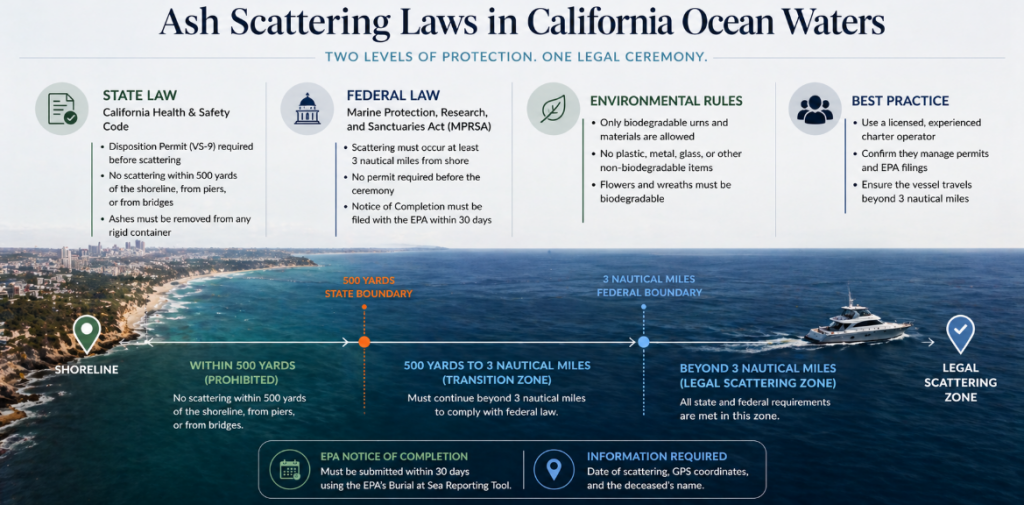
The primary legal framework governing ocean ash scattering is the Marine Protection, Research, and Sanctuaries Act (MPRSA), administered by the U.S. Environmental Protection Agency.
Under EPA regulations, cremated human remains must be scattered at least three nautical miles from the nearest shoreline. This minimum applies uniformly along California’s entire coastline, from San Diego to the Oregon border.
Scattering from beaches, piers, or within enclosed bays does not comply with federal law. California’s Health and Safety Code reinforces this by explicitly prohibiting scattering from bridges and piers.
Families who ask whether ashes can be scattered inside San Diego Bay receive a clear answer: no. The Bay is an enclosed tidal inlet, and all compliant ceremonies require departure to the open ocean before the scattering takes place.
No EPA permit is required before the ceremony itself. However, families must submit a Notice of Completion to the EPA within 30 days of the scattering using the agency’s Burial at Sea Reporting Tool. The notice requires the date, GPS coordinates, and the deceased’s name. Failure to file is a violation of federal law, even though no pre-authorization is needed.
California’s Disposition Permit Requirement
Before any ash scattering can take place in California, a Disposition Permit (the VS-9 form) is required by state law. This permit is issued by the county health department in which the death occurred and must be obtained before the ceremony. Families must provide the original death certificate to obtain it; photocopies are not accepted. The permit fee is $12.
California law also requires that ashes be removed from any rigid container before scattering. Biodegradable urns, such as those made from compressed peat or recycled paper, are legal and practical. Hard-sided containers of any material cannot be deposited into the ocean.
Most licensed charter operators handle the VS-9 permit and EPA notice filing on the family’s behalf, which removes a procedural burden during an already difficult time. Confirming that your provider manages both before booking is worth the conversation.
Attended vs. Unattended Ash Scattering: What the Difference Means
There are two broad categories of ocean scattering services, and the right choice depends on how a family wants to experience the ceremony. Attending scattering ceremonies brings family members aboard a private vessel.
The boat travels beyond three nautical miles, and the family participates directly in releasing the ashes. Flowers, biodegradable wreaths, spoken words, and music are all common elements. An attended ceremony gives families the physical experience of the ocean and a defined moment to mark the loss together.
The charter operator handles unattended scattering services without the family present. The vessel travels the required distance, releases the ashes, documents the GPS coordinates, and provides a certificate of completion with the information needed for the EPA filing.
This option works well for families who live far from the coast, have mobility limitations, or simply prefer a quieter closure. Wild Pacific Whale Watch offers both options from H&M Landing in San Diego.
For families who want to combine a scattering with a broader gathering on land, their guide to celebration-of-life venues in San Diego covers waterfront reception options that pair naturally with a morning at-sea ceremony.
Choosing an Ash Scattering Charter in Southern California
Not every California marina has charter operators licensed and equipped for memorial ceremonies, and the vessel shape considerably shapes the experience.
The Peregrine is an 82-foot yacht-style vessel Coast Guard-certified for up to 146 guests, fitted with twin Tohmei anti-rolling gyro stabilizers. This technology is found on fewer than a handful of U.S. whale watching and charter vessels.
For families with guests who are sensitive to motion or have mobility needs, it matters more than most people expect when booking an offshore ceremony. H&M Landing sits in Point Loma, minutes from downtown San Diego and San Diego International Airport. That geography makes it accessible for families traveling from across Southern California and from out of state, without a long drive to a remote harbor.
When evaluating any charter service for an ash scattering in California, families should confirm the provider handles VS-9 permit acquisition, knows the EPA filing requirements, operates on Coast Guard-certified vessels, and has a crew experienced with the particular pace and tone a memorial ceremony requires.
For a detailed look at San Diego-specific providers, vessel options, and pricing ranges, the companion guide to ash scattering in San Diego covers that ground in full.
What a Ceremony Aboard a Private Charter Involves
Departure and Transit
Departure from H&M Landing includes a transit period of approximately 30 to 45 minutes each way to reach the appropriate offshore distance, depending on sea conditions. During that outbound transit, families have space to settle, share memories, and prepare for the ceremony.
The Ceremony Itself
At the scattering site, the captain positions the vessel to account for wind direction, which matters both for the dignity of the moment and for practical safety. Families release the ashes from the stern or side, flowers or wreaths are placed in the water, and whatever words or ritual the family has chosen are observed.
On a private charter, there is no fixed script, no tight timeline, and no other guests to consider. Special requests, including music, readings, floral arrangements, and keepsake certificates, are all accommodated. The ceremony format is shaped entirely by the family’s wishes.
The return transit allows for the quiet that tends to follow. GPS coordinates are recorded, and Wild Pacific Whale Watch prepares the documentation families need for the EPA completion filing.
Planning Checklist Before You Book
A few practical steps make the day run without friction.
Confirm the service type: attended ceremony with family aboard or unattended scattering with documentation provided afterward. Decide on guest count and any accessibility needs, as the Peregrine’s lower deck accommodates most guests with limited mobility. Prepare the ashes in a biodegradable or non-rigid container before arrival.
Plan any symbolic elements such as flowers, readings, music, or keepsake certificates. Have the deceased’s full name and date of passing ready for the VS-9 permit and EPA notice, both of which Wild Pacific Whale Watch handles on the family’s behalf.
For additional guidance on weather policies, vessel access, and ceremony logistics, the FAQ page covers the most common planning questions in detail.
Ready to Begin Planning a Ceremony?
If your family is planning an ash scattering ceremony along the Southern California coast, Wild Pacific Whale Watch provides private attended charters and unattended scattering services from H&M Landing in San Diego. Their team handles navigation, permits, and EPA filing, so the ceremony stays focused on what matters.
Reach out at info@wildpacificwhalewatch.com, visit the burial-at-sea page to review service options, or contact the team directly to discuss availability and ceremony details.
Losing someone is hard enough. The logistics of honoring them should not be. Wild Pacific Whale Watch handles the permits, the paperwork, and the navigation so your family can focus entirely on the goodbye.
With over 40 years of combined maritime experience and a vessel built for comfort on open water, they bring both the expertise and the care that a ceremony at sea deserves. Reach out today to begin planning a farewell as enduring as the ocean itself.
Frequently Asked Questions About Scattering Ashes at Sea in California
How far offshore must ashes be scattered in California?
Under the Marine Protection, Research, and Sanctuaries Act, cremated remains must be scattered at least three nautical miles from the nearest shoreline. This federal rule applies along California’s entire coast. Charter operators confirm GPS position before any scattering begins to ensure the vessel is operating at the required distance.
Do I need a permit to scatter ashes in the ocean in California?
Yes. California requires a VS-9 Disposition Permit from the county health department before any ocean scattering takes place. The permit costs $12 and requires the original death certificate. Separately, federal law requires families to file a Notice of Completion with the EPA within 30 days of the ceremony. Licensed charter services typically handle both on the family’s behalf.
Can I scatter ashes in the ocean from a private boat in California?
Yes, provided the vessel reaches the three-nautical-mile minimum, the VS-9 permit is secured in advance, and the EPA notice is filed within 30 days. The challenge for most families is confirming offshore position, managing permit logistics, and documenting the coordinates for the federal filing. A licensed charter operator handles all of this, which is why most families opt for professional services even when they have access to a private boat.
What materials can be placed in the water during a scattering ceremony?
Only fully biodegradable materials may be placed in the ocean. Fresh-cut flowers, biodegradable paper, and water-soluble urns made from materials such as compressed peat or recycled paper are all acceptable. Plastic, foam, wire, and synthetic materials of any kind cannot be deposited in the water. Wild Pacific Whale Watch advises families on what to bring when booking.
How long does a full ash scattering charter take from H&M Landing?
Most private ash scattering charters from H&M Landing run between 1.5 and 2 hours total, including approximately 30 to 45 minutes of ocean transit each way and the ceremony itself. Wild Pacific Whale Watch can provide families with a more specific estimate based on group size, ceremony requests, and anticipated conditions at the time of booking.
What is the difference between a burial at sea and scattering ashes at sea in California?
Scattering cremated remains at least three nautical miles offshore requires no prior EPA authorization, only the state VS-9 permit and a post-ceremony notice filed within 30 days. A traditional burial at sea involving an intact body in a weighted biodegradable container requires an EPA permit issued before the burial and carries additional regulatory requirements. The simpler notice-based process governs families planning cremation scatterings.