
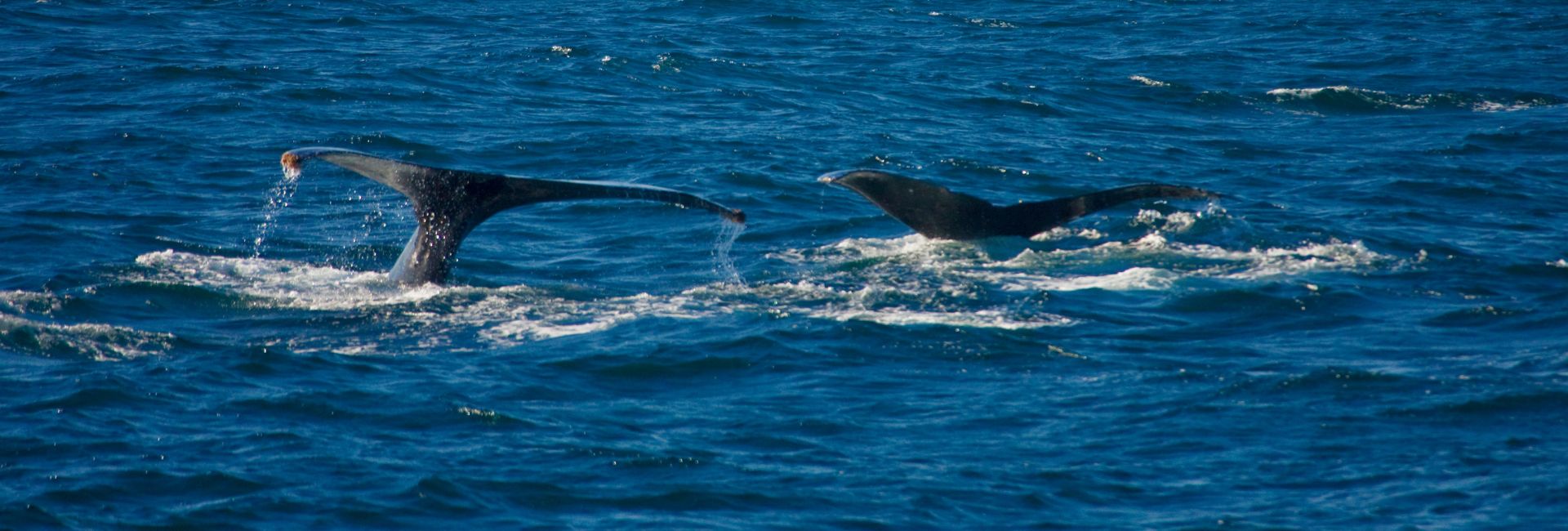
Humpback whales are present in San Diego waters throughout the year, but certain months make sightings far more likely than others. Understanding when and why these whales appear off the Southern California coast turns a good whale watching trip into a great one.
Wild Pacific Whale Watch runs year-round tours aboard the 82-foot Peregrine, departing from H&M Landing near Shelter Island with a crew carrying over 40 years of combined experience. Whether you are visiting during peak humpback activity or planning around another species, San Diego’s coastal waters reward patience on every departure.
When Do Humpback Whales Visit San Diego Waters?
Humpback whales can be spotted off San Diego in any month, but three distinct windows offer the highest sighting rates. Understanding each one helps set realistic expectations before booking a trip.
October through mid-December is the most reliable late-year window. As water temperatures cool and food availability shifts in northern feeding grounds, humpbacks traveling between the U.S. West Coast and breeding waters off Mexico and Central America pass through San Diego’s offshore habitat. Sightings during this stretch often involve animals in steady transit, surfacing at regular intervals as they move south.
March through April brings the northbound return. Humpbacks heading back toward California and Pacific Northwest feeding grounds pass through San Diego’s waters, often alongside gray whale calves making the same journey. Spring sightings tend to involve more active surface behavior as whales are energized after months in warmer breeding waters.
June through September offers a summer feeding window. San Diego’s deep coastal canyons and cold-water upwelling create nutrient-rich conditions that draw humpbacks to feed alongside blue whales and large dolphin pods.
Research from Scripps Institution of Oceanography and the Cascadia Research Collective has shown that humpback diets in the California Current shift between krill and schooling fish depending on ocean conditions, confirming that these waters are a dynamic and productive feeding ground.
Outside these windows, humpback sightings remain possible year-round. November can carry over strong late-year activity into early winter, and individual animals are documented feeding opportunistically in San Diego waters across all seasons.
Why San Diego Is a Humpback Whale Hotspot
San Diego’s position along the Pacific coast places it within the California Current System, one of the most productive marine ecosystems in the world. The humpbacks seen here belong primarily to two population groups recognized by NOAA Fisheries: the Mexico Distinct Population Segment (listed as threatened under the Endangered Species Act) and the Central America DPS (listed as endangered). Both groups breed in warmer waters off Mexico and Central America and travel north to feed along the U.S. West Coast.
Research led by the Cascadia Research Collective has shown that the proportion of Central America DPS humpbacks is highest in Southern California, making San Diego one of the more important feeding destinations for this population.
A separate population of humpbacks migrates between Hawaii and Alaska, but those animals are not the ones typically encountered on San Diego whale watching tours.
Several geographic features work in the region’s favor. Deep submarine canyons just offshore create cold-water upwelling that brings nutrient-dense water toward the surface, concentrating krill and small fish in accessible feeding zones. During the summer months, this upwelling supports conditions that draw multiple large whale species into the same waters at the same time.
The 70 miles of San Diego coastline also means that boats departing from Shelter Island can reach productive offshore waters quickly. On the Peregrine, which cruises at up to 25 knots, the trip from harbor to prime offshore habitat takes a fraction of the tour time, leaving more time on the water where the action is.
Understanding Humpback Whale Migration Along the California Coast
Humpback whales undertake long seasonal migrations between warm breeding waters and cold, food-rich feeding grounds. The populations most relevant to San Diego travel between breeding areas off mainland Mexico, the Revillagigedo Archipelago, and Central America, and feeding areas along the coasts of California, Oregon, and Washington.
NOAA Fisheries recognizes four humpback whale DPS groups in the North Pacific, each defined by its wintering area. The two groups that feed off Southern California breed in Mexican and Central American waters. A 2021 NOAA Technical Memorandum evaluating these population boundaries using decades of photo-identification and genetic data confirmed that whales wintering off mainland Mexico show strong migratory fidelity to the California-Oregon feeding region.
The migration follows a broadly predictable calendar. Summer months find humpbacks in the productive waters of the California Current, where they feed on krill and small schooling fish. According to NOAA Fisheries, a single humpback can consume up to 1.5 tons of food per day during feeding season, building the fat reserves that sustain the animal through months of limited feeding in warmer breeding waters.
By fall, the southbound movement begins. Breeding and calving happen in warmer offshore waters through winter, and the return north begins in spring. San Diego sits along this corridor in both directions, which is why the region offers sighting opportunities across multiple seasons rather than a single concentrated window.
How to Identify Humpback Whales
Several features distinguish humpbacks from the other large whale species regularly seen in San Diego.
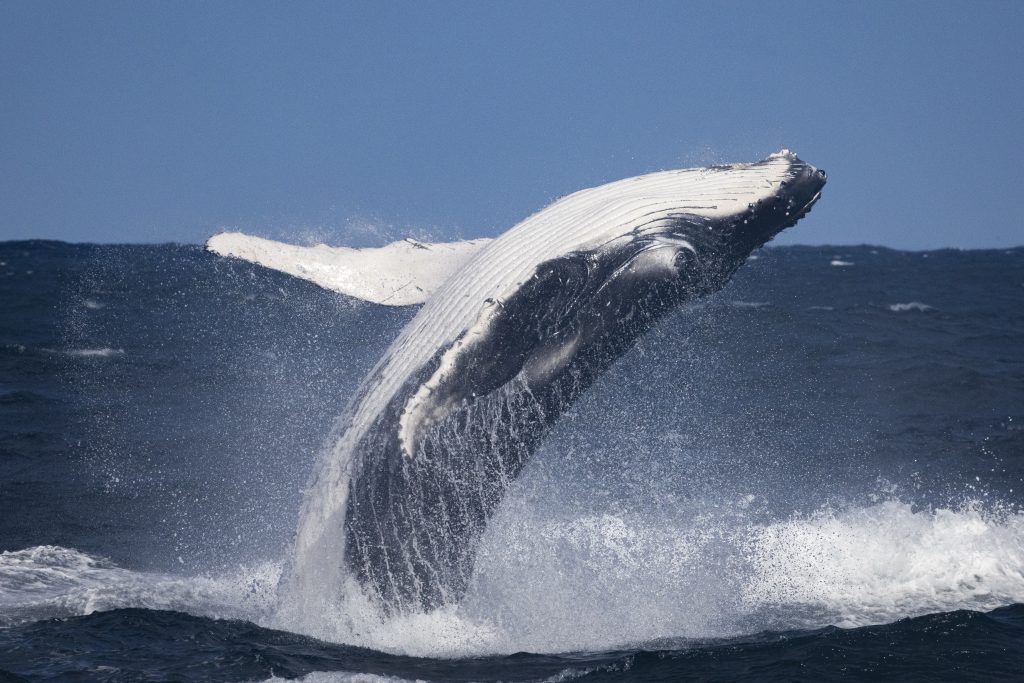
The most visible identification cue at a distance is the blow. Humpbacks produce a tall, bushy exhalation reaching up to 10 to 12 feet in height. The shape is broad and rounded, quite different from the more columnar blow of a blue whale or the heart-shaped blow of a gray whale.
At closer range, the pectoral fins are distinctive. The scientific name Megaptera novaeangliae translates to “great wing of New England,” a reference to the humpback’s exceptionally long pectoral fins, which can reach up to 16 feet. These fins are visible as the whale rolls at the surface and appear white or mottled on the underside.
The dorsal fin sits on a pronounced hump of the back, giving the species its common name. When a humpback dives, it typically raises its flukes clear of the water. The underside of each fluke carries a unique black-and-white pattern used by researchers for individual identification across sightings and seasons. The Cascadia Research Collective and platforms like Happywhale have matched over 26,000 individual humpbacks in the North Pacific using this method.
Humpbacks are also the most behaviorally active large whale species seen off San Diego. Breaching, in which the animal launches itself partially or fully clear of the water, is a signature behavior. Tail slapping and pectoral fin waving are also frequently observed and typically visible from a considerable distance.
What to Expect on Your Whale Watching Tour
Year-round marine life
Humpbacks are one of several large whale species present in San Diego across different seasons. Gray whales migrate through from December through April. Blue whales feed offshore from mid-May through September. Fin whales and minke whales are present year-round. Multiple dolphin species, sea lions, and harbor seals are reliable sightings on virtually every departure.
The Wild Pacific Whale Watch sightings log is updated regularly and provides a current picture of what the crew has encountered in recent trips.
Best preparation for your trip
Ocean conditions differ from onshore. Dress in layers, as temperatures drop noticeably at sea even in summer, and bring a windproof outer layer. Sunscreen, sunglasses, and a hat are practical on any clear-sky departure.
A camera with a zoom lens is worth carrying: humpback breaches happen quickly and without warning. Motion sickness medication taken at least 30 minutes before boarding is advisable for those prone to seasickness, though the Peregrine’s twin Tohmei anti-rolling gyro stabilizers reduce vessel motion significantly compared to conventional whale watching boats. For a full packing list, the what to bring guide covers everything from clothing layers to camera tips.
Regulations and responsible watching
Federal law under the Marine Mammal Protection Act requires vessels to maintain a minimum distance of 100 yards from all large whales. Captains must not position the vessel between a mother and calf, and the approach must be made from the side or rear, not head-on.
Wild Pacific Whale Watch operates within these guidelines on every trip, and the crew’s naturalist explains the reasoning behind responsible watching practices during each departure.
Plan Your Humpback Whale Watching Trip
Booking during October through November or March through April maximizes humpback sighting probability during migration, though summer trips offer the added possibility of blue whales, active dolphin pods, and feeding behavior that can be exceptional. Morning departures typically offer the calmest sea conditions for any season.
Wild Pacific Whale Watch operates private charters for groups seeking a dedicated ocean experience, in addition to its regular whale watching schedule. For specific questions about timing, species activity, or group bookings, review the FAQ page or contact the team directly. Departures run year-round from H&M Landing, 2803 Emerson Street, San Diego, CA 92106. Phone: (619) 821-8205.
Frequently Asked Questions
What is the best time of year to see humpback whales in San Diego?
October through mid-December and March through April represent the strongest windows for humpback sightings, corresponding to the southbound and northbound legs of the migration between breeding grounds off Mexico and Central America and feeding areas along the U.S. West Coast. Summer months from June through September offer additional sighting opportunities as humpbacks feed in the nutrient-rich offshore waters of the California Current.
Are humpback whales present near San Diego year-round?
Yes. While sighting frequency peaks during migration and summer feeding months, humpback whales can be encountered in San Diego waters throughout the year. Individual animals have been documented feeding opportunistically in these waters outside the traditional peak windows.
Which humpback whale populations does San Diego see?
San Diego’s humpbacks belong primarily to two groups recognized by NOAA Fisheries: the Mexico DPS (listed as threatened) and the Central America DPS (listed as endangered). Both breed in warmer waters off Mexico and Central America and travel north to feed along the California coast. The larger Hawaii-to-Alaska population is a separate group and is not commonly encountered in San Diego waters.
How large do humpback whales get?
Adult humpback whales reach lengths of up to 50 feet and weigh up to 40 tons. Their pectoral fins can extend to 16 feet, one of the longest fin-to-body ratios of any whale species, and the origin of their scientific name, Megaptera, meaning “great wing.”
What do humpback whales eat?
Humpback whales are filter feeders that consume krill and small schooling fish such as anchovies and sardines. NOAA Fisheries documents daily intake of up to 1.5 tons during peak feeding season. Research from the Cascadia Research Collective and Scripps Institution of Oceanography has shown that humpback diets in the California Current shift between krill and fish depending on ocean temperature and upwelling conditions.
What behaviors might I see on a tour?
Humpbacks are among the most behaviorally active large whales. Breaching, in which the whale launches itself partially or fully out of the water, is a signature display. Tail slapping, pectoral fin waving, and spy-hopping (raising the head vertically above the surface) are also commonly observed.
Do humpback whales interact with boats during tours?
Humpbacks are known for curiosity toward vessels and will occasionally approach boats on their own, swimming alongside or passing beneath the hull. Breaching near boats is not uncommon, particularly during active feeding or social behavior. The crew will always maintain the legally required 100-yard minimum distance, but the whales themselves are under no such obligation.
See Humpback Whales for Yourself
San Diego’s combination of submarine canyon upwelling, position along the Mexico and Central America migration corridor, and year-round mild weather makes it one of the most reliable destinations on the West Coast for humpback whale encounters. The conditions that make this region productive for humpbacks are structural features of the coastline and ocean floor, not seasonal flukes.
Wild Pacific Whale Watch departs daily from Shelter Island aboard the Peregrine, with a crew that tracks real-time sightings and adjusts routes to maximize wildlife encounters. Book your whale watching tour or contact the team to discuss dates and private charter availability.