
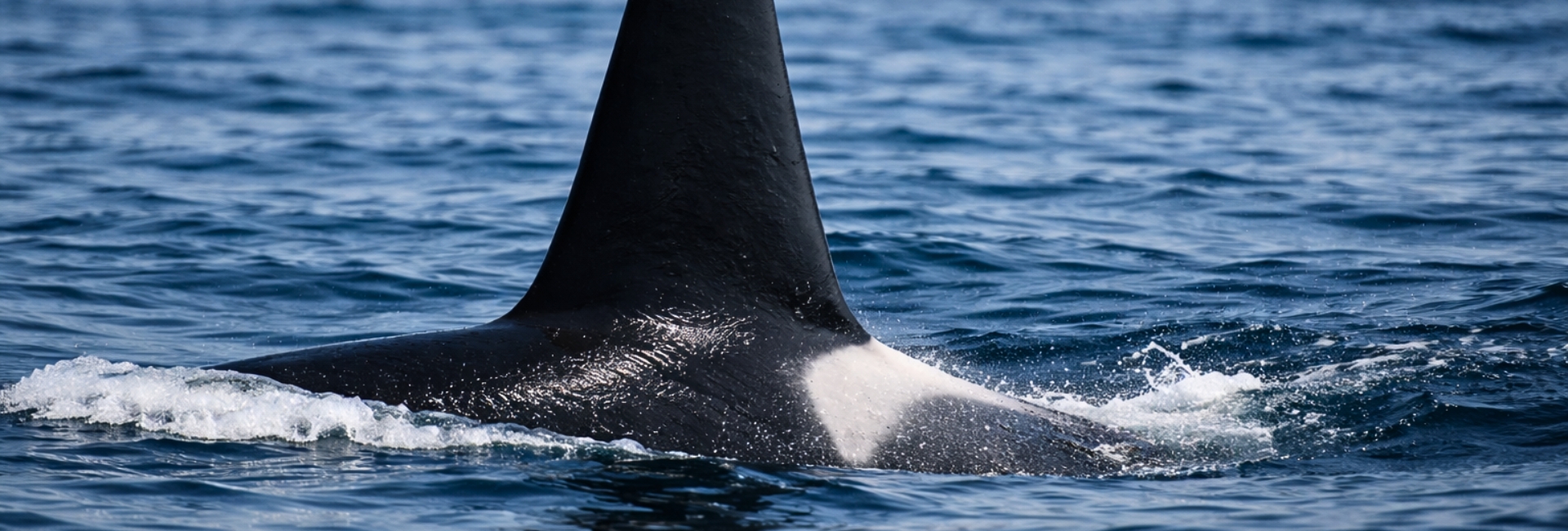
San Diego is known for gray whales in winter and blue whales in summer. Orca sightings are something else entirely: rarer, less predictable, and when they happen, unlike anything else on the water. Since 2017, a pod of Eastern Tropical Pacific orcas has been returning to Southern California with increasing frequency, and the winters of 2023 and 2024 produced some of the most dramatic sustained orca activity the region has ever recorded.
If you are planning a whale watching trip and hoping to see killer whales, Wild Pacific Whale Watch departs year-round from H&M Landing near Shelter Island, with a crew carrying over 40 years of combined experience in San Diego and Monterey Bay waters. When orcas are in the area, local knowledge matters.
Understanding Orcas: More Than Just Killer Whales
What orcas actually are
Despite the name, orcas are not whales. They are the largest members of the dolphin family, a distinction that surprises most people when they first hear it. Their scientific classification, Orcinus orca, places them firmly in Delphinidae, the same family as bottlenose dolphins and common dolphins.
On the water, they are unmistakable: bold black-and-white coloration, a prominent white eye patch, and a dorsal fin that, on adult males, can reach six feet in height. That tall, straight black fin rising from the surface is one of the most striking sights in ocean wildlife. Orcas grow up to 32 feet in length and are apex predators with no natural enemies in the sea.
They live in tight family groups led by a matriarch and communicate through distinct vocalizations. Different pods use different calls, and calves learn the family’s hunting techniques directly from their mothers and grandmothers, behaviors researchers have documented in San Diego waters during recent sightings.
The Eastern Tropical Pacific pod
Not all orcas are the same. Different ecotypes have different diets, social structures, and ranges. The orcas appearing off San Diego are Eastern Tropical Pacific orcas, a subgroup whose home range centers on the warm waters of Mexico and Central America.
According to Dr. Vanessa ZoBell, an oceanographer at Scripps Institution of Oceanography, this pod is native to Mexican waters and typically reaches no further north than Ventura County. Their diet focuses on marine mammals, primarily common and bottlenose dolphins, both of which are abundant in San Diego’s coastal waters. “They most likely came to San Diego because we have so many common dolphins and bottlenose dolphins,” Dr. ZoBell told San Diego Magazine in 2024.
The pod currently making these visits consists of ten members: two mothers, several offspring, and an older individual believed to be a grandmother. Scientists identify individual orcas by the shape of their dorsal fin and saddle patch, markings as distinctive as fingerprints, and have confirmed it is the same pod returning across multiple seasons.
When to See Orcas in San Diego
The documented pattern
Orca sightings in San Diego follow no fixed migration calendar. Unlike gray whales, which pass through on a reliable December-to-April schedule, orcas move where food is most abundant. That said, a clear pattern has emerged over the past several years.
Winter and early spring, roughly December through April, have produced the most sustained sighting events in San Diego. The winters of 2023/2024 and 2024/2025 were particularly remarkable: the pod spent weeks moving between San Diego and Los Angeles, with confirmed sightings on 15 separate days in January 2024 alone.
Harbor Breeze, a Southern California whale watching operator, counted 50 orca sightings in January 2024, nearly equal to the total recorded across all of 2023. Late summer and fall, particularly September and October, represent a secondary window, with the pod recorded off San Diego in September 2025.
Year-round sightings are possible but uncommon. The honest answer for anyone asking when their chances are highest: winter through early spring if you are targeting the ETP pod, with September and October offering a secondary opportunity.
What is bringing them north
Two factors are consistently cited by researchers. The first is El Niño-driven water warming, which makes Southern California waters more closely resemble the Mexican coastal habitat these orcas know. Dr. ZoBell noted that warmer temperatures “may be mimicking the waters they’re used to down in Mexico, which allowed them to shift their range farther north.”
The second is prey abundance. San Diego’s waters support large concentrations of common and bottlenose dolphins, and this pod specializes in hunting them. Whale watching operators have reported watching the orcas pursue dolphins in coordinated hunts, with younger calves observing alongside their mothers in what researchers describe as active teaching behavior.
The range shift itself began around 2017, when sightings in Southern California became noticeably more frequent after years of near-total absence. Marine biologist Alisa Schulman-Janiger of the California Killer Whale Project, who has been photo-identifying California killer whales since the late 1970s, described the 2023/2024 winter event as “unprecedented” in length and frequency.
Why Choose Wild Pacific Whale Watch
Experience and local knowledge
Wild Pacific Whale Watch is operated by a team with over 40 years of combined experience in San Diego and Monterey Bay, two of California’s most productive whale watching destinations. The crew tracks real-time conditions and maintains communication with other operators on the water, which matters on days when orcas are in the area and moving quickly.
A naturalist is aboard every trip to provide a marine biology context and help guests identify what they are seeing.
Orcas are not a guaranteed sighting on any tour. No legitimate operator will promise one. What experience provides is the crew’s ability to read the signs: a dolphin stampede on the horizon, a change in behavior among seabirds, a shift in surface activity, and then move toward them quickly.
The Peregrine vessel
Wild Pacific Whale Watch operates the Peregrine, an 82-foot yacht departing daily from H&M Landing near Shelter Island. The vessel carries Coast Guard certification for up to 146 guests and is equipped with twin Tohmei anti-rolling gyro stabilizers, a rare technology that significantly reduces vessel motion on open water.
Air-conditioned indoor seating, cushioned lounges, clean bathrooms, and a full galley are standard. Private charter options are available for groups who want a dedicated experience on their own schedule.
Tours run three to three and a half hours, which provides sufficient time to reach offshore areas where orca activity has been documented and to observe any encounter without rushing.
What to Expect on the Water
Year-round marine life
Orca sightings remain rare relative to other species. On any given trip, guests are more likely to encounter the marine life that makes San Diego one of California’s most productive year-round whale watching destinations. Gray whales migrate from December through April. Blue whales feed offshore from mid-May through September.
Humpback whales, fin whales, and minke whales appear across various seasons. Multiple dolphin species, including common, bottlenose, and Pacific white-sided dolphins, are present throughout the year alongside sea lions and harbor seals.
The sightings log on the Wild Pacific Whale Watch website is updated regularly and provides a current picture of what is being encountered on the water.
Identifying orcas on the water
If orcas are present, identification is straightforward. Look for a tall, straight, jet-black dorsal fin, distinctly different from the curved fin of a dolphin. The black-and-white body pattern and white eye patch are visible at close range. Male orcas have the tallest dorsal fins, sometimes reaching six feet. In groups, the size range within the pod is often visible, with smaller juveniles swimming close to their mothers.
One of the most reliable indicators that orcas are nearby is a dolphin stampede: a large group of dolphins moving rapidly at the surface in a single direction, typically away from a threat. Whale watching captains use this behavioral signal as one of the primary cues to investigate.
Orca behavior is worth watching for
When orcas are actively hunting, the scene unfolds in stages: the pod spreads out to cut off escape routes, then works together to exhaust prey before closing in. Observers aboard tour boats in 2023 and 2024 watched these hunts from close range.
Between hunts, the pod has been documented approaching boats, breaching, and engaging in what naturalists describe as social play. Calves travel alongside mothers and appear to observe and participate in hunts, consistent with the matriarchal learning structure documented in other orca populations.
Conservation and Responsible Watching
Wild Pacific Whale Watch operates in compliance with the Marine Mammal Protection Act, which establishes minimum approach distances and guidelines for vessel behavior around marine mammals.
The crew slows the vessel when marine mammals are nearby, maintains required distances, and allows orcas to approach voluntarily rather than pursuing them. These practices protect animal welfare and produce better observation conditions: undisturbed animals behave more naturally and remain on the surface longer.
The crew’s educational approach reflects a broader commitment to the marine environment. Every trip includes naturalist-led observation, with context on species behavior, conservation status, and the ecological role of apex predators in the Pacific.
Planning Your Trip
Book in advance during the winter months when orca activity is most likely. Morning departures generally offer calmer sea conditions. Dress in layers, as ocean temperatures in winter can be significantly cooler than onshore, and bring sunscreen and a camera.
Motion sickness medication taken at least 30 minutes before departure is advisable for those who are prone, though the Peregrine’s gyro stabilizers reduce vessel motion considerably compared to conventional whale watching boats. Review the Wild Pacific FAQ page for additional preparation guidance on what to bring and what to expect.
To check current availability and departure times, contact Wild Pacific Whale Watch directly or visit the booking page at H&M Landing, 2803 Emerson Street, San Diego, CA 92106. Phone: (619) 821-8205.
Frequently Asked Questions
How rare are orca sightings in San Diego?
Orca sightings in San Diego are uncommon but no longer exceptional. The Eastern Tropical Pacific pod has returned to Southern California every year since approximately 2017, with the winters of 2023/2024 and 2024/2025 producing the most sustained activity on record. A September 2025 sighting confirmed the pod’s continued presence in regional waters.
When is the best time of year to see orcas in San Diego?
December through April offers the highest documented probability, based on the pattern of ETP orca visits since 2017. September and October represent a secondary window. Sightings can occur year-round but are not predictable outside these periods.
Are orcas dangerous to humans?
No. There are no recorded instances of wild orcas attacking humans. Their “killer whale” name refers to their role as apex predators of the ocean, hunting marine mammals. In the wild, orcas consistently display curiosity toward boats and have been observed approaching whale watching vessels and swimming alongside them.
What is the difference between orcas and the other whales seen in San Diego?
Orcas are technically dolphins, the largest members of the dolphin family, not whales. They are distinguished by their black-and-white coloration, tall dorsal fin, and white eye patch. The gray, blue, humpback, and fin whales seen in San Diego are baleen whales with entirely different body shapes, feeding strategies, and seasonal patterns.
Why have orca sightings increased in San Diego since 2017?
Scientists attribute the increase to two primary factors: El Niño-driven warming that makes Southern California waters more similar to the pod’s native Mexican habitat, and the abundance of common and bottlenose dolphins in the region. As the pod experienced successful hunts in Southern California, the area became a regular stop on their northward range expansion.
What should I do if I spot orcas while on a personal boat?
Reduce speed immediately and avoid positioning the boat in the orcas’ path. The Marine Mammal Protection Act requires maintaining a minimum distance of 100 yards from killer whales in U.S. waters, with a 200-yard caution zone where vessels must operate at slow, no-wake speed.
Turn off fish finders and sonar if active. If the orcas approach your vessel on their own, hold your position and allow them to pass. Never pursue the pod or cut across their direction of travel.
Can I book a private charter specifically for orca watching?
Yes. Wild Pacific Whale Watch offers private charters for groups seeking a dedicated, flexible experience. Private charters allow for custom departure times and itineraries, which can be useful during periods of active orca sightings when timing and positioning matter.
See San Diego’s Orcas for Yourself
Orca sightings in San Diego have gone from once-in-a-decade events to a genuine seasonal possibility, with the same Eastern Tropical Pacific pod returning year after year and the 2023/2024 winter producing the most sustained activity the region has recorded. No tour can guarantee a sighting, but timing your trip between December and April, or planning around September and October, significantly improves your odds.
Wild Pacific Whale Watch runs year-round from H&M Landing near Shelter Island aboard the 82-foot Peregrine, with a crew that knows these waters and tracks real-time conditions on every departure. Whether orcas appear or not, San Diego’s coastal waters deliver reliable marine life encounters across every season. Book your whale watching tour or reach out to the team to discuss dates, group size, and private charter availability.