Planning a sea scattering ceremony is one of the most meaningful gifts you can give to a loved one’s memory. The open waters of the California coast offer a setting of profound natural beauty, and returning someone’s remains to the ocean is a deeply personal act of tribute.
At Wild Pacific Whale Watch, we guide families through every step of this process, from navigating legal requirements to creating a ceremony that truly honors the person you’ve lost.
What California Law Says About Ash Scattering
Before planning a ceremony, it’s important to understand both federal and state regulations that govern scattering ashes at sea in California. These rules exist to protect the marine environment, and working within them ensures your ceremony is legally sound and free of complications.
Federal law under the Clean Water Act requires that cremated remains be scattered at least three nautical miles from shore. This applies uniformly along California’s entire coastline and prohibits scattering from beaches, piers, bridges, or anywhere within state waters. Only a licensed vessel operating offshore can legally conduct the ceremony.
At the state level, California requires families to obtain a VS-9 Permit for Disposition of Human Remains from the county health department where the death was recorded.
This permit specifies the location and type of scattering and must be secured before the ceremony takes place. Additionally, California requires that any business handling ash scattering hold a Cremated Remains Disposer (CRD) license, which ensures providers meet state standards for legal and ethical practice.
Federal Clean Water Act Requirements
Human remains must be scattered or buried three nautical miles offshore. This law ensures that remains are placed in open ocean waters rather than coastal zones shared with swimmers, wildlife habitats, and shoreline communities.
Vessels must be properly certified to operate in these waters, and the scattering itself must be performed in full compliance with EPA environmental guidelines.
Wild Pacific Whale Watch operates fully certified vessels with captains who are well-versed in all federal requirements, so families never have to worry about whether the ceremony is being conducted correctly.
California State Permits and Licensing
The VS-9 permit is typically issued the same day by your county health department for a nominal fee. It must specify the scattering location and should be present at the ceremony. When selecting a provider, families should also verify that the operator holds a current CRD license, as this credential is a legal requirement for any California business offering ash scattering services.
The Legal Requirements Checklist
Understanding the full scope of paperwork involved helps families approach the process with confidence rather than stress. There are several key documents and steps to complete before any ceremony can legally proceed.
You will need a certified copy of the death certificate, a completed VS-9 permit from the county health department, and a licensed CRD provider to conduct the scattering.
Within 30 days of the ceremony, an EPA report must be filed that includes the name of the deceased, the date and time of the service, the exact GPS coordinates of the scattering location, the vessel name, and the contact information of the organizer.
The good news is that families working with Wild Pacific Whale Watch never have to manage this paperwork on their own. We handle all required documentation and EPA reporting on your behalf, allowing you to focus on the ceremony itself rather than administrative logistics.
Death Certificate and Documentation
A certified copy of the death certificate is required before any scattering permit can be issued. Families are advised to obtain several certified copies during the disposition process, as these documents are needed for various legal and financial purposes beyond the ceremony itself.
Bring your VS-9 permit and a copy of the death certificate to the service.
EPA Reporting and Compliance
The 30-day EPA reporting requirement is a federal obligation, and failure to comply can result in fines and legal complications. The report must document the exact latitude and longitude coordinates of the scattering site, making GPS tracking an essential part of the ceremony.
Most reputable providers issue a certificate of service that includes these coordinates, giving families both a compliance record and a meaningful keepsake.
Planning Your At-Sea Ceremony
With the legal groundwork in place, the focus can shift to creating a ceremony that is personal, peaceful, and genuinely meaningful. Thoughtful planning makes the difference between a routine offshore trip and a tribute that your family will carry with them for the rest of their lives.
Key considerations include the size of your group, the time of year, weather patterns along the coast, and the specific elements you want to include in the service. Planning an at-sea scattering ceremony with an experienced provider gives you access to local knowledge and logistical expertise that makes all of this much easier to navigate.
Choosing the Right Vessel
The vessel you choose directly shapes the experience for you and your guests. Wild Pacific Whale Watch conducts ceremonies aboard the Peregrine, an 82-foot luxury vessel originally outfitted as a private yacht. It accommodates up to 146 passengers and features climate-controlled indoor cabin areas, cushioned upper and lower deck seating, clean onboard restrooms, and a fully stocked galley.
The Peregrine is also equipped with twin Tohmei anti-rolling gyro stabilizers, a technology that remains rare in the U.S. whale watching industry. These stabilizers significantly reduce the side-to-side motion common on smaller vessels, making the journey comfortable even for guests who are sensitive to motion at sea.
Our captains bring over 40 years of combined experience from San Diego and Monterey Bay, and every crew member is selected for both maritime skill and genuine care for the families they serve.
Meaningful Locations and Timing
San Diego’s coastal waters offer a range of beautiful settings for scattering ceremonies, and our captains can work with families to find a location that carries personal significance.
Whether your loved one had a favorite stretch of coast or simply cherished the ocean in general, we can help identify a site that feels right. GPS coordinates of the scattering location are documented and provided to the family after every service, allowing for return visits on the water in the years ahead.
Timing matters too. California’s coastal weather is generally favorable year-round, though morning departures tend to offer calmer seas and clearer skies. Spring and fall are particularly beautiful times to be on the water in San Diego.
What You Can and Cannot Scatter
EPA environmental guidelines are specific about what materials may be released into the ocean during a scattering ceremony. Families should be aware of these rules well before the service to avoid any issues on the day of the ceremony.
Only fully biodegradable materials are permitted. This includes cremated remains, natural flower petals, biodegradable wreaths, and biodegradable urns designed for ocean release.
Plastics, metals, synthetic fabrics, and any non-biodegradable containers or decorations are strictly prohibited. These restrictions exist to protect marine ecosystems from contamination and physical harm to wildlife.
Eco-Friendly Options for a Personal Touch
There are many thoughtful, compliant ways to personalize a scattering ashes at sea ceremony. Families often choose to release biodegradable flower petals alongside the ashes, create a natural wreath to place on the water, or use a specially designed biodegradable urn that dissolves upon contact with the ocean.
For families who wish to keep a portion of the remains, scattering part at sea and preserving the rest in a keepsake urn or memorial jewelry is a meaningful and legally permissible option.
What the Ceremony Experience Is Like
For many families, the ceremony itself is the moment they have been building toward throughout a difficult process. Knowing what to expect can help ease anxiety and allow everyone present to be fully present for the experience.
Most ash scattering ceremonies with Wild Pacific Whale Watch last between one and two hours from departure to return. The outbound journey gives families time to settle in, share memories, and prepare for the scattering.
Once the vessel reaches the designated location at least three nautical miles offshore, the ceremony takes place at whatever pace feels natural to your group. The return trip offers quiet time for reflection on the water before arriving back at the harbor.
How Families Can Participate
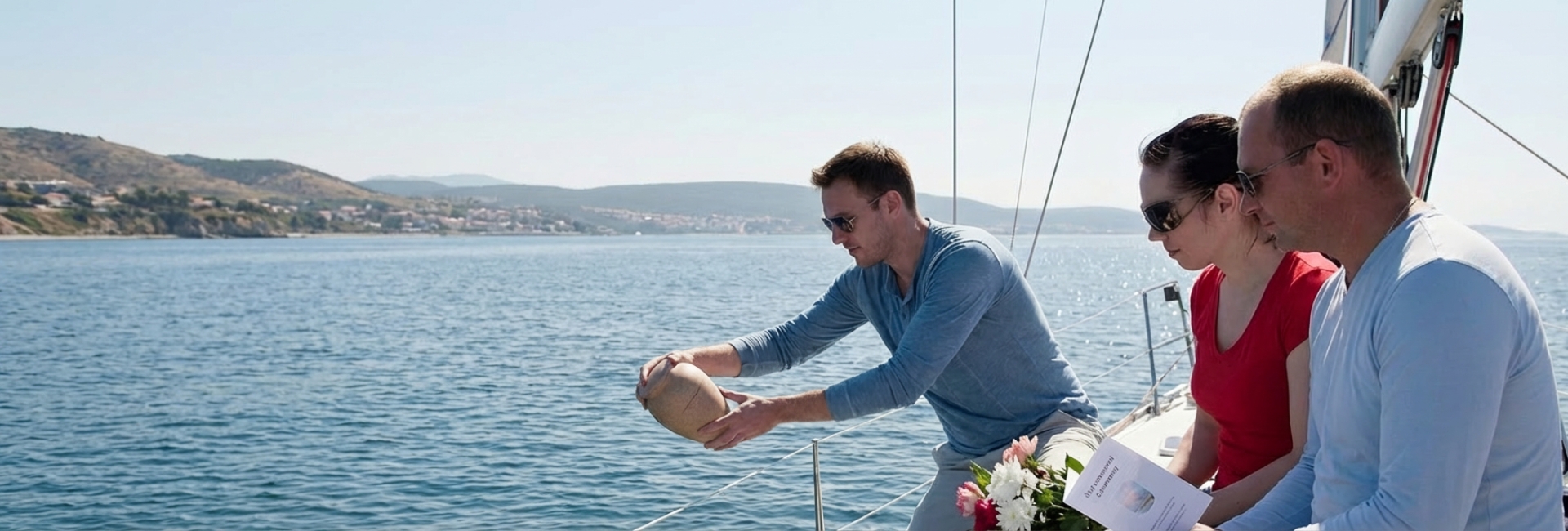
Every member of the family can play a meaningful role in the ceremony. Individuals can take turns scattering, or the ashes can be released collectively. Family members may wish to share words, read a poem, or observe a moment of silence.
Our crew provides respectful guidance throughout without imposing any particular format, allowing the ceremony to take the shape that feels most authentic to your family.
Vessel capacity allows for large gatherings when needed, accommodating extended family and close friends who want to be part of the farewell. We also honor veterans with military protocol options upon request.
Why Working with a Licensed Provider Matters
Choosing an unlicensed or improperly credentialed provider carries real risks. These include potential legal liability for the family, improper or missing permit filings, failure to meet EPA reporting requirements, and inadequate insurance coverage. An unlicensed operator puts families in a difficult position at an already difficult time.
Wild Pacific Whale Watch holds all required state and federal credentials, including CRD licensing, Coast Guard vessel certification, and full liability insurance.
Our 40 years of combined maritime experience means that every logistical and legal detail is handled correctly, every time. We verify permits, file EPA reports, and provide complete documentation so families have full peace of mind from the first call to the final ceremony.
Verifying Your Provider’s Credentials
Before booking any ash scattering service, families should confirm that the provider holds a current California CRD license, that their vessels carry valid Coast Guard certification, and that they have a clear process for EPA reporting and documentation. Do not hesitate to ask for proof of licensing. Reputable providers will always be glad to share it.
Frequently Asked Questions
Can we scatter ashes from a beach or pier?
No. California law prohibits scattering from beaches, piers, bridges, or within state waters. All scattering must be conducted offshore by licensed vessel or aircraft.
How long does a sea scattering ceremony typically take?
Most ceremonies last one to two hours total, including travel to the scattering location offshore, the ceremony itself, and the return journey to the harbor.
Can family and friends attend?
Yes, and we encourage it. The number of attendees is determined by vessel capacity. The Peregrine can accommodate up to 146 guests, making it suitable for both intimate gatherings and larger groups.
What happens if we don’t report the ceremony to the EPA?
Failure to file within 30 days can result in fines and legal complications. Wild Pacific Whale Watch handles all EPA reporting as a standard part of every service.
Can we scatter part of the ashes and keep the rest?
Yes. Many families choose to scatter a portion at sea and preserve the remainder in a keepsake urn, memorial jewelry, or another meaningful form.
How much does an ash scattering ceremony cost?
Pricing varies depending on charter duration, group size, and customization. Contact Wild Pacific Whale Watch directly for a personalized quote.
Let Us Help You Create a Ceremony Worth Remembering
Scattering ashes at sea in California is one of the most serene and meaningful tributes a family can offer. With the right provider by your side, the legal complexity fades into the background and what remains is the ceremony itself: the open ocean, the people you love, and a farewell that truly honors a life well-lived.Contact Wild Pacific Whale Watch today to speak with our team about planning your ceremony. We handle every detail with care so you can be fully present for the moments that matter most.